There's a moment that happens when you start learning Chinese seriously — usually around the time you realise that the most effective practice doesn't happen at a desk. It happens in kitchens, at dining tables, in parks on Sunday afternoons, and in the middle of games that have been played in Chinese families for generations.
Mahjong is one of those games.
This guide is for two kinds of people: those who already play and want to understand what's being said around the table, and those who want to use the game as a genuine entry point into Chinese vocabulary, culture, and conversation. It covers the complete vocabulary, the cultural context behind it, the conversational phrases that actually come up when you play with native speakers, and why mahjong is one of the most effective immersion tools available to a Chinese learner.
What Mahjong Actually Is (And Why It Matters for Chinese Learners)
Mahjong (麻将, májiàng) is a tile-based game played by four players, originating in China during the Qing dynasty in the mid-19th century. The goal is to build a winning hand by drawing and discarding tiles, forming sets — similar in structure to the card game rummy. A standard set has 144 tiles.
That's the functional description. The cultural reality is bigger.
In China, mahjong is woven into the fabric of family and social life in a way that has no real Western equivalent. It's the game at Chinese New Year gatherings when extended families crowd into a living room after dinner. It's what grandparents play in parks on weekday mornings. It's the background noise of countless Chinese childhoods — the distinctive clatter of tiles being shuffled (called 洗牌, xǐpái, "washing the tiles") is as recognisable and evocative as any sound in Chinese cultural memory.
Learning to play it teaches you far more than a vocabulary list. It teaches you how Chinese people count, how they navigate social situations, how they talk when they're excited or frustrated, and how humour works in a group setting. The game is, in miniature, a slice of Chinese social culture.
The Vocabulary You Actually Need
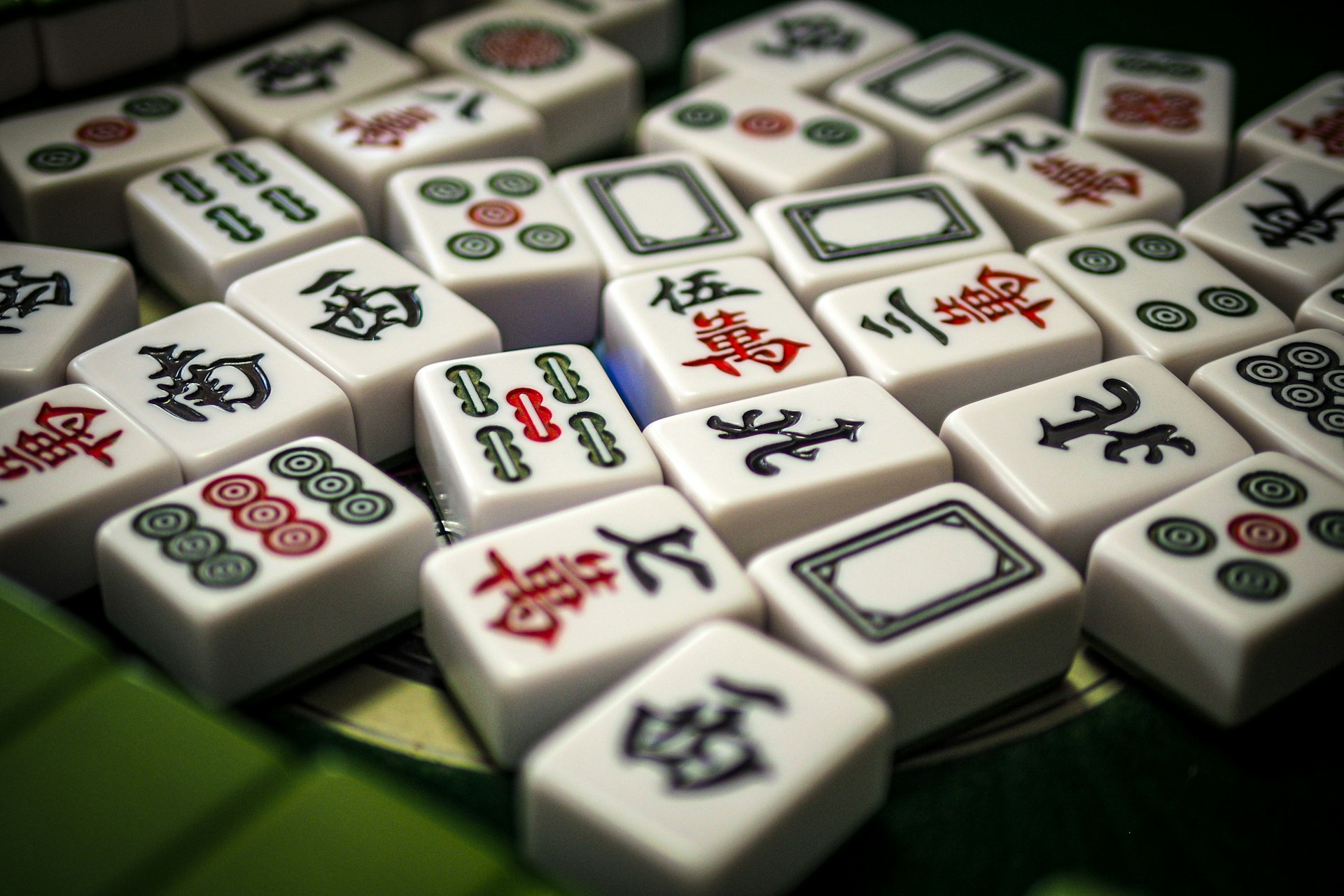
The good news: you don't need to be fluent to sit at a mahjong table. The core game vocabulary is manageable. What follows is the complete word set, with the cultural context that most guides leave out.
Numbers (数字, shùzì)
The three main tile suits are all numbered 1–9, so the first thing you need is the numbers. In practice, you'll say these constantly — calling out tiles, counting rounds, keeping score.
| Character | Pinyin | Number |
|---|---|---|
| 一 | yī | 1 |
| 二 | èr | 2 |
| 三 | sān | 3 |
| 四 | sì | 4 |
| 五 | wǔ | 5 |
| 六 | liù | 6 |
| 七 | qī | 7 |
| 八 | bā | 8 |
| 九 | jiǔ | 9 |
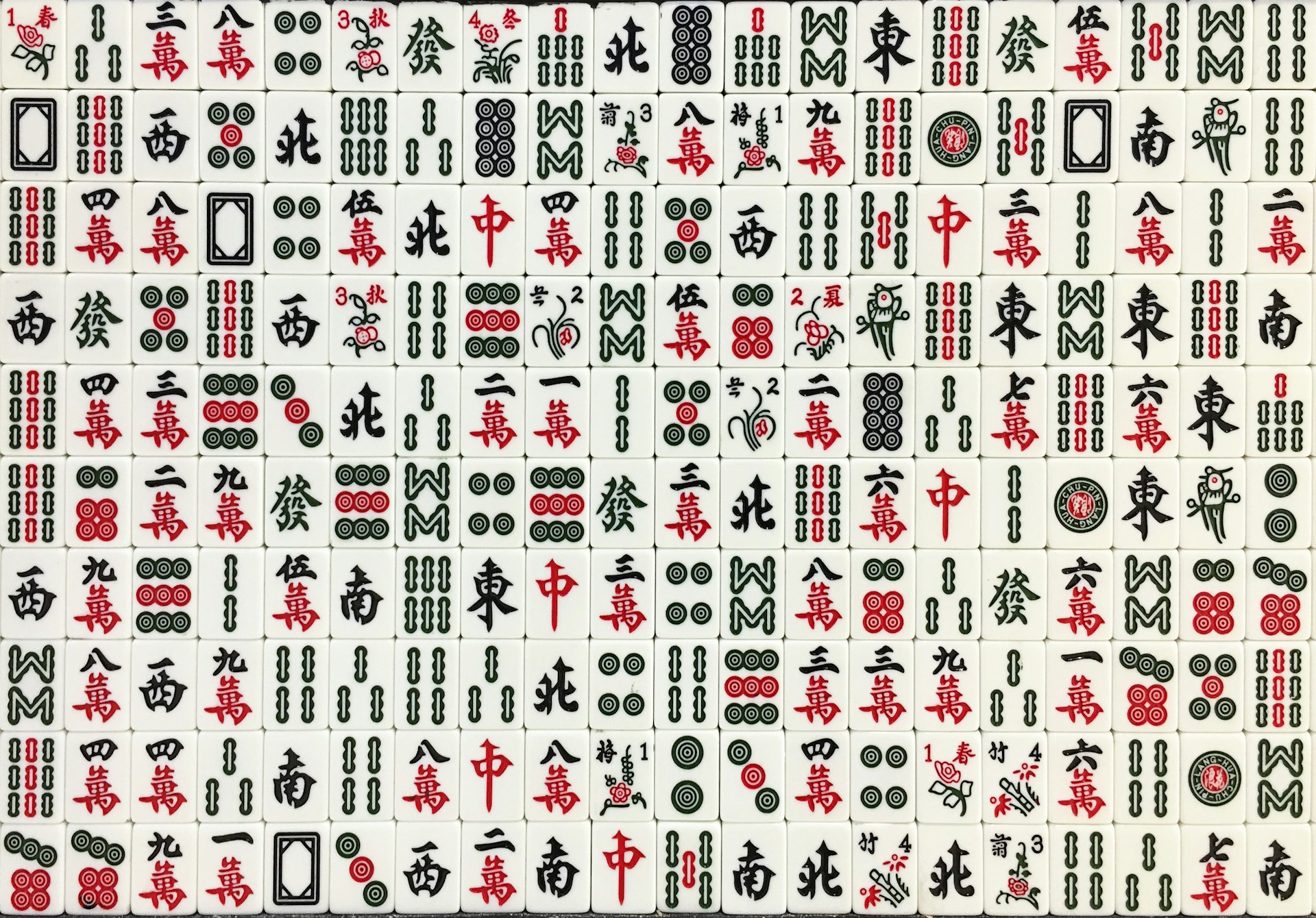
A note: the tiles on actual mahjong sets are usually written in Traditional Chinese characters, even when the players are from mainland China. So 萬 rather than 万, 圓 rather than 圆. If you've been learning Simplified characters, the tiles will look slightly different — worth knowing before you sit down.
The Three Suits
| Character | Pinyin | Suit name | What the tiles show |
|---|---|---|---|
| 万/萬 | wàn | Characters | Chinese characters (一万 through 九万) |
| 条/條 | tiáo | Bamboo | Bamboo sticks (一条 through 九条) |
| 筒 | tǒng | Circles | Circles (一筒 through 九筒) |
The character suit (万) is named after 万 (wàn) — ten thousand, the denomination used on the original tiles which depicted coins. The bamboo suit (条) uses the word for "strip" or "stick." The circle suit (筒) uses the word for a cylinder or barrel. You'll be calling these out constantly while playing: 三万 (sān wàn, three of characters), 七条 (qī tiáo, seven of bamboo), 五筒 (wǔ tǒng, five of circles).
The Wind Tiles (风牌, fēngpái)
The four wind tiles correspond to the four cardinal directions and the four seats at the table. Seat positions rotate through these winds as the game progresses.
| Character | Pinyin | Meaning |
|---|---|---|
| 东风 | dōngfēng | East wind |
| 南风 | nánfēng | South wind |
| 西风 | xīfēng | West wind |
| 北风 | běifēng | North wind |
These aren't arbitrary labels. In traditional Chinese thought — particularly the practice of 风水 (fēngshuǐ, feng shui) — the cardinal directions carry specific meanings and energies. East is the direction of the rising sun and new beginnings; it's why the dealer (庄家, zhuāngjiā) always starts in the East seat.
The Dragon Tiles (箭牌, jiànpái)
Despite their common name in English ("dragons"), the three honour tiles have Chinese names that tell you much more about their actual significance:
| English name | Chinese | Pinyin | Literal meaning |
|---|---|---|---|
| Red dragon | 红中 | hóngzhōng | Red centre |
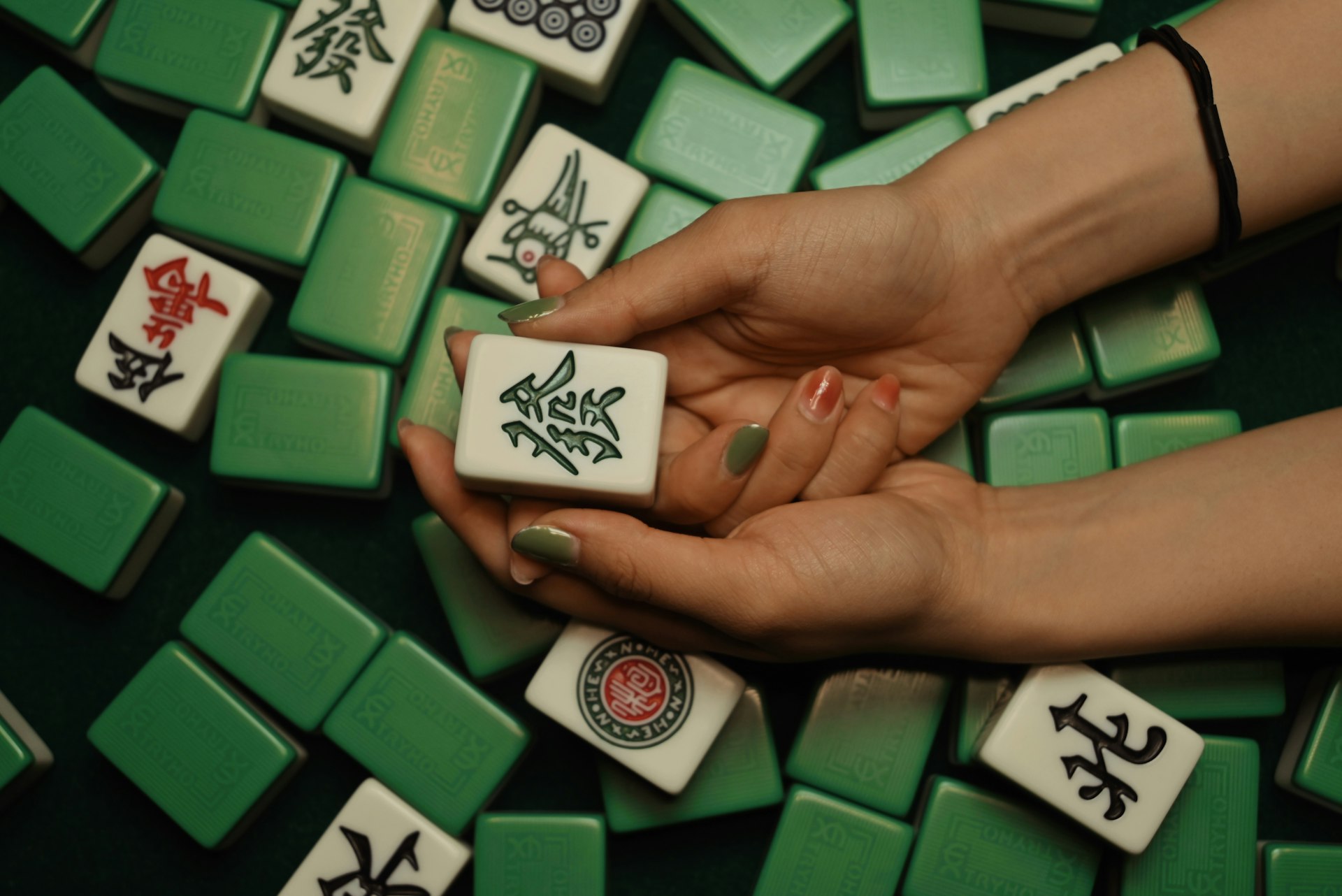
| Green dragon | 发财 | fācái | Make a fortune |
| White dragon | 白板 | báibǎn | White board / blank slate |
发财 (fācái) is one of the most culturally loaded phrases in Chinese — it's what people say at Chinese New Year meaning "may you prosper." Hearing it called out during a mahjong game connects the tile to its real-world use. This kind of cultural resonance is exactly what makes mahjong useful as a language learning tool: the vocabulary isn't isolated, it lives inside a larger world of meaning.
For more on how Chinese expressions carry cultural weight far beyond their surface meaning, 发财 is a perfect example to start with.
Game Actions: What You Say While Playing
These are the words you'll actually need to call out during play. Knowing them turns you from a silent observer into a participant.
| Character | Pinyin | When to say it | Notes |
|---|---|---|---|
| 洗牌 | xǐpái | When shuffling | Literally "wash the tiles" — the shuffling sound gives the word its vividness |
| 摸牌 | mōpái | When drawing a tile | 摸 (mō) means to feel or touch — you're feeling for your tile |
| 出牌 | chūpái | When discarding | 出 means "out" — you're putting a tile out |
| 吃 | chī | To claim a discarded tile to complete a sequence | Literally "eat" — one of the most memorable verbs in the game |
| 碰 | pèng | To claim a discarded tile to complete a set of three | Literally "bump" or "touch" — the tile "bumps" to complete your set |
| 杠/槓 | gàng | To claim a tile to complete a set of four | A kong in English |
| 听牌 | tīngpái | When you need only one more tile to win | 听 means "to listen/wait" — you're "waiting" for the tile |
| 胡了/和了 | hú le | When you win | The victory call. Say this loudly. |
| 自摸 | zìmō | When you draw your own winning tile | 自 means "self" — you drew it yourself rather than claiming a discard |
| 庄家 | zhuāngjiā | The dealer | 庄 means "estate/farm," 家 means "family/home" — the dealer hosts the round |
The word 吃 (chī, "eat") for claiming a sequence tile is worth pausing on. It's the same 吃 that appears in 吃饭 (chīfàn, "eat a meal") and 吃了吗 (chī le ma?, the casual greeting meaning "have you eaten?"). The same verb that Chinese culture uses to express care and connection is used in mahjong to describe taking what you need. Whether that's coincidence or something deeper is a question worth sitting with.
Bonus Tiles
Not all games use these — many players leave them out for simplicity — but if they're in play, you'll want to know them. The eight bonus tiles represent the four seasons and four plants:
Seasons: 春 chūn (spring), 夏 xià (summer), 秋 qiū (autumn), 冬 dōng (winter)
Plants: 梅 méi (plum blossom), 兰 lán (orchid), 菊 jú (chrysanthemum), 竹 zhú (bamboo)
These aren't random. The four plants — plum, orchid, chrysanthemum, bamboo — are known in Chinese art as the "Four Gentlemen" (四君子, sì jūnzǐ), each representing a virtue: resilience through hardship, elegance in solitude, endurance in adversity, and humble integrity. Finding them on mahjong tiles is a small reminder that the game was designed within a culture that valued philosophical meaning even in leisure.
Conversational Phrases Around the Table
This is what most mahjong vocabulary guides miss entirely. Native speakers don't just call out tile names — they talk. Here are the phrases that actually come up during a real game:
| Chinese | Pinyin | Meaning |
|---|---|---|
| 我们开始打麻将吧! | Wǒmen kāishǐ dǎ májiàng ba! | Let's start playing! |
| 谁当庄家? | Shéi dāng zhuāngjiā? | Who's the dealer? |
| 打麻将的时候,顺序是逆时针方向。 | Dǎ májiàng de shíhou, shùnxù shì nìshízhēn fāngxiàng. | When playing mahjong, the order goes counterclockwise. |
| 每个人都有十三张牌。 | Měi gèrén dōu yǒu shísān zhāng pái. | Each person has thirteen tiles. |
| 庄家先摸牌,也先打牌。 | Zhuāngjiā xiān mō pái, yě xiān dǎ pái. | The dealer draws first and discards first. |
| 你听了吗? | Nǐ tīng le ma? | Are you one tile away from winning? |
| 差一张! | Chā yī zhāng! | Just one tile away! |
| 运气真好! | Yùnqì zhēn hǎo! | What luck! |
| 太可惜了! | Tài kěxī le! | What a shame! / So close! |
| 再来一局! | Zài lái yī jú! | Let's play another round! |
太可惜了 (tài kěxī le, "what a shame") is one of the most useful phrases you'll learn from mahjong — it's used constantly in real Chinese life, not just at the table, whenever something almost worked out. Same with 运气真好 (yùnqì zhēn hǎo, "what luck") — genuine, frequently used expressions that happen to be easy to pick up in a game context. This is exactly the kind of authentic vocabulary that sentence mining from real situations produces, and why game-based learning works.
Join our discord server!
Join the Mandarin Zest community on Discord. Discover Chinese pop culture and internet trends, chat with fellow learners, and interact with teachers and fluent moderators.

Why Mahjong Specifically Works for Chinese Learners
The numbers 1–9, repeated across three suits, means you'll say the numbers more times in a single mahjong session than in a week of textbook study. Repetition in a meaningful context — where you're actually paying attention because the tile matters — produces far better retention than drilling vocabulary in isolation.
The vocabulary you need is small but real. Unlike phrasebook Mandarin, the words you learn playing mahjong are words native speakers actually use and care about. Saying 胡了 correctly, hearing the room react, is a small but genuine moment of communication.
You're exposed to natural speech. When experienced players talk during a game — commenting on strategy, teasing each other, arguing about scoring — that's authentic Mandarin at real speed. You won't understand everything at first. But exposure to natural, fast-paced Chinese is exactly what builds listening comprehension over time.
Cultural fluency comes with it. The wind tiles, the dragon tile names, the "Four Gentlemen" on the bonus tiles, the association of 发财 with prosperity — none of this is separable from the game itself. You're learning the language and the culture that shaped it simultaneously.
A Note on Playing with Native Speakers
If you get the chance to play with native Chinese speakers, take it. A few practical notes from experience:
Experienced players play fast and have long since forgotten what it felt like to be new to the game. Don't be afraid to ask them to slow down or call out the names of tiles as they play. Most Chinese players are genuinely welcoming when a foreigner makes the effort — both to learn the game and to use the vocabulary.
You might not understand everything being said, and that's fine. The goal isn't perfect comprehension — it's immersion. Sitting at the table, hearing the language, catching words you recognise, occasionally contributing something correct — this is what real acquisition looks like in practice.
If you want to practise first before playing with native speakers, mahjong apps let you play against AI opponents with Chinese-language interfaces. This is good training both for the game and for reading the tile vocabulary quickly under time pressure.
The Vocabulary in Context: Where It Fits in Your Learning
The words in this article are not isolated game terms. They appear across the HSK vocabulary lists and in real Chinese life:
- 出 (chū, out) appears in 出来 (come out), 出去 (go out), 出发 (set off)
- 摸 (mō, touch/feel) appears in 摸索 (grope, feel around), 摸清楚 (figure out)
- 听 (tīng, listen/wait) is the same listen in 听说 (I hear that...), 听课 (attend a class)
- 自 (zì, self) appears in 自己 (oneself), 自由 (freedom), 自然 (natural)
- 洗 (xǐ, wash) appears in 洗澡 (take a bath), 洗衣服 (do laundry)
This is one of the best reasons to learn vocabulary through real contexts like games, conversations, and graded reading — the words don't live in isolation. 洗牌 teaches you 洗 in a context you'll remember, which means you'll recognise 洗澡 faster when it appears. Every word connects to every other word.
Quick Reference: Complete Mahjong Vocabulary
| Chinese | Pinyin | Meaning |
|---|---|---|
| 麻将 | májiàng | Mahjong |
| 洗牌 | xǐpái | Shuffle tiles |
| 摸牌 | mōpái | Draw a tile |
| 出牌 | chūpái | Discard a tile |
| 吃 | chī | Claim a tile (sequence) |
| 碰 | pèng | Claim a tile (set of three) |
| 杠/槓 | gàng | Claim a tile (set of four) |
| 听牌 | tīngpái | One tile from winning |
| 胡了 | hú le | I've won! |
| 自摸 | zìmō | Draw your own winning tile |
| 庄家 | zhuāngjiā | The dealer |
| 万/萬 | wàn | Characters suit |
| 条/條 | tiáo | Bamboo suit |
| 筒 | tǒng | Circles suit |
| 东风 | dōngfēng | East wind |
| 南风 | nánfēng | South wind |
| 西风 | xīfēng | West wind |
| 北风 | běifēng | North wind |
| 红中 | hóngzhōng | Red dragon |
| 发财 | fācái | Green dragon (make a fortune) |
| 白板 | báibǎn | White dragon |
Final Thoughts
Mahjong is not a shortcut to fluency. No single activity is. But it's one of the most culturally authentic, vocabulary-rich, socially embedded ways to spend time in Chinese that exists — and unlike sitting alone with flashcards, it's genuinely enjoyable.
The clatter of 洗牌. The sharpness of 胡了! The slow accumulation of rounds, vocabulary, and cultural understanding that happens when you play a game you care about in a language you're learning.
If you get invited to a mahjong game — with family, with friends, with a Chinese community group — say yes. Bring this vocabulary. Expect to lose, at least at first. And pay attention to everything being said around you.
That's where the real learning happens.
Our Materials
Check out our dedicated materials, designed by teachers for learners.