Ask most Westerners what they know about dragons and the answer is predictable: fire, destruction, a monster to be slain. The dragon in Chinese culture is almost the exact opposite of all of that, and the gap between these two symbolic traditions is one of the most striking examples of how differently cultures can assign meaning to the same creature.
In China, the dragon is a spiritual and cultural symbol that represents prosperity and good luck, as well as a rain deity that fosters harmony. It's not feared. It's revered. And it has been for nearly 8,000 years.
The Word: 龙 (Lóng)
The Chinese word for dragon is 龙 (lóng). It's one of the most versatile and culturally loaded characters in the language, appearing in idioms, place names, personal names, chengyu, and across everything from architecture to astrology.
Some people now prefer the spelling "loong" in English to distinguish the Chinese cultural symbol from the darker image of the European dragon — a reasonable attempt at separation, though 龙 (lóng) remains the standard in Mandarin learning contexts.
The character itself has an ancient history. The earliest depictions of dragons in China can be traced back to the Neolithic period, particularly in the Hongshan culture (circa 4700–2900 BCE) and the Liangzhu culture (circa 3300–2300 BCE). One of the most famous early artefacts is a jade C-shaped dragon discovered in Inner Mongolia — a coiled, snake-like figure that already shows the dragon's characteristic sinuous form.
If you're learning to write Chinese characters, 龙 is one worth knowing early. Its simplified form is clean and recognisable, and it appears constantly — in words, in names, and across Chinese cultural reference.
What the Dragon Symbolises
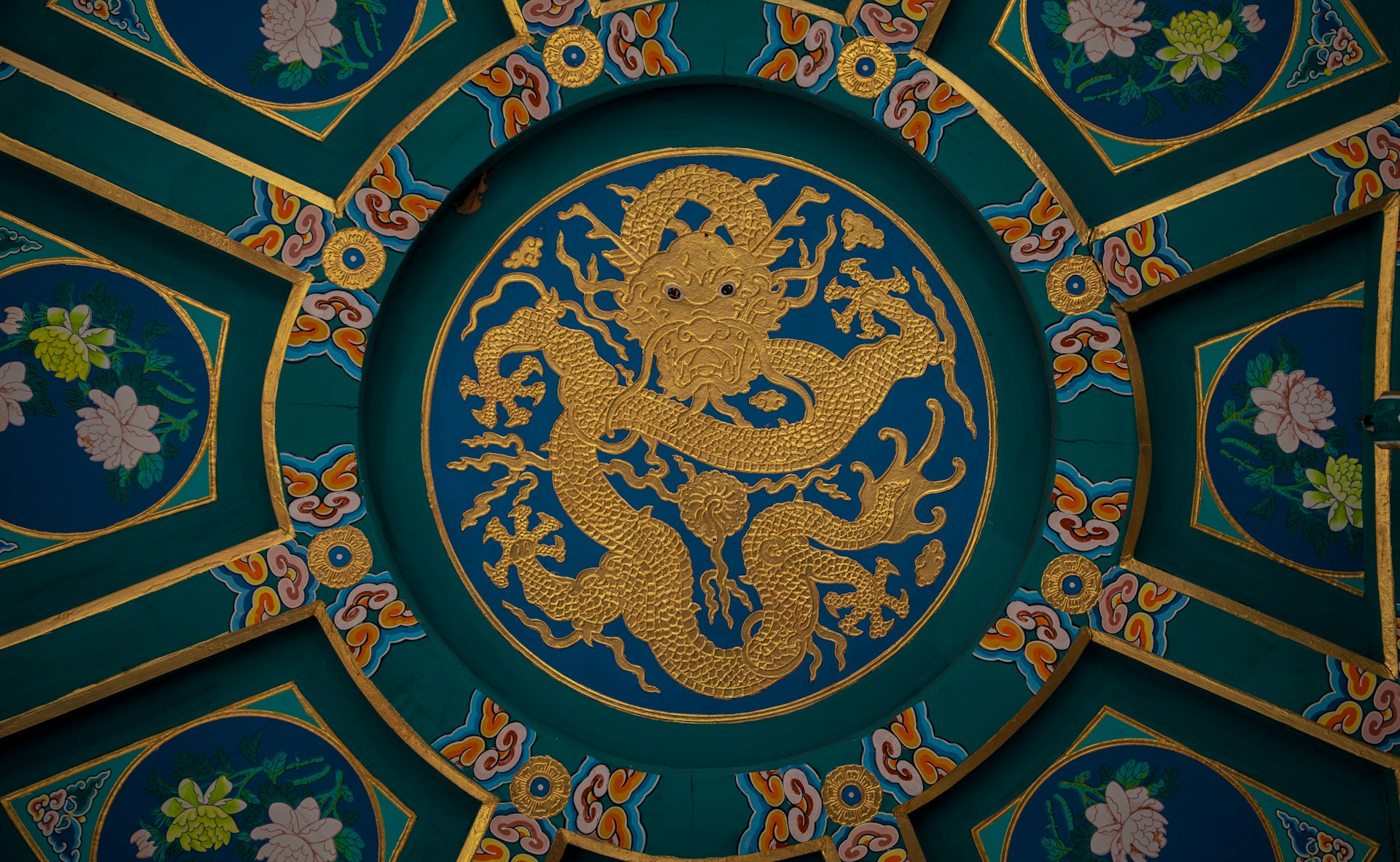
Chinese dragons are symbolic of being lucky, propitious, powerful, and noble. But that's a simplified summary of a much richer symbolic picture that developed over thousands of years.
Water and weather. The dragon's oldest role is as a controller of natural forces — dragons are believed to have supposed control over watery phenomenon, e.g. summoning rain during a drought. In an agricultural civilisation entirely dependent on rainfall and river flooding, this made the dragon one of the most important spiritual figures imaginable. The four Dragon Kings were believed to rule the four seas surrounding China, each responsible for the weather and water in their domain.
Imperial power. Historically, the Chinese dragon was associated with the emperor of China and used as a symbol to represent imperial power. Liu Bang, the founder of the Han dynasty, claimed that he was conceived after his mother dreamt of a dragon. Emperor imagery was saturated with dragons — on robes, thrones, carriages, palace stairs. At that time, ordinary people were not allowed to have items with pictures of dragons on them. The dragon didn't just represent authority; it was authority, made visible.
Luck and prosperity. Beyond imperial symbolism, the dragon carries a general aura of good fortune that extends into every aspect of Chinese life — celebrations, names, architecture, business. This is one reason the colour red in Chinese culture and the dragon so often appear together: both are considered maximally auspicious.
Ancestry. The phrase "Descendants of the Dragon" (龙的传人) is used to describe the Chinese people, emphasising their shared heritage and resilience. The dragon isn't just a symbol sitting outside Chinese identity — for many Chinese people, it's woven into how they understand where they come from.
The Dragon and the Chinese Zodiac
The dragon is the only mythical creature among the twelve Chinese zodiac animals. It is the only symbol in the Chinese horoscope which is mythical and not a real animal. That alone says something about how the dragon is regarded — extraordinary enough to sit alongside real animals as an equal.
In the story of the Great Race that determined the zodiac order, the Dragon — who could fly and should have arrived first — came fifth. He stopped on the way to bring rain to a village suffering from drought, and then paused again to blow a gust of wind to help the Rabbit cross a log. The Jade Emperor was so impressed by this selfless detour that he gave the Dragon the fifth position as an honoured placement. It's a story that captures something essential about how the Chinese dragon is imagined: powerful, but using that power for others.
People born in Dragon years (1952, 1964, 1976, 1988, 2000, 2012, 2024) are considered especially fortunate. Those born in the Dragon Years are often seen as natural leaders, full of vitality and charisma. Dragons are known for their boldness, courage, and ambition. Birth rates in China measurably increase during Dragon years as parents hope to give their children the Dragon's fortune — a pattern that shows up in national statistics every twelve years.
Learning Chinese?
Get our HSK 3–4 workbook based on the Story of the Great Race.
Learn about the Chinese zodiac while improving your reading and writing skills!
Dragon Colours and What They Mean
There are blue, green, red, black, white, yellow, and golden dragons in Chinese culture. Different colours of dragon represent different things.
Yellow/Gold — The imperial colours. Yellow was the exclusive colour of the emperor's dragon robes. Golden dragons represent wealth, power, and the highest status. Yellow dragons were a symbol of the emperor. They represented wisdom, good fortune, and power.
Red — Lucky and festive. Red is China's luckiest colour. It is often used to decorate the house/building used for a wedding or festival. The red dragon therefore has lucky symbolism. It is a tradition to use red dragons for dragon dances.
Blue/Green — Nature, spring, growth, healing. A blue/green dragon symbolises the approaching of spring, new life, and plant growth. The Azure Dragon (青龙, qīng lóng) is one of the Four Symbols of Chinese mythology, representing the East and the season of spring.
Black — In ancient China, the black dragon is often linked to catastrophes like storms and floods. In modern contexts, black dragons appear in criminal iconography, associated with power of a more threatening kind.
White — White is traditionally connected to death and mourning in Chinese culture. However, a white Chinese dragon symbolises purity and virtue.
Dragon Idioms in Chinese
One of the fastest ways to see how deeply the dragon is embedded in Chinese language is through its idioms. There are a number of Chinese idioms that reference dragons, including "a dragon's pool and a tiger's den" (龙潭虎穴), meaning you're entering a dangerous location.
Several more are worth knowing:
画龙点睛 (huà lóng diǎn jīng) — "To paint a dragon and dot its eyes." This describes adding the finishing touch that brings something to life. The story behind it: a painter painted dragons but left the eyes blank. When he finally added the pupils, the dragons flew off the wall. Today it means the small detail that completes the whole — the key insight, the perfect final line.
龙马精神 (lóng mǎ jīng shén) — "The spirit of the dragon-horse." Vitality, vigour, an unstoppable drive. Often used as a blessing for the elderly — wishing them the energy of a dragon-horse even in old age.
一龙一凤 (yī lóng yī fèng) — "One dragon and one phoenix." A perfect pairing, often used for ideal couples or harmonious partnerships. The dragon represents the husband, the phoenix the wife in traditional Chinese wedding symbolism.
These kinds of culturally loaded Chinese expressions are one of the things that make the language so rich once you get past the basics. The dragon shows up in chengyu repeatedly because it carries so much symbolic weight — power, transformation, excellence — that can be deployed in a single character.
The Dragon in Chinese Celebrations
Dragon Dance (舞龙, wǔ lóng)
The dragon dance is one of the most vibrant expressions of the dragon's cultural legacy. A dragon figure — sometimes 70 metres long, constructed with bamboo frames covered in shiny fabric — is held aloft by a team of dancers who create its undulating movement in unison. The longer the dragon and the more vigorous the dance, the more good fortune it's believed to bring.
Dragon dances happen at Chinese New Year, at business openings, at festivals — anywhere a powerful blessing is wanted.
Dragon Boat Festival (端午节, Duānwǔ jié)
The Dragon Boat Festival is one of China's four major public holidays, held on the 5th day of the 5th lunar month. The races commemorate the poet Qu Yuan, and the boats themselves are built in the image of dragons — long, narrow, decorated with a dragon's head at the bow and tail at the stern, powered by teams of paddlers rowing to the beat of a drum.
Celebratory practices such as the dragon dance and festivals like the Dragon Boat Festival continue to honour the dragon's legacy.

The Nine Dragon Children
There is not just one dragon that matters in China. In fact, there are nine dragon children that can be found all throughout Chinese art and architecture. Each has a different appearance, different abilities, and appears in different architectural or decorative contexts:
Chiwen/Chiwei — A lizard-like dragon who sits on rooftops and can swallow fire, summoning rainfall. You'll spot him on the corners and ridges of traditional buildings.
Bixi — Turtle-featured, described as having uncomplaining strength. Found in temples and ancestral halls, often carved supporting heavy stone tablets.
Pulao — Lives in the ocean, with a roar that can shake heaven and earth. Engraved on bells, including on the famous Big Bell Temple in Beijing.
Bi'an — Wise and just, watching over doorways and prisons. Associated with law and the settlement of disputes.
Suanni — Loves fire without breathing it. Found engraved on the bases of Buddhist thrones and incense holders.
The prevalence of these nine across Chinese architecture means that once you know what to look for, almost every historic building in China becomes a kind of dragon gallery — an education in symbolism built into the stonework.
Dragon vs Western Dragon: The Full Gap
It's worth being explicit about this, because the conflation causes genuine misunderstanding.
In many Western myths, dragons are dangerous creatures. They breathe fire, guard treasure, destroy villages, or appear as monsters to be defeated. The Chinese dragon is very different. In Chinese tradition, the dragon is usually wise, noble, powerful, and benevolent.
It was reported that the Chinese government decided against using the dragon as its official 2008 Summer Olympics mascot because of the aggressive connotations that dragons have outside of China. The concern was that Western audiences would see a monster where Chinese people see a blessing.
This gap matters for language learners too. When you encounter 龙 in Chinese text, what you're reading is not the fire-breathing adversary of European folklore. It's closer to the opposite — a benevolent cosmic force, a symbol of excellence, an expression of the very best that power can be.
Join our discord server!
Join the Mandarin Zest community on Discord. Discover Chinese pop culture and internet trends, chat with fellow learners, and interact with teachers and fluent moderators.

Dragon Vocabulary
If you're building your Mandarin vocabulary around Chinese culture, here are the core dragon-related words worth knowing. They all appear across the HSK vocabulary lists at various levels:
| Character | Pinyin | Meaning |
|---|---|---|
| 龙 | lóng | dragon |
| 龙年 | lóng nián | Year of the Dragon |
| 龙舟 | lóngzhōu | dragon boat |
| 龙王 | lóng wáng | Dragon King |
| 舞龙 | wǔ lóng | dragon dance |
| 龙的传人 | lóng de chuánrén | descendants of the dragon |
| 画龙点睛 | huà lóng diǎn jīng | the finishing touch (idiom) |
| 龙马精神 | lóng mǎ jīng shén | vigour and vitality (idiom) |
| 龙凤呈祥 | lóng fèng chéng xiáng | dragon and phoenix bringing prosperity (auspicious blessing) |
Final Thoughts
The dragon is one of the most direct windows into how Chinese culture thinks about power, nature, luck, and identity. It's not a monster to be defeated. It's not a metaphor for evil. It's a symbol of what power looks like when it's used well — to bring rain to a drought-stricken village, to foster harmony, to bless the people who honour it.
For Chinese learners, recognising 龙 and understanding what it carries isn't just cultural knowledge. It's linguistic knowledge. The character shows up in idioms, in names, in place names, in festival vocabulary, in architectural descriptions. Each time it does, it brings this entire symbolic tradition with it.
That's what makes Chinese such a rewarding language to learn — the words carry history. And few characters carry more of it than 龙.

Antoine Collard
Originally from Belgium, Antoine lived more than 5 years in Taipei, Taiwan. He graduated from a Chinese-taught master’s program in Political Science at National Taiwan University.