
There's a moment that happens to almost every serious Chinese learner, usually well past the beginner stage. You're reading something — a chengyu, an old saying, a phrase your teacher uses without explanation — and you suddenly realise the words aren't just communicating information. They're carrying an entire worldview.
时间是最好的老师 (Shíjiān shì zuì hǎo de lǎoshī — Time is the best teacher). 塞翁失马 (Sài wēng shī mǎ — the old man at the border who lost his horse, an idiom about how misfortune can become fortune). 天下无难事,只怕有心人 (Tiān xià wú nán shì, zhǐ pà yǒu xīn rén — nothing is impossible for a willing heart).
These aren't just sentences to memorise for an exam. They're compressed philosophy — fragments of Confucian ethics, Daoist patience, and centuries of lived experience, folded into phrases short enough to say in a single breath.
Most textbooks teach you to translate these expressions. Almost none teach you to actually understand them.
Why Chinese Expressions Are Different From Idioms in Other Languages
Every language has idioms, of course. English has "it's raining cats and dogs" and "barking up the wrong tree" — vivid, but largely decorative. They don't usually carry philosophical weight; they're just colourful ways of saying something plainer.
Chinese expressions are often doing something different. Many trace directly back to specific philosophical traditions — Confucianism's emphasis on social harmony and moral cultivation, Daoism's acceptance of natural cycles and non-forcing, Buddhism's teachings on impermanence and suffering. When a Chinese speaker uses one of these expressions, they're not just being colourful. They're invoking a framework for how to think about the situation.
This is part of why Chinese conversations can feel, to outside observers, unusually wise or measured. It's not necessarily that individual speakers are more philosophical — it's that the language itself hands you ready-made philosophical tools every time you reach for an expression instead of a plain description.

The Modern Layer: When Ancient Philosophy Meets Internet Culture
What makes this even more fascinating is that this isn't just an ancient phenomenon. Contemporary Chinese internet culture has produced its own wave of expressions that function the same way — compressing complex modern feelings into compact, philosophically loaded phrases.
躺平 (tǎng píng, "lying flat") — a term that exploded across Chinese social media to describe a deliberate rejection of relentless work culture and social competition. It's not laziness; it's a philosophical stance, almost Daoist in its refusal to strive against an exhausting system.
内卷 (nèi juǎn, "involution") — originally an academic term, now used to describe the exhausting cycle of competition that produces no real collective progress, only escalating individual effort. A single word capturing an entire generation's economic anxiety.
佛系 (fó xì, "Buddha-like") — describing a detached, accepting attitude toward outcomes one can't control. A direct descendant of Buddhist non-attachment, repurposed by young people navigating modern uncertainty.
These aren't separate from the ancient tradition — they're its continuation. The same linguistic instinct that produced 塞翁失马 two thousand years ago is still alive, still generating new compressed wisdom for new circumstances. Chinese has never stopped being a language that thinks in expressions.
What This Means for Learners
If you're learning Mandarin primarily through vocabulary lists and grammar drills — which, to be clear, you genuinely need to do — there's a real risk of missing this entire dimension of the language. You can reach a respectable HSK level knowing thousands of words and still have no real sense of why Chinese speakers reach for the expressions they do, or what emotional and philosophical weight those expressions carry.
This matters for more than cultural appreciation. Understanding the philosophy behind expressions makes them dramatically easier to remember (a phrase tied to a vivid story or worldview sticks far better than an isolated translation), helps you use them appropriately in context, and — perhaps most importantly — gives you genuine insight into how Chinese speakers actually think and feel, not just what they say.
It's the difference between knowing a language and understanding the people who speak it.

A Book Built Entirely Around This Idea
This is exactly the territory explored in Words That Hold the Sky: The Philosophy Behind Chinese Expressions — a 120-page book by Yu, a 21-year-old aspiring Chinese teacher from Shenzhen, exploring 100 Chinese expressions across 15 thematic chapters.
What makes this book distinctive is its voice. Yu wrote it after a transformative year living in Chicago — a year that gave her, by her own account, a new clarity about her own language. Looking at the same moon above Lake Michigan that her grandmother once watched from Shenzhen, she began to see Chinese expressions not as vocabulary, but as emotional worlds: compressed memory, inherited philosophy, generations of human experience folded into ordinary phrases.
The book moves across an unusually wide emotional and philosophical territory:
- Heaven, fate, and time — how Chinese expressions frame human powerlessness against larger forces
- Love, friendship, and relationships — the vocabulary of connection and its obligations
- Perseverance and resilience — the philosophical scaffolding behind Chinese attitudes toward hardship
- Wisdom and learning — expressions inherited from Confucian educational tradition
- Face, harmony, and social navigation — the linguistic tools for managing one of Chinese culture's most complex social systems
- Ambition, morality, and character — how language encodes ethical expectation
- Nature and the seasons — Daoist-inflected expressions about cyclical time
- Modern life, burnout, and internet culture — 躺平, 内卷, 佛系, and the contemporary expressions reshaping how young Chinese speakers describe their lives
- Home, nostalgia, and belonging — the emotional vocabulary of distance and return
- Art, dreams, and the inner life — expressions about creativity, imagination, and interiority
It's written for a deliberately wide readership — not just Chinese learners, but anyone drawn to East Asian philosophy, diaspora readers reconnecting with inherited language, travellers wanting deeper cultural context, teachers looking for material that goes beyond textbook explanations, and readers who simply love books that treat language as a mirror of human experience.
The question at the heart of the book is worth sitting with on its own: what happens when a language doesn't merely describe life, but teaches you how to live it?
Going Deeper: Understanding the Writing System Itself
If Words That Hold the Sky explores the philosophy carried inside Chinese words, there's a natural companion question: how is the writing system itself constructed to carry meaning?
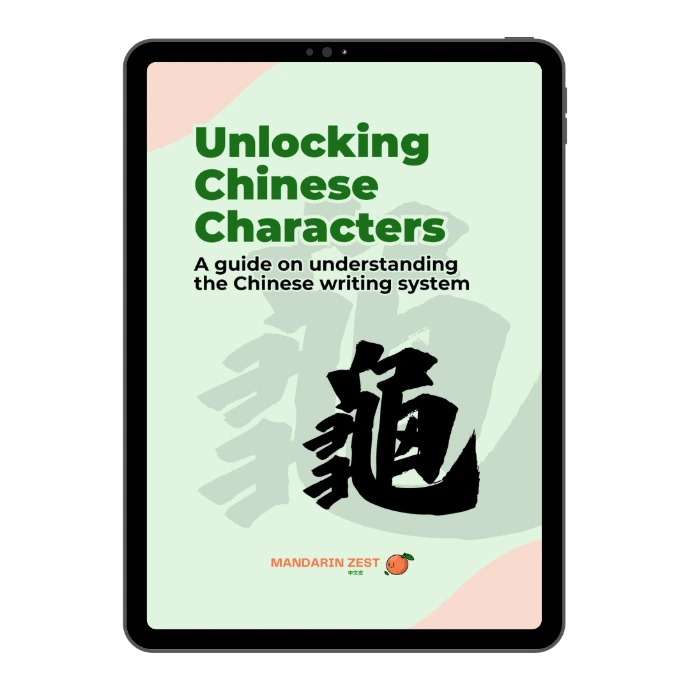
Unlocking Chinese Characters: A Guide on Understanding the Chinese Writing System approaches Chinese from the structural side of the same question. Where Words That Hold the Sky asks what expressions mean, this guide explains how individual characters are built — the six classical types of character construction, the 214 radicals that encode meaning, the phonetic components that hint at pronunciation, and the history connecting modern Simplified characters back through thousands of years of evolution.
Read together, the two books offer something genuinely rare: a complete picture of Chinese as both a structural system and a philosophical inheritance. One shows you how the bricks are made; the other shows you what people have built with them across two thousand years of use.
For any learner — or simply anyone curious about how Chinese encodes meaning differently from Western languages — this pairing goes well beyond what a standard textbook or vocabulary app can offer. It's the difference between learning to operate a language and beginning to genuinely understand it.
Learn Chinese Characters the right way!
Chinese characters are often seen as one of the most intimidating parts of learning Mandarin. This guide was created to change that.
Why This Kind of Reading Matters, Even If You're Not Fluent Yet
A common misconception among language learners is that cultural and philosophical depth is something you "graduate into" once your vocabulary is advanced enough. In practice, the opposite is often more useful: understanding the why behind expressions and characters from early in your learning journey makes everything else — vocabulary retention, grammar intuition, listening comprehension — meaningfully easier, because you're building a mental framework instead of memorising disconnected facts.
You don't need to be at HSK 5 or 6 to benefit from a book like Words That Hold the Sky. Many of its expressions are ones you'll encounter from HSK 3 onward, and understanding their philosophical roots early means that when you do encounter them in real conversation, in dramas, in social media, or in literature, they'll already feel familiar rather than opaque.
Final Thoughts
Every language carries some trace of the worldview of the people who built it — but Chinese carries an unusually large amount, compressed into expressions short enough to text a friend and old enough to trace back to Confucius. Learning the vocabulary gets you function. Understanding the philosophy gets you meaning.
Words That Hold the Sky is an invitation to sit with that meaning — to read Chinese expressions not as homework, but as a genuine window into how an entire civilisation has thought about fate, love, ambition, suffering, and belonging for thousands of years, and how it continues to think about all of it today.
join our discord server!
Join the Mandarin Zest community on Discord. Discover Chinese pop culture and internet trends, chat with fellow learners, and interact with teachers and fluent moderators.

FAQ
No — the book is written in English, exploring Chinese expressions, their characters, pinyin, and meanings, with the philosophical and cultural context explained in accessible English prose. It's suited to complete beginners as much as advanced learners.
Both. The book deliberately bridges classical philosophy (Confucianism, Daoism) with contemporary internet-era expressions like 躺平, 内卷, and 佛系 — showing how the same linguistic instinct for compressed wisdom continues into the present day.
Most idiom references give you a literal translation and a one-line explanation. Words That Hold the Sky is structured thematically and written in a personal, reflective voice — closer to a collection of essays than a reference book. It's designed to be read for insight and enjoyment, not just looked up for definitions.
Chinese learners at any level, lovers of East Asian philosophy, diaspora readers reconnecting with their heritage language, travellers wanting deeper cultural context before visiting China, teachers seeking richer classroom material, and anyone who enjoys books exploring language as a window into human experience.
There's no wrong order. Many readers find that pairing cultural-philosophical reading like this with structural study (vocabulary, characters, grammar) accelerates both — the philosophy gives meaning and memorability to the structure, and the structure gives you the tools to recognise these expressions when you encounter them in the wild.

Yu Lin
Yu is originally from Shenzhen and is currently pursuing a 3-year degree to become a certified Chinese teacher. She helps Mandarin Zest with proofreading teaching materials.