
Before you learn your first character, there's a question that trips up almost every Mandarin beginner: Simplified or Traditional?
Ask ten people and you'll get ten different opinions — some passionate, some dismissive, some confusing. Traditionalists argue that Traditional Chinese preserves the beauty and history of the writing system. Simplifiers point to sheer practicality and the number of speakers. Others say it doesn't matter and you should just pick one.
This guide cuts through the noise and gives you a genuinely useful answer — one based on your goals, your situation, and how the two systems actually differ in practice.
What Are Simplified and Traditional Chinese?
Both Simplified and Traditional Chinese refer to the same spoken language — Mandarin (and other Chinese languages). The difference is purely in the written characters.
Traditional Chinese (繁體字, fántǐzì) is the older writing system, with roots going back thousands of years. The characters are more complex, with more strokes, and preserve many of the original structural elements of the writing system.
Simplified Chinese (简体字, jiǎntǐzì) was introduced by the People's Republic of China in the 1950s and 1960s as part of a literacy reform programme. The government simplified many characters — reducing stroke counts, merging some characters, and standardising variant forms — to make reading and writing easier and faster to learn.
The result is two parallel written systems representing the same spoken language, with significant overlap but real differences.
How Different Are They, Really?
This is where most beginner guides mislead you — either by overstating the differences (so you feel you need to "choose a side") or understating them (so you're surprised when you realise Traditional looks nothing like what you studied).
The honest answer: it depends on the specific character.
Some characters are identical in both systems:
| Character | Meaning | Same in both |
|---|---|---|
| 人 | person | ✓ |
| 山 | mountain | ✓ |
| 水 | water | ✓ |
| 中 | middle | ✓ |
| 大 | big | ✓ |
Some are similar — simplified versions with minor stroke reductions:
| Simplified | Traditional | Meaning |
|---|---|---|
| 话 | 話 | speech / words |
| 时 | 時 | time |
| 来 | 來 | to come |
| 问 | 問 | to ask |
And some look quite different:
| Simplified | Traditional | Meaning |
|---|---|---|
| 龙 | 龍 | dragon |
| 爱 | 愛 | love |
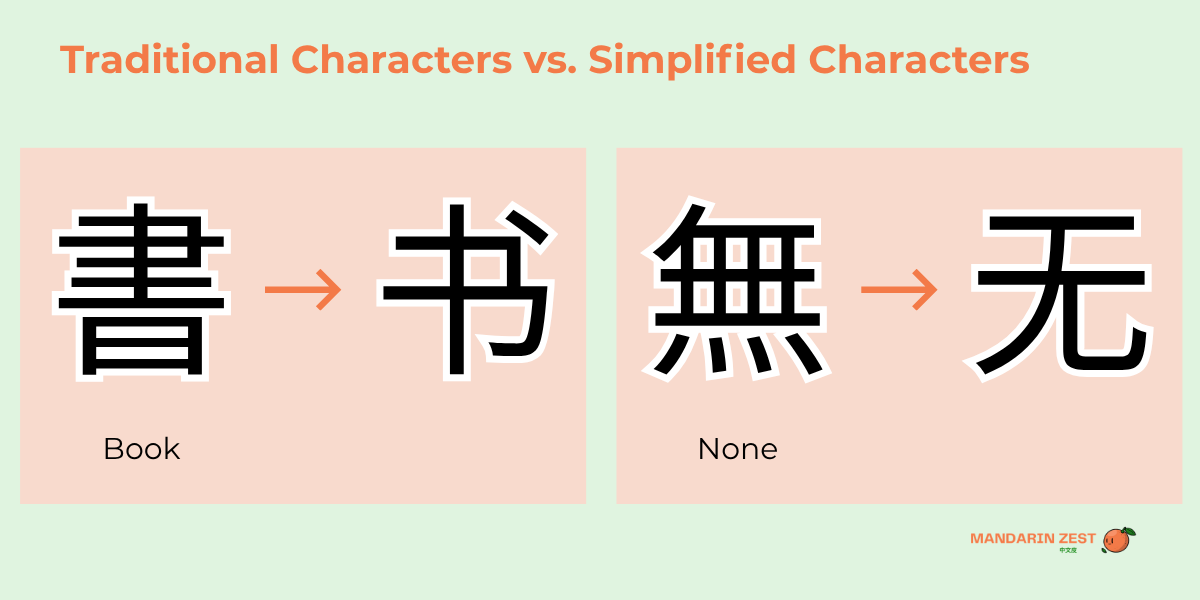
| 书 | 書 | book |
| 马 | 馬 | horse |
| 开 | 開 | to open |
Overall, researchers estimate that roughly two-thirds of the 3,500 most common Chinese characters are identical or nearly identical in both systems. The remaining third ranges from minor to significant differences.
What this means practically: once you're proficient in one system, the other is learnable — but it requires real study, not just a glance.
Where Is Each System Used?
Geography is the single most practical factor in choosing between Simplified and Traditional Chinese.
| Region | Script used |
|---|---|
| Mainland China | Simplified |
| Singapore | Simplified |
| Malaysia (official) | Simplified |
| Taiwan | Traditional |
| Hong Kong | Traditional |
| Macau | Traditional |
| Many overseas Chinese communities | Traditional (historically) |
A few nuances worth knowing:
- The HSK exam (China's official Mandarin proficiency test) uses Simplified Chinese exclusively
- Most major Chinese social media platforms (WeChat, Weibo, Douyin/TikTok) predominantly use Simplified
- Classical Chinese literature was written in Traditional, so scholars and those interested in classical texts typically need Traditional
- Overseas Chinese communities in Europe, North America, and Southeast Asia have historically used Traditional — though this is shifting in younger generations as mainland influence grows
The Practical Case for Simplified Chinese
For most learners — particularly those starting from zero — Simplified Chinese is the more practical starting point, for several clear reasons:
1. More speakers. Mainland China has over 1.4 billion people. Add Singapore and Malaysia and you have the vast majority of Mandarin speakers using Simplified script in daily life. If sheer communicative reach is your goal, Simplified wins by a significant margin.
2. It's what the HSK tests. If you're working toward any HSK certification — for university admission, visa applications, or professional recognition — you'll be tested in Simplified Chinese. Studying Traditional and sitting HSK exams is an unnecessary complication.
3. It's on most digital platforms. WeChat, the dominant messaging platform in China, uses Simplified. Most Chinese apps, websites, and streaming services aimed at a mainland audience use Simplified. For learners who want to engage with modern Chinese digital life, Simplified is the default.
4. Fewer strokes = faster initial progress. Simplified characters have fewer strokes on average — 书 (book) has 4 strokes in Simplified versus 10 in Traditional. This doesn't make Simplified "easier" in any fundamental sense, but it means beginners can reach basic writing fluency faster.
Who should start with Simplified: learners focused on mainland China, HSK exam candidates, business professionals targeting the China market, and most general-purpose Mandarin learners.
The Practical Case for Traditional Chinese
Traditional Chinese isn't a harder or worse system — it's a different one with its own genuine advantages and contexts where it's the clear choice.
1. It's the system used in Taiwan, Hong Kong, and Macau. If your goals are connected to any of these regions — travel, study, business, family — Traditional is what you need. Mainland Simplified is understood by educated readers in Taiwan and Hong Kong, but Traditional is the norm.
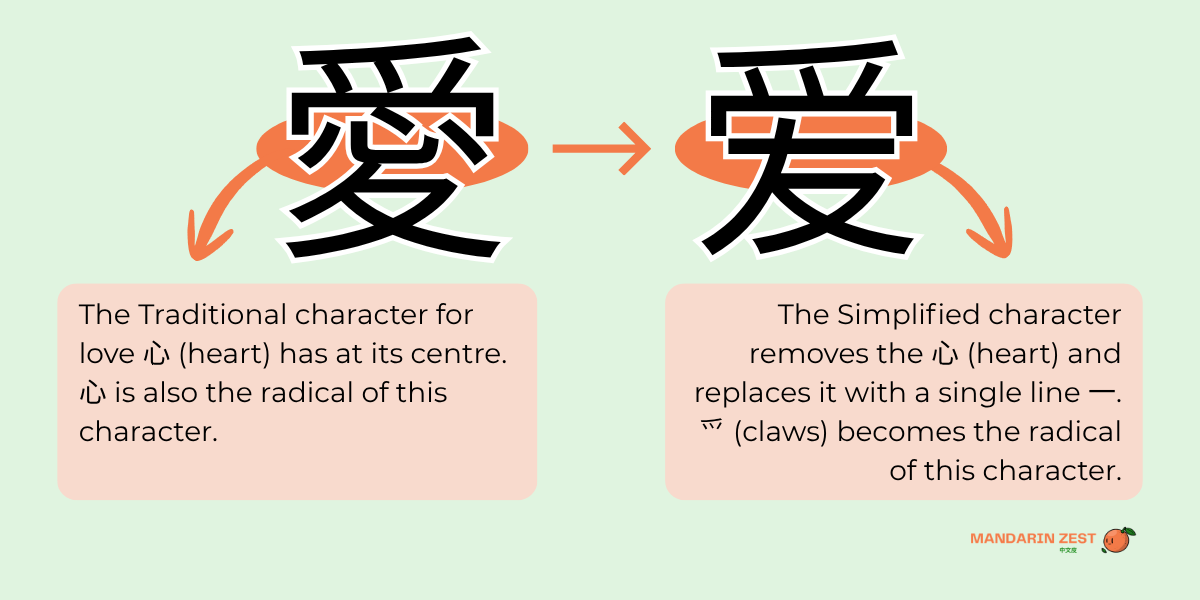
2. The characters preserve more structural logic. Traditional characters retain more of the original radical and phonetic components that the Chinese writing system was built on. Many learners find that Traditional characters are easier to understand because their internal logic is more visible. The character 愛 (love) in Traditional contains the character 心 (heart) at its centre — 爱 in Simplified does not. These semantic connections help with memorisation.
3. Access to classical literature. Pre-20th century Chinese literature, poetry, and historical texts were written in Traditional Chinese (or classical Chinese, which uses Traditional characters). If you're interested in Chinese history, philosophy, or classical culture, Traditional is essential.
4. Overseas Chinese community contexts. Many older overseas Chinese communities — particularly those with roots in Hong Kong, Taiwan, or pre-1949 mainland China — use Traditional in their newspapers, signage, and community institutions.
Who should start with Traditional: learners with Taiwan or Hong Kong connections, those interested in classical Chinese culture and literature, people in communities where Traditional is dominant, and learners who find the structural logic of Traditional characters more intuitive.
What If You Want to Learn Both?
You can — and many serious learners eventually do. But the question of when matters.
Don't try to learn both simultaneously at the start. Trying to learn two character systems at once as a beginner is significantly harder than learning one properly first, then adding the other. The confusion between similar-but-different characters creates interference that slows both systems down.
The recommended approach: Master one system to a solid intermediate level (roughly HSK 3–4 for Simplified, or equivalent Traditional literacy), then study the other system. At that point, you have a strong enough foundation that the differences are learnable rather than overwhelming.
Going from Simplified to Traditional is generally considered slightly easier, because Traditional characters often contain more visual information — once you know the Simplified form, spotting the Traditional additions is somewhat systematic.
Going from Traditional to Simplified is equally manageable and sometimes faster, since Simplified is often a reduction of what you already know.
A good resource for learners who've mastered Simplified and want to add Traditional — or who simply want to understand the relationship between the two systems — is the Unlocking Chinese Characters guide from Mandarin Zest. Among its bonus materials, it includes a dedicated guide specifically on how to learn Traditional characters once you know Simplified — making the transition as efficient as possible.
BEST SELLER · GUIDE
Unlocking Chinese Characters
Stop memorizing randomly. Understand how characters work: their history, the six types, radicals and components, and stroke order.
BEST SELLER · GUIDE
Unlocking Chinese Characters
Stop memorizing randomly. Understand how characters work: their history, the six types, radicals and components, and stroke order.
What About the Writing System Itself?
Whether you choose Simplified or Traditional, both systems share the same underlying logic — the same stroke types, the same radical system, the same six types of character construction (六书, liùshū). Understanding how characters are built, rather than just memorising their forms, makes learning either system dramatically faster.
This is one of the most underappreciated insights in Chinese learning: characters are not arbitrary. They have structure, history, and internal logic. A character that looks like chaos on first glance often contains a meaning clue (radical) and a pronunciation clue (phonetic component) once you know what to look for.
Learners who understand this structure retain characters faster, make better guesses about unfamiliar characters, and develop a much richer appreciation for the language. It applies equally to Simplified and Traditional — because both systems are built on the same foundations.
So: Which Should You Choose?
Here's the simplest possible decision framework:
- Do you want to communicate with mainland China, pass the HSK, or engage with modern Chinese digital culture? → Start with Simplified
- Are your goals connected to Taiwan, Hong Kong, classical literature, or traditional culture? → Start with Traditional
- Not sure? → Start with Simplified. It's the more practical default for most learners, and going from Simplified to Traditional later is a clearly defined, manageable step.
The most important thing is to pick one and commit. Both systems are learnable. Both are beautiful. Neither is a mistake. The learners who get stuck are those who spend months debating which to choose instead of choosing and starting.
Start. Adjust later if needed. The characters will teach you what you need to know.
FAQ
With effort, yes — but not automatically. Educated mainland Chinese speakers can often read Traditional with some difficulty, particularly for common characters. But functional Traditional literacy requires specific study. Don't assume Simplified automatically gives you Traditional.
Neither. Traditional Chinese is older and preserves more historical structure. Simplified Chinese is the product of a deliberate, systematic reform. Both are fully functional writing systems for modern Chinese. The idea that one is "real" Chinese and the other isn't is a cultural and political position, not a linguistic one.
Cantonese is primarily spoken in Hong Kong and Guangdong province. In Hong Kong, it's typically written in Traditional. In mainland China, even Cantonese speakers generally use Simplified for formal writing. Cantonese has some unique written characters that don't appear in standard Mandarin writing at all.
Not at all. Simplified and Traditional Chinese represent the same spoken language. Your pronunciation, tones, and spoken vocabulary are identical regardless of which writing system you study. The script only affects reading and writing.
In the early stages, yes — encountering unfamiliar character variants can be disorienting. This is another reason not to mix systems at the start. Once you're past the beginner stage, encountering the other system is more interesting than confusing.
Most major language learning apps offer both Simplified and Traditional options. Duolingo's Chinese course uses Simplified. Anki has community decks for both. Pleco supports both in its dictionary. Check your app's settings to confirm which system it's using.