
The moment most beginners find out how many Chinese characters exist, the same thought appears: there is no way I can memorise all of these.
And they're right — if memorising is the approach.
Here's what experienced learners know that beginners don't: Chinese characters are not random. They are constructed from recurring components, built on a logical system that has been in place for over two thousand years. Once you understand that system, you stop memorising characters as isolated symbols and start reading them as structured information. That shift changes everything.
This guide shows you exactly how to make that shift — what the system is, how to work with it rather than against it, and the practical steps that turn character learning from an overwhelming memory task into something genuinely manageable.
The Myth of the "Impossible" Writing System
Let's start with some reassuring numbers.
There are roughly 50,000 characters in total across all historical Chinese texts. An educated native speaker uses around 5,000–8,000 in daily life. Basic literacy — reading newspapers and everyday text — requires approximately 3,000 characters. And for HSK 1, the entry level of China's official proficiency exam, you need just 300.
Three hundred characters. Studied in frequency order. Over a period of weeks, not years. That's the real starting point — and it's far more achievable than the headline number suggests.
But the how matters as much as the what. The learners who struggle are those who approach each character as a unique, arbitrary symbol to be memorised in isolation. The learners who succeed are those who quickly grasp that characters have a structure — and use that structure to learn faster, remember more, and forget less.
How Chinese Characters Are Actually Built
Before diving into study strategies, it helps to understand the system you're working with.
The Six Types of Characters (六书 liùshū)
Chinese characters were constructed in six ways, a classification system that dates back thousands of years:
1. Pictographs (象形 xiàngxíng) — characters that evolved from drawings of physical objects. 日 (sun), 月 (moon), 山 (mountain), 木 (tree), 人 (person)
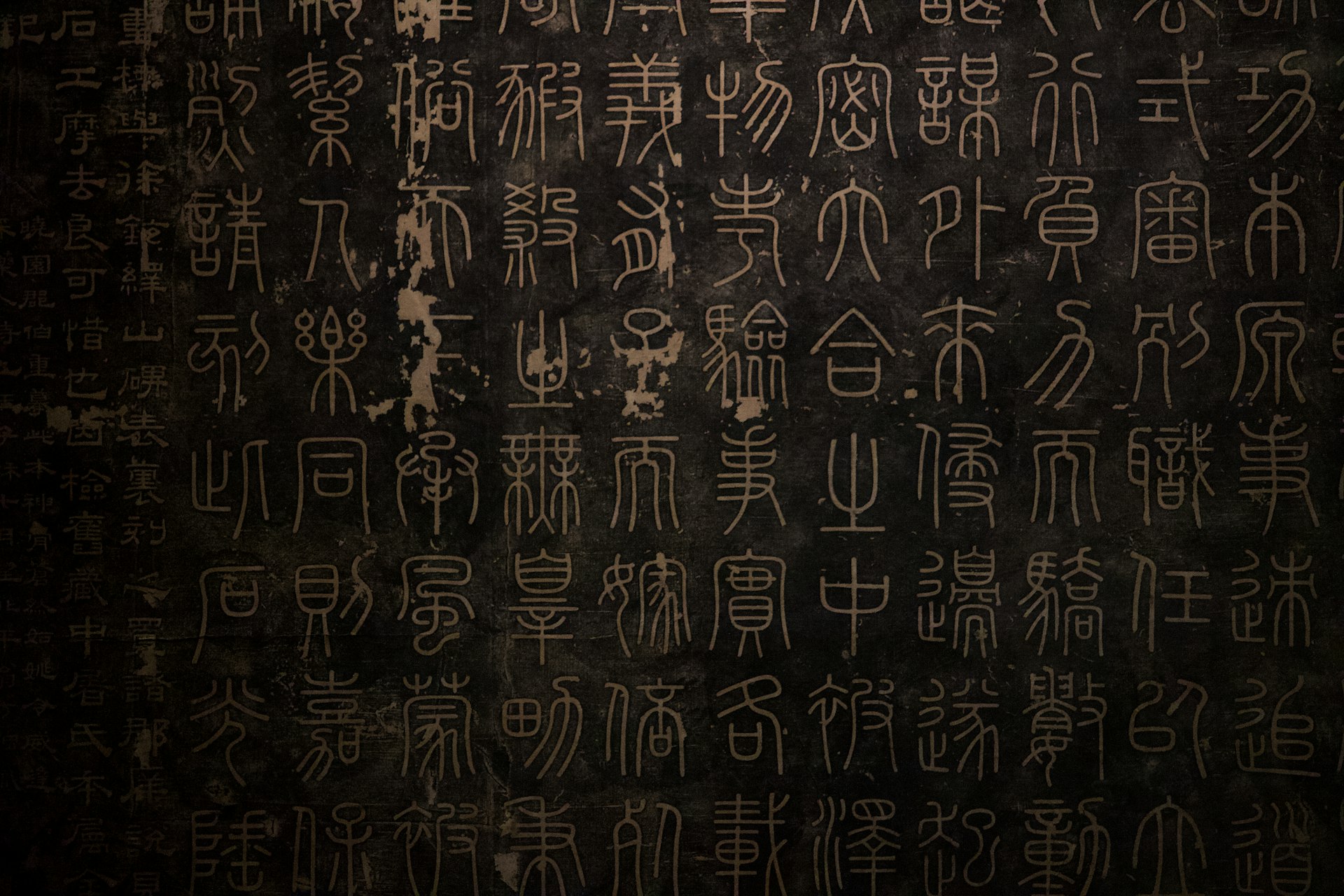
You can still see the visual connection in these characters if you know to look for it. 日 was originally a circle with a dot; 山 shows three peaks. Over centuries they were standardised into today's written forms.
2. Ideographs (指事 zhǐshì) — characters that represent abstract concepts through simple visual logic. 上 (above), 下 (below), 一 (one), 二 (two), 三 (three)
3. Logical compounds (会意 huìyì) — characters formed by combining two or more meaningful components. 明 (bright) = 日 (sun) + 月 (moon) — together they make brightness 休 (rest) = 人 (person) + 木 (tree) — a person leaning against a tree 森 (forest) = 木 (tree) + 木 (tree) + 木 (tree) — three trees make a forest
These are among the most satisfying characters to learn, because once you see the logic, you can't unsee it.
4. Phono-semantic compounds (形声 xíngshēng) — by far the most common type, making up roughly 80–90% of all Chinese characters. Each contains two elements: a semantic component (which hints at meaning) and a phonetic component (which hints at pronunciation).
For example: 妈 (mother), 马 (horse), 吗 (question particle), 骂 (to scold) — all share the phonetic component 马 (mǎ) and carry similar pronunciations. Their meaning components differ: 女 (woman) for mother, 口 (mouth) for question particle, and so on.
Understanding phono-semantic structure is one of the most powerful shortcuts in character learning. It means most characters are not arbitrary — they contain pronunciation clues that, once you know how to read them, significantly reduce the memorisation burden.
5 & 6. Derivative cognates and loan characters — less common categories that account for a small fraction of characters.
Understanding these six types transforms your relationship with characters. Instead of seeing 妈 as a shape to memorise, you see: "woman radical on the left, horse component giving me a pronunciation clue on the right — this is a word related to women that sounds something like mǎ." That's not memorisation. That's reading a code.
Learn Chinese Characters the right way!
Chinese characters are often seen as one of the most intimidating parts of learning Mandarin. This guide was created to change that.
Radicals: The Meaning Building Blocks
The radical (部首 bùshǒu) is the semantic component of a character — the part that hints at its meaning category. There are 214 traditional radicals, and learning the most common 50–100 is one of the highest-leverage investments any character learner can make.
Here are some of the most useful, along with the characters they appear in:
| Radical | Meaning | Example characters |
|---|---|---|
| 氵(water) | liquids, rivers | 海 sea, 河 river, 泳 swim, 洗 wash |
| 亻/人 (person) | people, human actions | 他 he, 你 you, 休 rest, 做 do |
| 口 (mouth) | speech, eating | 吃 eat, 叫 call, 唱 sing, 说 speak |
| 木 (wood/tree) | trees, wooden objects | 树 tree, 桌 table, 椅 chair, 森 forest |
| 女 (woman) | women, family | 妈 mother, 她 she, 姐 sister, 好 good |
| 心/忄(heart) | emotions, feelings | 爱 love, 想 think, 忘 forget, 快 happy |
| 火/灬(fire) | heat, fire | 热 hot, 烧 burn, 炒 stir-fry |
| 手/扌(hand) | manual actions | 打 hit, 拿 hold, 推 push, 拉 pull |
| 言/讠(speech) | communication | 说 speak, 话 words, 读 read, 请 invite |
| 目 (eye) | sight, vision | 看 look, 眼 eye, 睡 sleep |
Once you know these radicals, new characters become partially interpretable even before you've studied them. Encounter an unfamiliar character with 氵on the left? It probably relates to water or liquids. See 忄on the left? It's almost certainly an emotion.
This is the single most effective shift you can make in character study: stop treating characters as wholes and start reading their components.
Latest Stories
Explore fresh ideas and updates from our editorial team.
Stroke Order: Why It Matters More Than You Think
Stroke order — the specific sequence in which you write each stroke of a character — is one of the most underestimated aspects of character learning. Many beginners skip it entirely, assuming it's pedantic formality. It isn't.
Correct stroke order:
- Makes your handwriting look natural and legible to native readers
- Helps you remember character structure — writing in the correct sequence reinforces the character's internal logic
- Is essential for handwriting input on smartphones and tablets, which use stroke-order-based recognition
- Develops the muscle memory that makes writing fast and automatic
The core rules are simple: top to bottom, left to right, horizontal before vertical, outside before inside. Most characters follow these rules consistently — once you've internalised the principles, you can often infer the correct stroke order for a new character without being told.
The Mandarin Zest Stroke Order Information page provides animated stroke order for most Chinese characters — covering all HSK 1 characters. Bookmark it and use it every time you encounter a character whose stroke order you're unsure of.
The Practical Method: How to Learn Characters That Stick
Step 1: Learn the story, not just the shape
For every character you study, spend 30 seconds asking: what type of character is this, and what do its components tell me?
明 = sun + moon = brightness. That's not a fact to memorise — it's a story that makes the character memorable. 休 = person + tree = rest. 森 = tree × 3 = forest. The more connections you draw between a character's components and its meaning, the more anchored it becomes in memory.
Step 2: Learn stroke order from the first character
Don't develop bad habits and correct them later. Learn stroke order correctly for every character from day one. Use the Mandarin Zest stroke order tool, Skritter, or any animated reference when you're unsure. The time spent on this early is repaid many times over.
Step 3: Write by hand — regularly
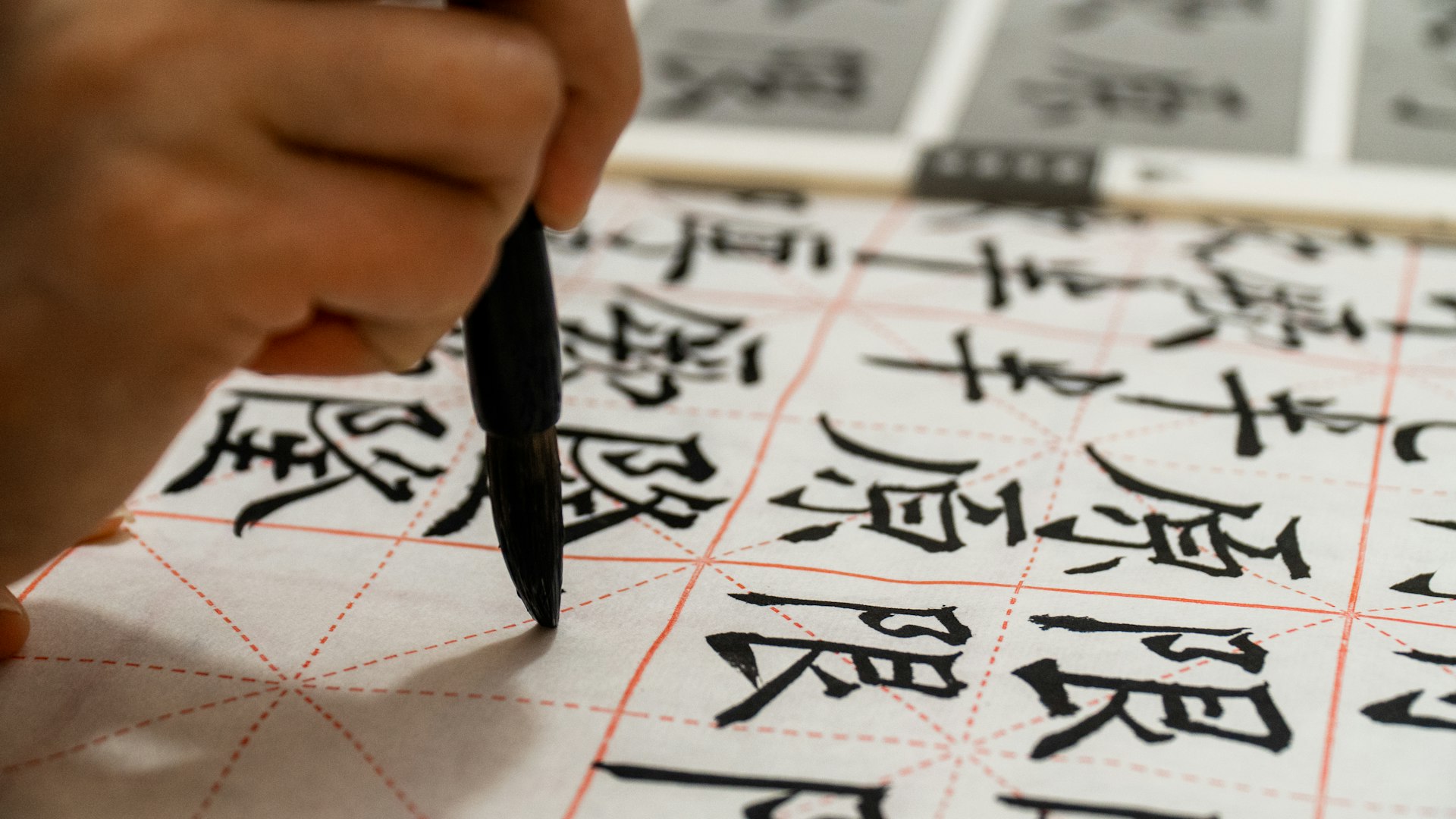
Writing characters by hand is not optional if you want genuine character literacy. The physical act of reproducing a character — stroke by stroke, in order — is a form of active recall that builds memory pathways no flashcard app replicates.
You don't need to write each character fifty times. Studies suggest that writing a character correctly three to five times, with full attention to structure, is more effective than writing it twenty times on autopilot. Quality over repetition.
Step 4: Follow frequency order, not random order
Learn characters in order of how often they appear in real Chinese — which is exactly what the HSK vocabulary lists are structured to do. The characters in HSK 1 are the ones you'll encounter most in everyday Chinese. Learning them first means you start recognising familiar characters almost immediately, which builds confidence and reinforces your study.
Step 5: Use spaced repetition for review
Spaced repetition — reviewing characters at increasing intervals, just before you're about to forget them — is the most research-backed vocabulary retention method available. Apps like Anki and Pleco implement this well. The key: use spaced repetition to review characters you've already learned through writing and study. It's a retention tool, not a substitute for initial learning.
Step 6: Read characters in context as soon as possible
Characters are truly memorised when you encounter them repeatedly in different contexts — not when you've written them in isolation enough times. As soon as you have a foundation of 200–300 characters, start reading graded texts that use them in sentences and stories. Graded readers at HSK 1–2 level are ideal: the vocabulary is controlled so you're reading within your range, but the characters appear in real, meaningful contexts that accelerate retention.
Understanding the Writing System Changes Everything
Most character study resources focus entirely on what to learn — the stroke order, the meaning, the pronunciation. Fewer explain why the character is the shape it is, where it came from, and how it connects to the thousands of other characters built from the same components.
That understanding — the history, the six types of character construction, the radical system, the phonetic patterns — is what separates learners who grind through endless memorisation from those who develop a genuine intuition for characters.
Unlocking Chinese Characters: A Guide on Understanding the Chinese Writing System is built entirely around this insight. Instead of treating characters as symbols to memorise, it teaches you the logic of the writing system:
- The history of Chinese characters and how they evolved
- The Six Types of Chinese Characters (六书) explained clearly
- How radicals work and why they matter
- Pronunciation clues hidden inside character structure
- Stroke order and writing logic
- Natural Chinese handwriting — what it looks like, and how to develop it
- Traditional vs Simplified Chinese — how they relate and how to navigate between them
The guide also includes substantial bonus materials: all 214 Chinese radicals as a reference PDF, the 100 most common Chinese characters, printable character practice sheets, and access to the HSK 1 stroke order page covering 300 beginner characters.
For any learner who's been approaching characters as pure memorisation — or who wants to build a genuine understanding of the writing system rather than just a list of shapes — this guide changes the approach fundamentally.
For Handwriting Practice: Beyond Stroke-Order Worksheets
Understanding character structure is one thing. Getting it into your hands is another.
Most beginner character worksheets focus on stroke order for individual characters in isolation — which is useful at the very start, but quickly becomes insufficient. Real Chinese handwriting fluency requires practising characters in vocabulary context, developing natural stroke flow (not the blocky, careful style of beginner worksheets), and building the kind of automaticity that lets you write without thinking about each stroke.
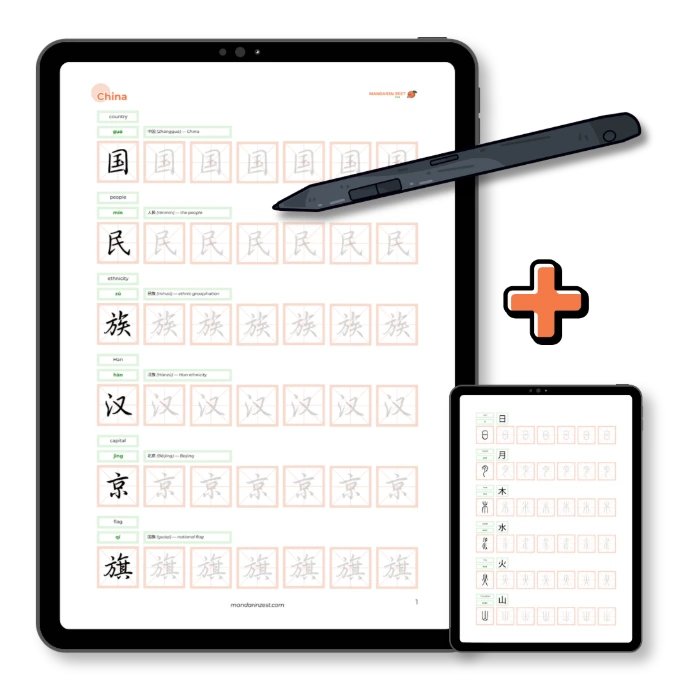
Chinese Handwriting Practice Sheets is designed exactly for this stage. The 55-page digital workbook covers 300 commonly used Chinese characters across 17 vocabulary categories. Unlike beginner worksheets, it focuses on natural writing flow rather than textbook-style block characters. Each character comes with pinyin, English meaning, and an associated vocabulary word in context — so you're practising characters as part of real vocabulary, not as isolated shapes.
The workbook is fully digital and flexible: print it for pen-and-paper practice, use it on a tablet with GoodNotes, Notability, or Procreate, or repeat pages as many times as needed. It also includes a bonus section on seal script (篆书) — the ancient predecessor of modern characters — for learners who want cultural depth alongside practical skill.
If you've been practising characters on apps and find your handwriting still feels unnatural or slow, this is the tool that bridges the gap.
Use code WELCOME10 for 10% off both products.
Looking for writing practice?
Our full workbook contains 50+ pages of writing practice with a total of 300 Chinese characters over 17 different categories.
Comes with our bonus Seal Script writing practice, a fun and easy way to dive into China's first standardized writing system!
Final Thoughts
The learners who find characters overwhelming are almost always those who've been approaching them as thousands of arbitrary shapes to memorise in sequence. The learners who find them manageable — even enjoyable — are those who spent time early on understanding the system: radicals, phonetic components, stroke logic, the history of how characters evolved.
That understanding doesn't eliminate the work. You still need to write characters regularly, review them consistently, and read them in context. But it changes the nature of the work — from brute-force memorisation to something closer to pattern recognition, structural literacy, and genuine engagement with a writing system that is, once you see it clearly, genuinely remarkable.
Start with the system. The characters follow.
FAQ
The New HSK 1 requires 300 vocabulary items. Not all of these are single characters — some are two-character compound words — but building recognition and writing ability for the full HSK 1 set is your first character milestone.
Alongside them is more practical. Learn the radical of each character as you study it, rather than trying to memorise all 214 radicals before touching any characters. Over time, you'll naturally build familiarity with the most common radicals through repeated encounter.
For most beginners — especially those studying for the HSK or focusing on mainland China — Simplified is the practical starting point. Once you have a solid Simplified foundation, learning Traditional becomes considerably easier. The Unlocking Chinese Characters guide includes a dedicated section on exactly this transition.
At 10 new characters per day with daily review, the HSK 1 set takes approximately 6–8 weeks to cover. Add another 2–3 weeks of consolidation before an exam and you're exam-ready in roughly 10 weeks. The timeline assumes structured, daily practice — consistency matters more than session length.
HSK 1 only tests listening and reading — there's no writing section. But writing practice dramatically improves recognition and retention, so learners who write characters by hand consistently score better on reading sections than those who only use flashcard apps.
Apps are useful supplements — especially for spaced repetition review — but they don't replace writing practice. Recognising a character when it appears on a screen with the answer nearby is a different cognitive process from reading it in context or writing it from memory. Both skills need developing; apps only train one of them.