
Chinese planet names are one of those small vocabulary topics that open into something much larger than you'd expect. On the surface, you're learning eight words. Underneath, you're discovering how Chinese encodes Western astronomical concepts through a combination of ancient mythology, the Five Elements philosophy, and a logical naming system so consistent that once you understand the pattern, you can predict what any planet's Chinese name will be before looking it up.
This is that guide — the vocabulary, the naming logic, the cultural context, and how it all connects to the broader Chinese you're learning.
The Naming System: 星 and 行星
Before the individual planets, the vocabulary framework.
星 (xīng) means star. It's one of the most fundamental characters in Chinese astronomy and appears across the full range of celestial vocabulary: 星星 (xīngxīng, stars), 星座 (xīngzuò, constellation/star sign), 星球 (xīngqiú, celestial body), 流星 (liúxīng, meteor/shooting star).
行星 (xíngxīng) means planet — literally "moving star" or "wandering star." The character 行 (xíng) means to move, travel, or walk. Ancient astronomers across cultures noticed that planets, unlike fixed stars, move across the sky over time — and Chinese named them accordingly. Planet = moving star. The logic is immediate and transparent.
太阳系 (tàiyángxì) means solar system — 太阳 (the sun) + 系 (system, family). 宇宙 (yǔzhòu) means universe. These are the words that frame everything else.
The Inner Planets: Where It Gets Interesting
The four inner planets — Mercury, Venus, Mars, and Jupiter — were known to ancient Chinese astronomers for millennia before Western contact. Their Chinese names don't come from Greek or Roman mythology. They come from the Five Elements philosophy (五行, wǔxíng) — the ancient Chinese framework of wood, fire, earth, metal, and water that underlies traditional medicine, feng shui, and Chinese cosmological thinking.
Each inner planet was assigned one of the five elements based on its observed characteristics — colour, brightness, movement. The names reflect these assignments directly.
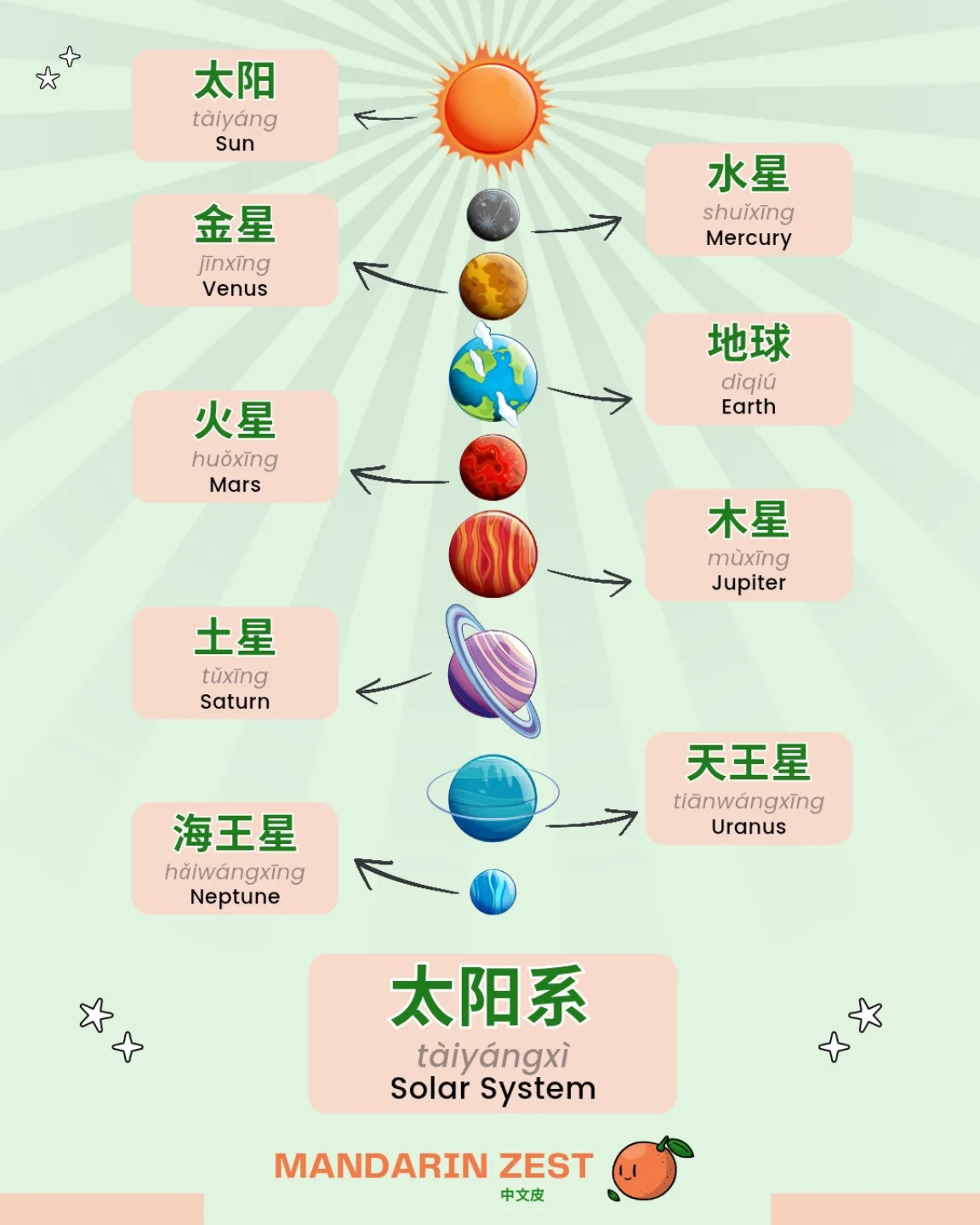
水星 (Shuǐxīng) — Mercury
水 (shuǐ, water) + 星 (xīng, star) = Water Star.
Mercury moves faster than any other planet and was associated with the water element in Chinese cosmology — water representing fluidity, speed, and change. In Western mythology, Mercury was the messenger god, known for speed. Different cultural paths to similar associations.
Stroke note: 水 is one of the most important characters in Chinese — it's the root of the water radical 氵 that appears in hundreds of characters: 海 (sea), 河 (river), 洗 (wash), 汤 (soup). Learning it through planet names gives you a radicals connection that extends across the language.
金星 (Jīnxīng) — Venus
金 (jīn, gold/metal) + 星 = Metal Star / Gold Star.
Venus is the brightest object in the sky after the sun and moon, gleaming gold-white. The Five Elements assignment to metal (金) reflects this brilliance. 金星 also means "gold star" in everyday Chinese — the type you'd put on a sticker chart, or the ones on the Chinese flag.
Venus in Chinese is also called 启明星 (qǐmíng xīng, the dawn-brightening star) when visible in the morning, and 长庚星 (chánggēng xīng, the long-lasting star) in the evening — poetic names from classical Chinese astronomy that appear in literature.
地球 (Dìqiú) — Earth
地 (dì, earth/ground) + 球 (qiú, ball/sphere) = Earth Ball.
Earth doesn't follow the [Element] + 星 pattern because Chinese didn't need to name Earth as a "star" viewed from a distance — it's where we are. 地球 simply means "the Earth sphere." 地 is the earth element in the Five Elements system; 球 is the same character as in 篮球 (basketball), 足球 (football), and all ball sports.
火星 (Huǒxīng) — Mars
火 (huǒ, fire) + 星 = Fire Star.
Mars is visibly reddish, and Chinese astronomers associated it with the fire element. The name is direct and logical. 火星 is also the destination of China's Tianwen-1 mission — China's first Mars probe, launched in 2020 and named 天问 (Tiānwèn, "Heavenly Questions") after a classical poem by Qu Yuan, the poet commemorated in the Dragon Boat Festival.
木星 (Mùxīng) — Jupiter
木 (mù, wood) + 星 = Wood Star.
Jupiter is the largest planet, and wood in the Five Elements represents growth, expansion, and spring — a fitting association for the solar system's giant. Jupiter has a 12-year orbital cycle, which mirrors the 12-year cycle of the Chinese zodiac. Ancient Chinese astronomers used Jupiter to track the zodiac calendar — one zodiac animal per Jupiter year.
土星 (Tǔxīng) — Saturn
土 (tǔ, earth/soil) + 星 = Earth Star.
The fifth element — earth (土) — goes to Saturn. Note the distinction: 地球 (our Earth, the planet) uses 地 (dì, ground/earth); 土星 (Saturn) uses 土 (tǔ, soil/dirt). Both relate to earth, but differently — one is the planet we stand on, one is the element assigned to Saturn.
Our Materials
Check out our dedicated materials, designed by teachers for learners.
The Outer Planets: Western Mythology in Chinese
The three outer planets — Uranus, Neptune, and Pluto — were discovered after Western contact with China, so they couldn't be assigned to the Five Elements. Instead, their Chinese names are semantic translations of the Western mythological names. And the naming logic here is equally beautiful.
天王星 (Tiānwángxīng) — Uranus
天 (tiān, sky/heaven) + 王 (wáng, king) + 星 = Sky King Star.
Uranus was named after the Greek god of the sky. In Chinese: Sky King Star. The translation is direct and logical — 天 (sky) + 王 (king) = the sky deity, rendered as a Chinese title. 天王 is also used in Chinese for "heavenly king" in other contexts — 天王 is an honorific for top-tier Cantopop/Mandopop male stars.
海王星 (Hǎiwángxīng) — Neptune
海 (hǎi, sea) + 王 (king) + 星 = Sea King Star.
Neptune was named after the Roman god of the sea. Chinese: Sea King Star. 海 uses the water radical 氵— connecting back to 水星 (Mercury) and the broader water character family. 海王 means "sea king" — the 龙王 (Dragon King) of Chinese mythology, who rules the seas, is a conceptual parallel.
冥王星 (Míngwángxīng) — Pluto
冥 (míng, darkness/underworld) + 王 (king) + 星 = Underworld King Star.
Pluto was named after the Roman god of the underworld. Chinese: Underworld King Star. 冥 (míng) specifically refers to the deep darkness of the underworld — it appears in 冥界 (míngjiè, the underworld/realm of the dead) and 阴曹地府 (yīncáo dìfǔ, the Chinese underworld). The naming is evocative and accurate — the most distant, darkest classical planet gets the underworld-king name.
Note on Pluto's demotion: In 2006, the International Astronomical Union reclassified Pluto as a dwarf planet (矮行星, ǎi xíngxīng — literally "dwarf moving star"). 冥王星 technically became a 矮行星, but Chinese speakers frequently still refer to it as a planet in casual conversation, and the name 冥王星 remains in use.

The Complete Planet Table
| Planet | Chinese | Pinyin | Literal meaning | Element/Logic |
|---|---|---|---|---|
| Mercury | 水星 | Shuǐxīng | Water Star | Five Elements: water |
| Venus | 金星 | Jīnxīng | Metal/Gold Star | Five Elements: metal |
| Earth | 地球 | Dìqiú | Earth Sphere | Our home — not a "star" |
| Mars | 火星 | Huǒxīng | Fire Star | Five Elements: fire |
| Jupiter | 木星 | Mùxīng | Wood Star | Five Elements: wood |
| Saturn | 土星 | Tǔxīng | Earth/Soil Star | Five Elements: earth |
| Uranus | 天王星 | Tiānwángxīng | Sky King Star | Uranus = sky god |
| Neptune | 海王星 | Hǎiwángxīng | Sea King Star | Neptune = sea god |
| Pluto | 冥王星 | Míngwángxīng | Underworld King Star | Pluto = underworld god |
China's Space Programme: The Vocabulary Worth Knowing
China has one of the world's most ambitious space programmes, and its missions have beautiful names drawn from Chinese mythology and classical literature — worth knowing both for the cultural depth and because they appear regularly in news and media.
嫦娥 (Cháng'é) — China's lunar exploration programme, named after the moon goddess of Chinese mythology. 嫦娥 is the woman who drank an immortality elixir and floated to the moon, where she lives with her jade rabbit (玉兔, yùtù). The jade rabbit is also the name of China's lunar rover — 玉兔号 (Yùtù Hào).
天宫 (Tiāngōng) — China's space station, literally "Heavenly Palace" — the name of the celestial court in Chinese mythology where the Jade Emperor holds court. The Monkey King famously caused havoc in the Heavenly Palace in Journey to the West.
神舟 (Shénzhōu) — China's crewed spacecraft series, literally "Divine Vessel" or "Divine Craft." 神 (shén, divine/spirit) + 舟 (zhōu, boat/vessel). The name also puns on 神州 (Shénzhōu, a poetic name for China itself meaning "Divine Land").
天问 (Tiānwèn) — China's Mars exploration mission, named after a classical poem by Qu Yuan meaning "Heavenly Questions" — a 2,300-year-old poem asking philosophical questions about the cosmos and the nature of heaven.
天眼 (Tiānyǎn) — China's FAST radio telescope in Guizhou, the world's largest single-dish radio telescope. Literally "Heavenly Eye." In use since 2016.
| Mission | Chinese | Pinyin | Meaning |
|---|---|---|---|
| Lunar programme | 嫦娥 | Cháng'é | Moon goddess |
| Lunar rover | 玉兔 | Yùtù | Jade rabbit |
| Space station | 天宫 | Tiāngōng | Heavenly Palace |
| Crewed spacecraft | 神舟 | Shénzhōu | Divine Vessel |
| Mars mission | 天问 | Tiānwèn | Heavenly Questions |
| Radio telescope | 天眼 | Tiānyǎn | Heavenly Eye |
Join the Mandarin Zest Club
Join the Mandarin Zest Club and become part of a welcoming international community of Chinese learners from all over the world. Practice together, stay motivated, and connect with people who share your goals for learning Mandarin.

Useful Astronomy and Space Vocabulary
| Chinese | Pinyin | Meaning |
|---|---|---|
| 宇宙 | yǔzhòu | universe |
| 太阳系 | tàiyángxì | solar system |
| 行星 | xíngxīng | planet (moving star) |
| 卫星 | wèixīng | satellite / moon |
| 月球 | yuèqiú | the Moon |
| 太阳 | tàiyáng | the Sun |
| 彗星 | huìxīng | comet |
| 流星 | liúxīng | meteor / shooting star |
| 黑洞 | hēidòng | black hole |
| 银河系 | Yínhéxì | the Milky Way galaxy |
| 宇航员 | yǔhángyuán | astronaut |
| 太空 | tàikōng | outer space |
| 航天 | hángtiān | space travel / astronautics |
| 望远镜 | wàngyuǎnjìng | telescope |
| 矮行星 | ǎi xíngxīng | dwarf planet |
| 小行星 | xiǎo xíngxīng | asteroid |
How to Talk About Space in Chinese
Useful sentences:
你最喜欢哪个星球? Nǐ zuì xǐhuān nǎge xīngqiú? Which planet do you like best?
火星上有没有生命? Huǒxīng shàng yǒu méiyǒu shēngmìng? Is there life on Mars?
中国的太空探索发展很快。 Zhōngguó de tàikōng tànsuǒ fāzhǎn hěn kuài. China's space exploration is developing rapidly.
嫦娥是中国神话中的月亮女神。 Cháng'é shì Zhōngguó shénhuà zhōng de yuèliàng nǚshén. Chang'e is the moon goddess in Chinese mythology.
冥王星现在被认为是矮行星。 Míngwángxīng xiànzài bèi rènwéi shì ǎi xíngxīng. Pluto is now considered a dwarf planet.
Why This Vocabulary Matters Beyond Astronomy
The planet names are a compact, memorable vehicle for some of the most important characters in Chinese.
水, 金, 火, 木, 土 — the Five Elements characters — appear across vast swathes of Chinese vocabulary. Once you know them as planet names:
- 水 (shuǐ, water): 水果 (fruit), 水平 (level/standard), 喝水 (drink water), 洗手 (wash hands — 氵 radical)
- 金 (jīn, gold/metal): 金融 (finance), 金牌 (gold medal), 黄金 (gold)
- 火 (huǒ, fire): 火车 (train — "fire vehicle"), 火锅 (hot pot — "fire pot"), 发火 (to get angry)
- 木 (mù, wood): 木头 (wood/timber), 树木 (trees), 木工 (carpentry)
- 土 (tǔ, earth/soil): 土地 (land), 土豆 (potato), 本土 (local/native)
Learning the planets teaches you five of the most productive characters in the language — characters that appear in dozens of everyday compound words. That's the kind of vocabulary efficiency that understanding radicals and character structure makes possible.
These characters all appear in the New HSK vocabulary lists at HSK 1–2 level — they're among the highest-frequency characters in the language. The 214 Chinese radicals guide shows how each of them functions as a building block in the broader character system.
FAQ
The five planets visible to the naked eye (Mercury, Venus, Mars, Jupiter, Saturn) were known to ancient Chinese astronomers long before Western contact. They assigned each planet one of the Five Elements (water, metal, fire, wood, earth) based on observed characteristics — colour, brightness, movement. These assignments became the planet names: Water Star, Metal Star, Fire Star, Wood Star, Earth Star. It's a naming system that connects astronomy to the same philosophical framework that underlies traditional Chinese medicine, the zodiac, and Chinese cosmological thinking.
Officially, Pluto (冥王星) was reclassified as a dwarf planet (矮行星) in 2006. In practice, many Chinese speakers continue to refer to it informally as a planet, and 冥王星 remains the widely-used name regardless of its official classification status.
太空 (tàikōng) — literally "great emptiness." Also used: 宇宙 (yǔzhòu, universe), 太空 (tàikōng, outer space), and 航天 (hángtiān, spaceflight/astronautics).
天宫 (Tiāngōng, Heavenly Palace). It's been continuously inhabited since 2021 and is one of the most ambitious infrastructure projects in China's space programme.
The planets are typically taught in order from the sun outward — the same order used internationally. Chinese primary school science uses the same heliocentric solar system model as the rest of the world; the uniqueness is in the names, not the scientific framework.