
Most people recognise the flag of the People's Republic of China immediately. Bright red, five gold stars in the upper left corner, one large and four small. But very few people — including most Chinese people — know the full story behind it: who designed it, what was almost different about it, and how it fits into a broader history of Chinese flags that stretches back to the opium wars.
This is that story.
Why China Didn't Have a National Flag Until the 1860s
For most of its history, China didn't need a national flag in the modern sense. The concept of a standardised national flag is relatively recent globally — most countries only developed them as nation-states formalised in the 18th and 19th centuries. Before that, Chinese emperors had dynastic symbols, imperial seals, and military banners, but no single unified flag representing "China" to the outside world.
The pressure to create one came from an unexpected source: foreign ships.
During the Second Opium War (1856–1860), British naval commanders couldn't distinguish Chinese military ships from civilian ones. The absence of a clear national maritime flag created confusion and, from a Western legal standpoint, complications around what counted as a military target. The Qing court was essentially told, in diplomatic language, that China needed a flag.
The result was the 黄龙旗 (huánglóng qí) — the Yellow Dragon Flag — adopted in 1862, though it went through several versions before its most recognisable form was standardised in 1889.
黄龙旗 — The Yellow Dragon Flag (1862–1912)
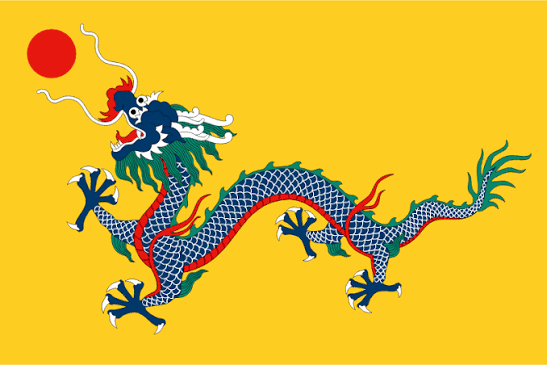
The flag was simple: a yellow background with a black dragon chasing a red flaming pearl in the upper left corner.
Every element was deliberate.
Yellow (黄, huáng) was the imperial colour. In the entire Qing empire, only the emperor and a small circle of the highest officials were permitted to wear yellow. Buildings in the Forbidden City had yellow roof tiles. Commoners wearing yellow could face severe punishment. The flag's yellow background announced, without ambiguity, that this was an imperial vessel.
The dragon (龙, lóng) was the emperor's personal symbol. But not just any dragon — look carefully and the dragon on the Qing flag has five claws on each foot. This matters. In Chinese iconography, only imperial dragons were permitted five claws. A four-clawed dragon was for high nobility; three claws for lower officials. Five claws on a dragon was a direct claim of imperial authority.
The flaming pearl that the dragon pursues represents wisdom, wealth, and luminosity — a classical symbol in Chinese Buddhist and Daoist imagery, associated with achieving enlightenment or perfection.
The Yellow Dragon Flag flew during one of the most difficult periods in Chinese history — the Boxer Rebellion, the escalating encroachment of foreign powers, the final decades of two thousand years of dynastic rule. When the flag was lowered for the last time in 1912, it ended not just a dynasty but the entire imperial system.
五色旗 — The Five Colour Flag (1912–1928)

When the Republic of China was established in 1912 following the Xinhai Revolution, it needed a new flag immediately. The republic that replaced the empire was a fragile coalition of different political factions — Han Chinese nationalists, Manchu supporters, regional warlords, and Sun Yat-sen's revolutionary movement — and the flag reflected this awkward compromise.
The 五色旗 (wǔsè qí), or Five Colour Flag, had five horizontal stripes: red, yellow, blue, white, and black. Each colour represented one of China's five main ethnic groups: the Han, Manchu, Mongol, Hui, and Tibetan peoples. The arrangement was an explicit statement of multi-ethnic unity under the new republic.
This flag was never particularly beloved. The republic it represented was unstable from the start — warlords divided the country, foreign powers maintained their treaty port privileges, and Sun Yat-sen's Nationalist Party (Kuomintang, KMT) was repeatedly frustrated in its attempts to unify the country. The Five Colour Flag flew over a China that was fracturing, not unifying.
When the KMT finally consolidated enough power to establish a proper national government in Nanjing in 1928, they replaced it.
青天白日满地红 — The Blue Sky, White Sun, Full Red Earth (1928–Present in Taiwan)
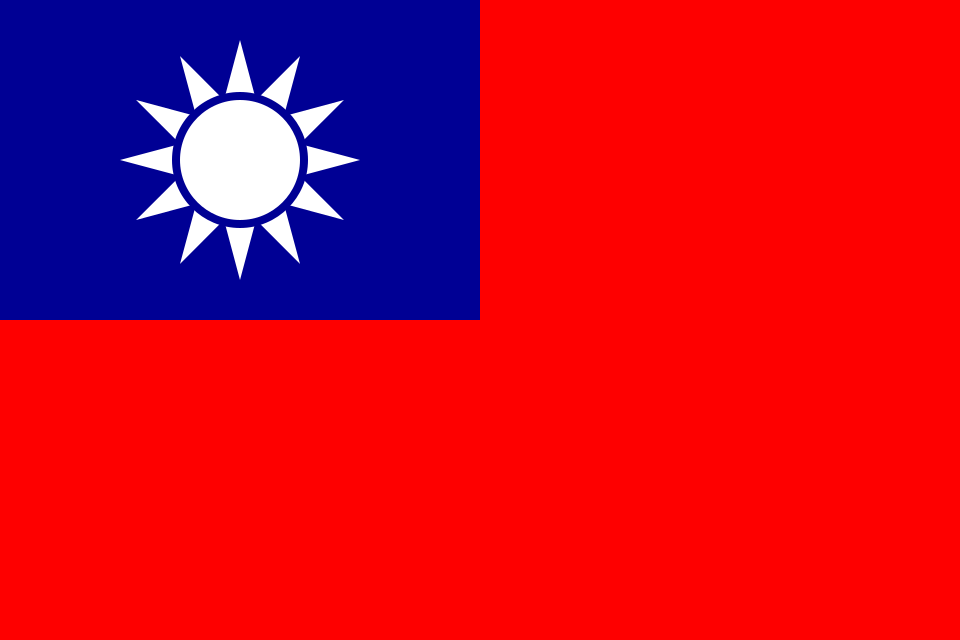
The flag adopted by the Republic of China in 1928 was not new. It had been developed decades earlier by the revolutionary movement and went by a poetic name: 青天白日满地红 (qīngtiān báirì mǎndì hóng) — literally "blue sky, white sun, full red earth."
The design traces back to Lu Haodong, a close associate of Sun Yat-sen who created the white sun on a blue background as the revolutionary movement's emblem in the 1890s. The red field was added later, making it the full national flag.
Each element carries the symbolism of Sun Yat-sen's Three Principles of the People (三民主义, Sānmín Zhǔyì):
Blue represents 民族主义 (mínzú zhǔyì), nationalism — the sovereignty of the Chinese people White represents 民权主义 (mínquán zhǔyì), democracy — the political rights of the people Red represents 民生主义 (mínshēng zhǔyì), the people's livelihood — economic welfare
The white sun itself has twelve rays, representing the twelve months of the year and the twelve traditional two-hour periods of the Chinese day. Each ray points outward with mathematical precision.
This flag survived the fall of the ROC mainland government in 1949 and continues to fly in Taiwan today — officially representing a government that technically still claims to be the legitimate government of all China, though in practice nobody seriously maintains that position anymore. The flag appears at the Olympics under the name "Chinese Taipei" (中華台北, Zhōnghuá Táiběi) with a modified version, because the PRC has blocked Taiwan from competing under its official flag or name.
五星红旗 — The Five Star Red Flag (1949–Present)
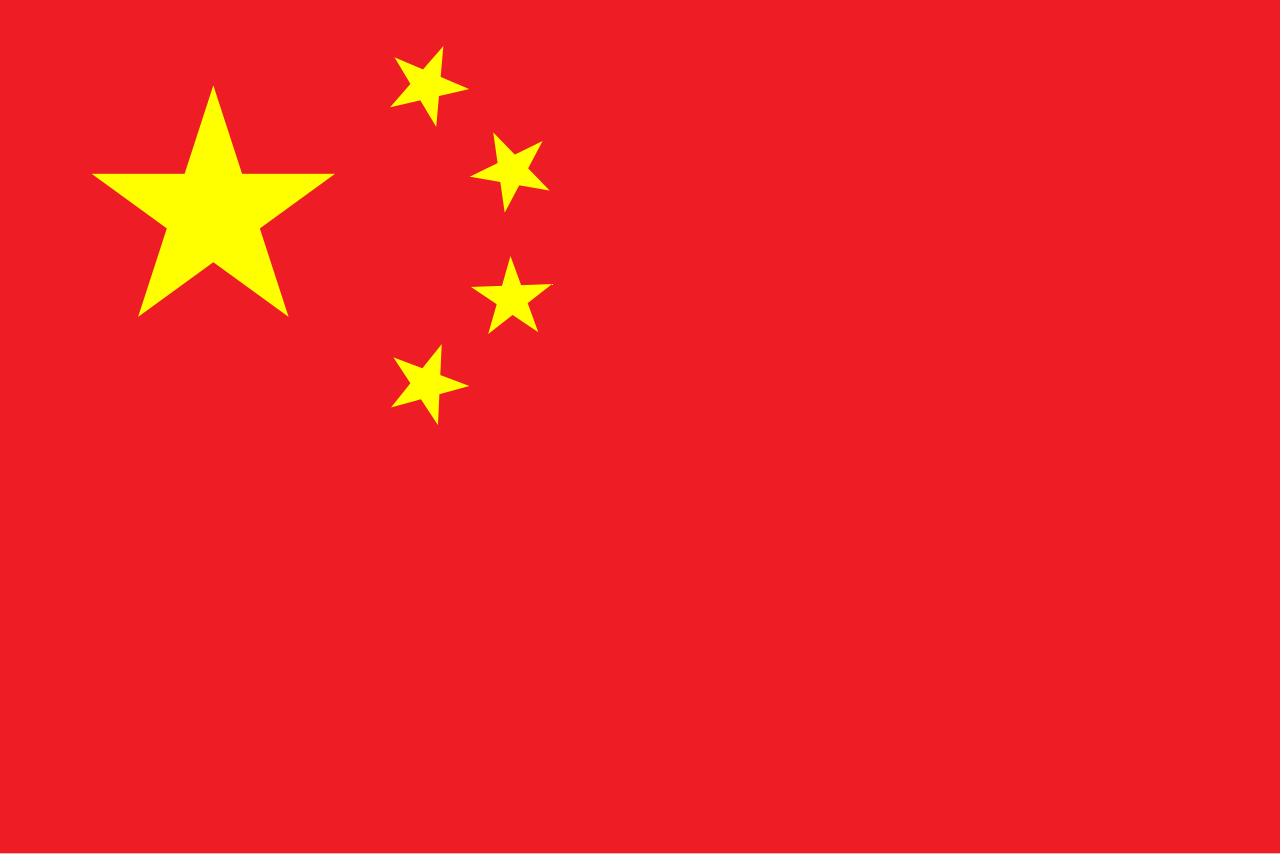
The flag of the People's Republic of China was introduced on October 1, 1949, when Mao Zedong stood at the Gate of Heavenly Peace in Beijing and proclaimed the establishment of the new state. It had been selected through a nationwide design competition that received nearly 3,000 entries.
The winning design came from Zeng Liansong (曾联松, Zēng Liánsōng), an economist from Shanghai who submitted his design while living as a refugee in the city. His original submission was slightly different from what was ultimately adopted — the large star had a yellow stripe through it, representing the Yellow River and the Han people. Mao had this removed, arguing that the flag should represent all Chinese people equally, not emphasise a single ethnic group.
The red background (红色, hóngsè): In Chinese revolutionary symbolism, red represents the communist revolution and the blood of those who died fighting for it. Red is also, of course, the colour most deeply associated with good fortune and celebration in Chinese culture — a happy coincidence of symbolism that the new republic embraced.
The large gold star represents the Communist Party of China leading the nation.
The four smaller stars represent the four social classes that Mao defined as the foundation of the new state: the working class (工人阶级, gōngrén jiējí), the peasantry (农民阶级, nóngmín jiējí), the urban petite bourgeoisie (城市小资产阶级, chéngshì xiǎo zīchǎn jiējí), and the national bourgeoisie (民族资产阶级, mínzú zīchǎn jiējí). Each of the four small stars points one tip directly toward the centre of the large star — a design choice that visually represents all four classes unified under Party leadership.
The geometry matters: this alignment was not accidental. It was specified in the original design requirements. If you draw lines from the tips of the small stars pointing toward the large one, they converge precisely at its centre.
The Flags of Hong Kong and Macau: Special Cases
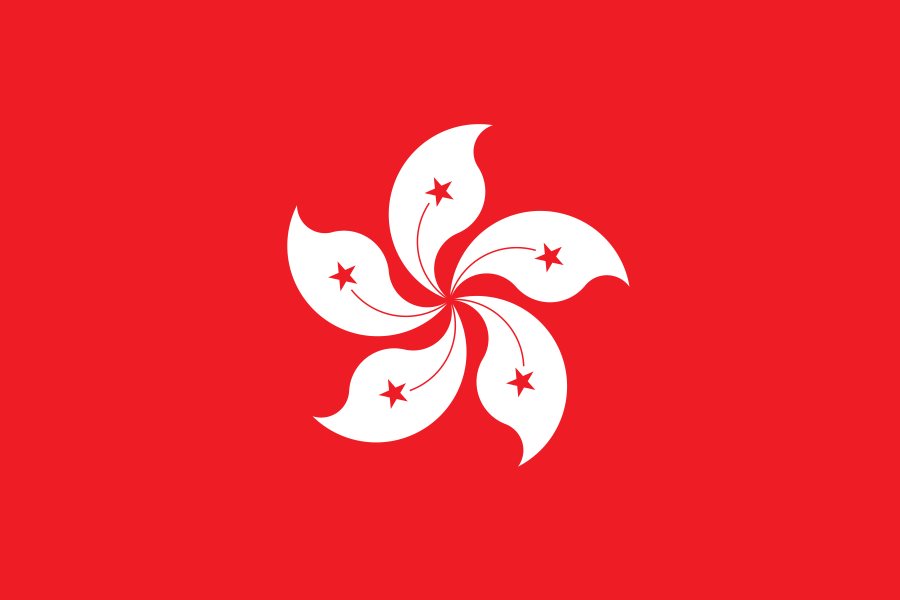
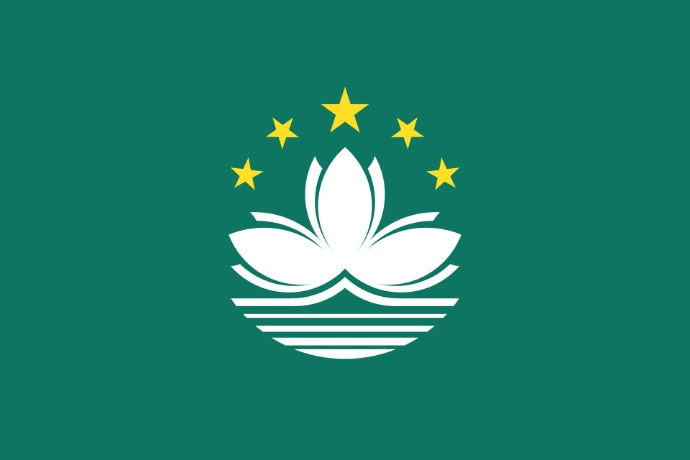
Worth mentioning separately: neither Hong Kong nor Macau uses the PRC's five-star red flag as its sole official symbol. As China's two Special Administrative Regions, both have their own regional flags alongside the national flag.
Since 1997, Hong Kong has flown a distinctive red flag featuring a white stylised bauhinia flower (紫荆花, zǐjīng huā) — a flower native to the region — with five red stamens, each bearing a small red star at its tip. The five stars echo the symbolism of the PRC flag while the bauhinia represents Hong Kong's distinct identity within the "one country, two systems" framework.
Macau, which returned to Chinese sovereignty in 1999, uses a green flag featuring a white lotus flower above a stylised depiction of the Governor Nobre de Carvalho Bridge and water. Above the lotus are five yellow stars arranged in the same pattern as those on the PRC flag, symbolising Macau's connection to China while highlighting its own regional identity.
Both flags reflect the unique status of Hong Kong and Macau under the "one country, two systems" principle, combining symbols of national sovereignty with elements that represent their distinct histories and local identities. Whether that framework continues to function in the way originally envisioned is a separate, much-discussed question.
The Vocabulary of Chinese Flags
For learners, flags give you a surprisingly rich set of characters worth knowing — colours, numbers, symbols, and historical terms that appear throughout Chinese culture and language.
| Chinese | Pinyin | Meaning |
|---|---|---|
| 国旗 | guóqí | national flag |
| 五星红旗 | Wǔxīng Hóngqí | Five Star Red Flag (PRC flag's official name) |
| 黄龙旗 | huánglóng qí | Yellow Dragon Flag (Qing dynasty) |
| 红色 | hóngsè | red (colour) |
| 黄色 | huángsè | yellow (colour) |
| 金色 | jīnsè | gold (colour) |
| 星星 | xīngxīng | star |
| 五星 | wǔxīng | five stars |
| 龙 | lóng | dragon |
| 革命 | gémìng | revolution |
| 共产党 | gòngchǎndǎng | Communist Party |
| 中华人民共和国 | Zhōnghuá Rénmín Gònghéguó | People's Republic of China |
| 中华民国 | Zhōnghuá Míngúo | Republic of China (Taiwan) |
| 开国大典 | kāiguó dàdiǎn | founding ceremony (October 1, 1949) |
The distinction between 中华人民共和国 and 中华民国 is worth memorising — both use 中华 (Zhōnghuá, Chinese/China) and 共 (gòng, shared/together), but one is the PRC and one is the ROC. Knowing which is which matters in any serious discussion of Chinese politics or history.
Join the Mandarin Zest Club
Join the Mandarin Zest Club and become part of a welcoming international community of Chinese learners from all over the world. Practice together, stay motivated, and connect with people who share your goals for learning Mandarin.

Why the Simplified/Traditional Divide Echoes Here
One of the quieter ways the PRC/ROC division shows up in everyday Chinese is in the choice between Simplified and Traditional characters. Mainland China uses Simplified Chinese, introduced in the 1950s under the same government that raised the five-star flag. Taiwan uses Traditional Chinese, the same script used across all of China before 1949.
The flags and the writing systems map onto the same political division. The ROC flag and Traditional characters are the Taiwan side; the PRC flag and Simplified characters are the mainland side. For language learners, this is a useful way to remember the distinction: whatever flag you see on a Chinese government building tells you which character set is in official use there.
Learn Chinese Characters the right way!
Chinese characters are often seen as one of the most intimidating parts of learning Mandarin. This guide was created to change that.
FAQ
The large star represents the Communist Party of China. The four small stars represent the four social classes that Mao identified as the foundation of the new state: the working class, the peasantry, the urban petite bourgeoisie, and the national bourgeoisie. Each small star is precisely angled so that one tip points directly at the centre of the large star.
Red represents the communist revolution in the PRC's official symbolism. It also connects to the deep cultural associations red carries in Chinese culture — luck, celebration, and prosperity — which made it a doubly resonant choice for the new republic.
Zeng Liansong (曾联松), an economist from Shanghai, submitted the winning design in the 1949 national competition. His original design included a yellow stripe through the large star; Mao Zedong had this element removed before the final flag was approved.
Taiwan (officially the Republic of China) uses the blue sky, white sun, red field flag adopted in 1928. It predates the PRC flag by over twenty years and is still the official flag of the ROC government. Taiwan competes in international sporting events as "Chinese Taipei" under a different, compromise flag.
Not officially. It occasionally appears in historical reenactments, period dramas, and as a curiosity flag among collectors. Some overseas Chinese communities with connections to the Qing period have historical flags, but it has no official status anywhere today.