
Taiwan and Hong Kong both use "traditional" Chinese characters, but they're not identical. Learn about different standardized forms, Cantonese-only characters, and why 佢, 冇, or 曱甴 will stump a Taiwanese reader.
If you’ve studied Mandarin in Taiwan and then opened an article from Hong Kong, you may have had a strange experience: the text is written in “traditional Chinese” — just like what you learned — and yet some characters look slightly off, while others are completely unfamiliar.
Learn Chinese Characters the right way!
Chinese characters are often seen as one of the most intimidating parts of learning Mandarin. This guide was created to change that.
That’s not a mistake or a glitch. It’s because “traditional Chinese characters” (繁體字 or 正體字) isn’t actually one single, uniform system. Taiwan and Hong Kong have developed their own standards for how traditional characters are written, so although they share the same broad tradition, they don’t always use exactly the same forms.
This article breaks down the real, practical differences between Taiwanese and Hong Kong traditional characters — from officially standardized stroke forms to characters that only exist because Hong Kong is a Cantonese-speaking city.
"Traditional Chinese" Is Not One Single Standard
It's a common misconception that "traditional Chinese" is a single, unified writing system, in contrast to simplified Chinese. In reality, both Taiwan and Hong Kong (along with Macau) use traditional characters, but each region has its own official standardization body and its own standard glyph shapes — meaning the "correct" way to write certain characters can differ, even when both versions are unmistakably traditional (not simplified).
- Taiwan follows the Standard Form of National Characters (國字標準字體), maintained by the Ministry of Education (教育部). This standard grew out of curriculum and dictionary work in the 1970s–80s and is what's taught in Taiwanese schools, used in textbooks, and reflected in software input methods designed for Taiwan.
- Hong Kong follows glyph guidance associated with institutions such as the Hong Kong Education Bureau and reference works compiled by universities (including the Chinese University of Hong Kong), which document standard and variant forms used locally. Hong Kong's standard developed under different historical influences — including British-era printing conventions and local publishing norms — and was formalized separately from Taiwan's.
Different Standardized Stroke Forms (Same Character, Different "Official" Shape)
The most common type of difference isn't about vocabulary at all — it's about which version of a character's shape is considered standard. Chinese characters often have multiple historically attested forms (異體字, "variant characters"), and Taiwan and Hong Kong don't always pick the same one as "the" standard.
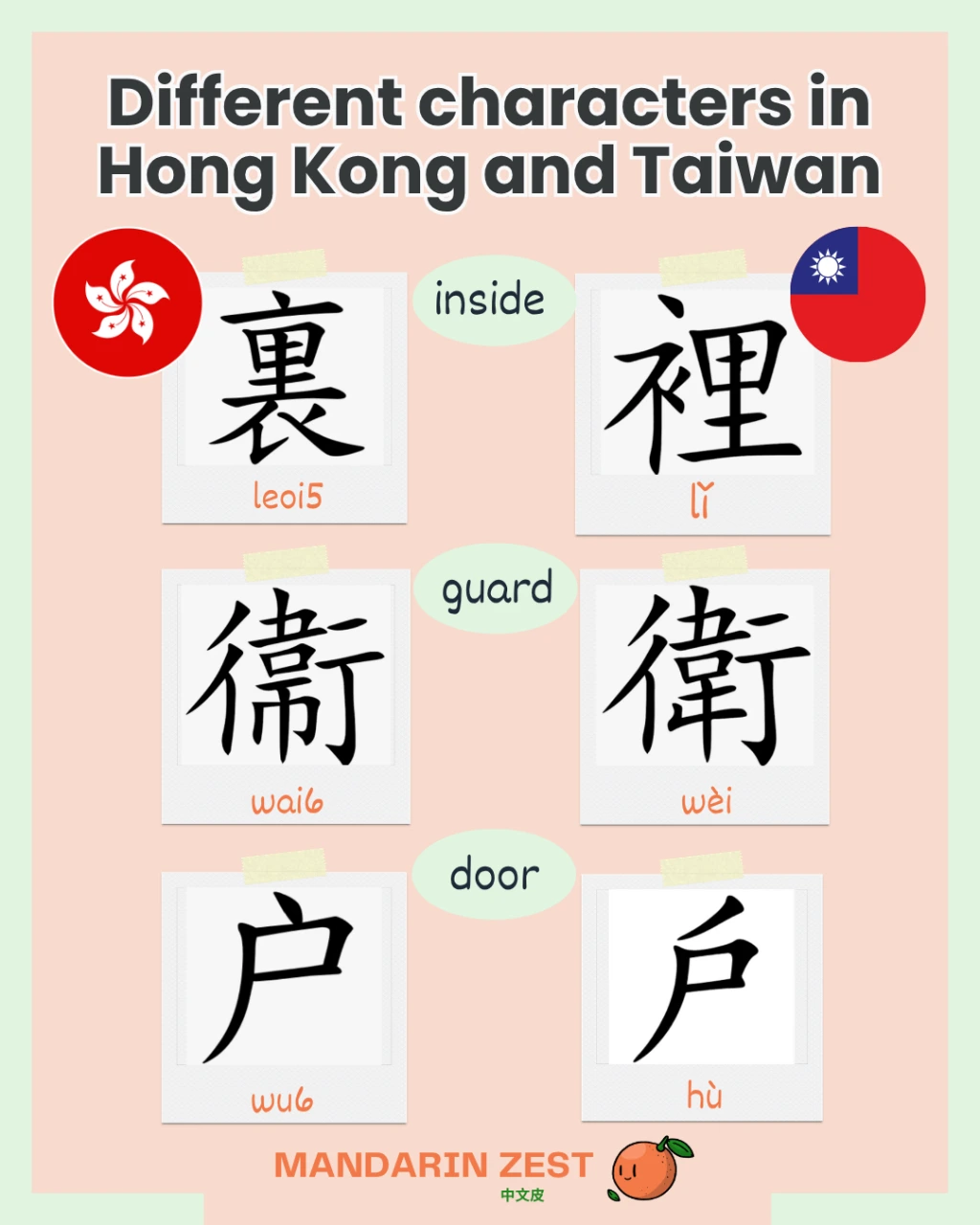
裡 vs. 裏
Take 裡 and 裏, both meaning "inside" (as in 裡面/裏面, "inside"). These are variant forms of the same character, not two different words. The Chinese University of Hong Kong's language reference resources confirm that 裏 and 裡 are variants of one another — a single character with two accepted written shapes.
Here's the nuance:
- In Taiwan, 裡 is the standardized form taught in schools and used in official Ministry of Education materials, while 裏 is treated as a secondary/variant form.
- In Hong Kong, both forms genuinely exist in everyday use. Historically, 裏 had a stronger foothold in Hong Kong print and publishing. But 裡 became increasingly widespread in Hong Kong once computer input and cross-region content (including Taiwanese media and websites) became common. It would be inaccurate to call 裏 "the" Hong Kong form — it's simply a form with deeper historical roots there, not one used to the exclusion of 裡.
Opposite "Orthodox" Choices: When Taiwan and Hong Kong Pick Different Variant Forms
Chinese has always had 異體字 (yìtǐzì) — historically attested "variant characters" that share the same meaning and pronunciation but are written slightly differently. Because Taiwan's Ministry of Education and Hong Kong's language-education authorities standardized their reference character lists independently, they didn't always agree on which variant to designate as the "orthodox" (正字/正體) form. The result: some characters that a Taiwanese reader considers correct are considered the unorthodox variant in Hong Kong, and vice versa.
衛 vs. 衞 — "to guard/defend"
This is one of the clearest examples of a genuine standard-vs-standard split, rather than a case where both forms simply coexist.
- In Taiwan, the Ministry of Education's standard explicitly designates 衛 as the orthodox form. 衞 is classified as a non-standard variant. As a result, Taiwanese textbooks, government documents, and place names (e.g. 衛生局, "health bureau") consistently use 衛.
- In Hong Kong, the historical reference point is the Shuōwén Jiězì (《說文解字》), the foundational 2nd-century Chinese character dictionary, which treats 衞 as the original, authorized form and 衛 as a later variant. This isn't arbitrary: the component 帀 (not to be confused with the unrelated 币, "currency") means "to make a full circuit" (環繞一周). Combined with 行 ("to move/patrol") and 韋 ("to encircle"), 衞 visually and etymologically captures the idea of defending a boundary through a patrol that circles it completely. Hong Kong street signs, older institutional names, and some formal usage still reflect this — a well-known example is the Hong Kong hospital and place name 衞生署 (Department of Health), spelled with 衞 rather than Taiwan's 衛.
着 vs. 著 — a grammatical particle, split differently by each region
着 historically split off from 著 around the Song dynasty as a separate written form for certain grammatical uses (the durative/progressive aspect marker, roughly equivalent to "-ing," as in 走着/走著, "walking").
- Hong Kong's 常用字字形表 (List of Graphemes of Commonly-used Chinese Characters) keeps 着 and 著 as two distinct, purpose-specific characters: 著 is reserved for the reading zhù (as in 著名, "famous," or 著作, "written work"), while 着 is used for every other reading and grammatical function (zhe, zhuó, zháo, zhāo in Mandarin; zoek3 in Cantonese).
- Taiwan's standard collapses this distinction entirely: citing older character dictionaries such as the Lìbiàn, Gānlù Zìshū, and Guǎngyùn, which treat 着 as a "vulgar/popular form" (俗字) of 著, Taiwan's Ministry of Education standardizes on 著 for all five readings, and 着 essentially disappears from official Taiwanese writing. So a Taiwanese textbook will always print 走著, never 走着 — the opposite of Hong Kong convention.
群 vs. 羣 — "group; crowd"
This pair shows the split can go in either direction depending on the region:
- In Taiwan, 群 (left-right structure: 君 + 羊) is the standardized orthodox form, while 羣 (top-bottom structure: 君 above 羊) is treated as a variant. Interestingly, Taiwan's own standards committee originally leaned toward 羣 as historically "more correct," but switched to 群 partly for practical reasons — early low-resolution computer fonts rendered the stacked 羣 poorly, so 群 was adopted instead, reportedly after a formal vote.
- In Hong Kong, 羣 is treated as the standard form (closer to the form recorded in the Kangxi Dictionary), with 群 as the variant.
Other Stroke-Level Variants
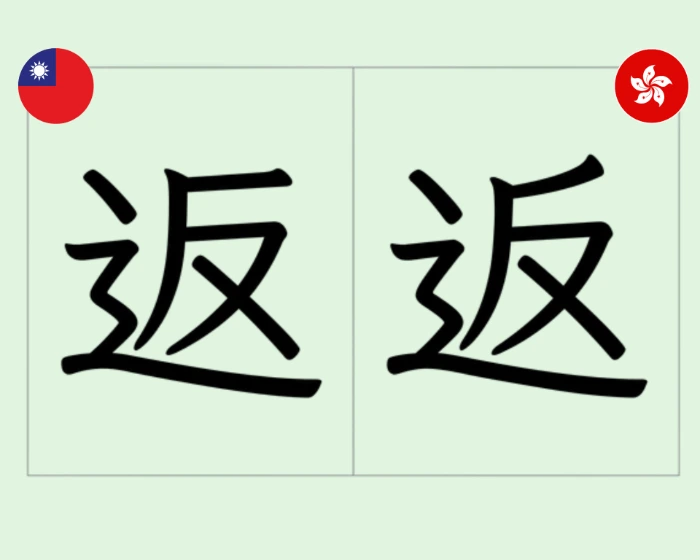
Beyond 裡/裏, there are dozens of characters where the "textbook standard" stroke count, component placement, or radical choice differs subtly between Taiwan and Hong Kong references — things like whether a component is written with 又 or 攵, or minor differences in how enclosed strokes are drawn. Individually these are small, but collectively they mean that Taiwan-standard fonts and Hong Kong-standard fonts are genuinely not pixel-identical, even for characters both regions consider "traditional."
For publishers and app developers, this is why serious Chinese typography products often ship separate Taiwan and Hong Kong font variants rather than a single generic "traditional Chinese" font
2. Cantonese-Specific Characters:
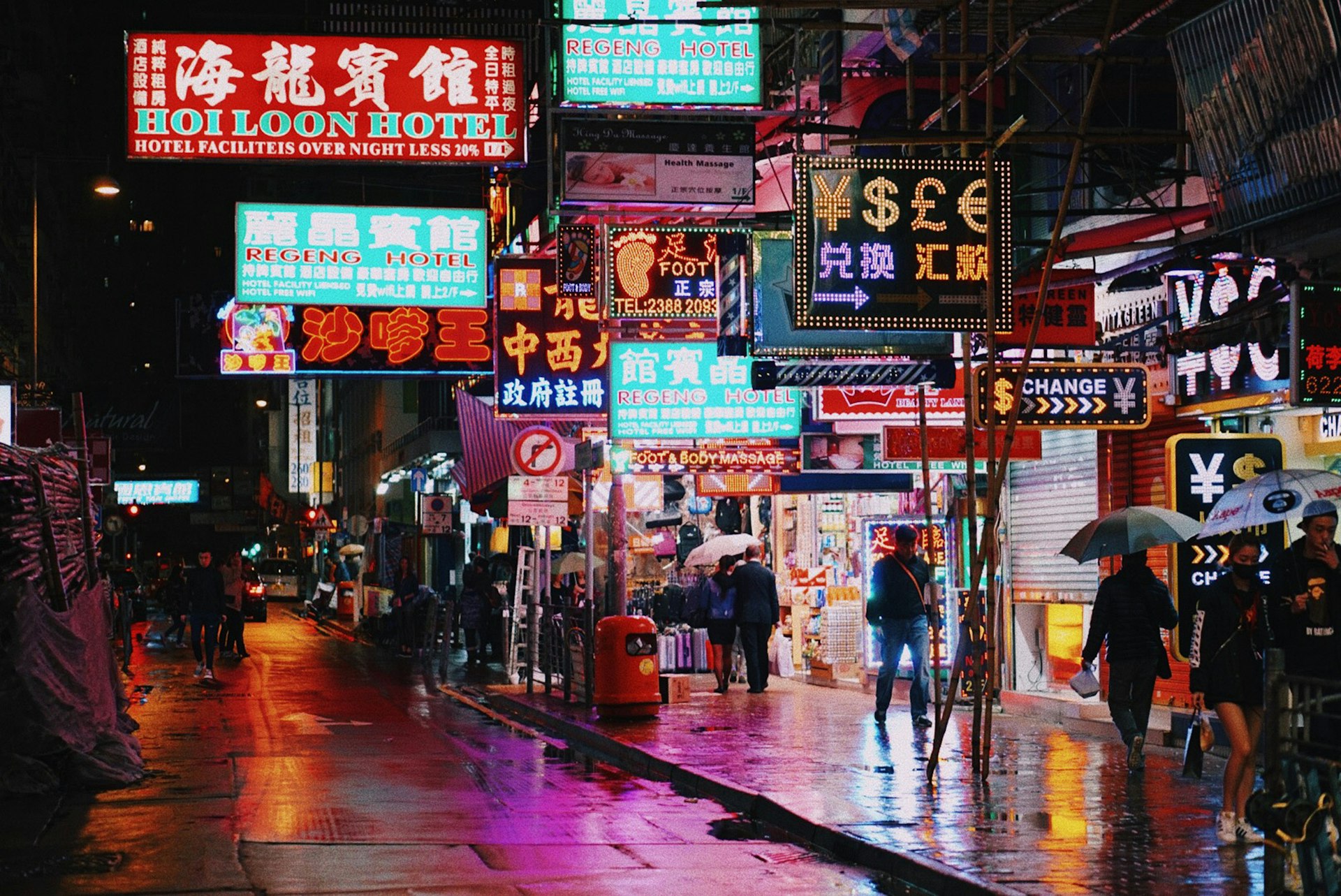
This is the difference that actually causes comprehension problems, not just aesthetic ones. Hong Kong's written language is heavily influenced by spoken Cantonese, and everyday Hong Kong writing — social media, subtitles, advertising, comics, casual messaging — regularly uses characters that exist specifically to represent Cantonese words and sounds.
Formal written Taiwanese Mandarin generally does not use these characters at all, because they don't correspond to standard Mandarin vocabulary.
Here are some clear examples:
佢 (keoi5) — "he / she / it"
In Cantonese, 佢 is the everyday third-person pronoun, functionally equivalent to Mandarin's 他/她/它. It's an extremely common word in spoken Cantonese and appears constantly in Hong Kong text messages, comment sections, and colloquial writing. In Taiwan, 佢 is essentially unused — a Taiwanese reader who studied only standard Mandarin may not recognize it as a pronoun at all, or may not know how to pronounce it. This single character is one of the fastest ways to tell that a piece of text was written by a Cantonese speaker rather than a Mandarin speaker.
冇 (mou5) — "to not have"
冇 is the Cantonese negative existential verb, the counterpart to 有 ("to have/there is"). Structurally, it's even written as 有 with the middle strokes removed, visually suggesting "emptiness" or absence. It's used constantly in Hong Kong: 冇問題 ("no problem"), 冇錢 ("no money"), 冇事 ("it's nothing/no big deal"). Mandarin simply doesn't have this character in its standard vocabulary — Mandarin speakers use 沒 or 沒有 instead. 冇 is a textbook example of a character that exists because Cantonese grammar needed it, not because Chinese writing in general needed it.
曱甴 (gaat6 zaat2) — "cockroach"
This is one of the more striking examples because it looks almost nothing like ordinary vocabulary. 曱甴 is the Cantonese word for cockroach, and both characters are essentially exclusive to this word — they're rarely, if ever, used in standard Mandarin, whether in Taiwan or mainland usage. Mandarin instead uses 蟑螂 for "cockroach," a completely different pair of characters. If a Taiwanese reader encounters 曱甴, there's a good chance they simply won't know what it says without looking it up, because the characters barely appear anywhere in the Mandarin lexicon.
呃 in 呃神騙鬼 — "to deceive; swindle"
The character 呃 appears in the Cantonese expression 呃神騙鬼 (roughly, "deceiving gods and cheating ghosts" — i.e., being deceitful to an extreme, lying to everyone). In this usage, 呃 functions as a verb meaning "to cheat" or "to deceive," which is a Cantonese usage. This is not how 呃 is used in standard Mandarin.
In Mandarin, 呃 is mainly encountered as an interjection (like a hiccup sound, "呃…") rather than as a verb meaning "to deceive." So while the character itself technically exists in the Mandarin character set, its meaning and grammatical role in this Cantonese phrase are essentially foreign to a Taiwanese Mandarin reader — another example of the same character carrying different functional weight in each writing system.
3. Why These Differences Exist
A few historical and linguistic factors explain the split:
- Spoken language base. Taiwan's standard written Chinese is built on Mandarin grammar and vocabulary, even though many Taiwanese people also speak Hokkien or Hakka at home. Hong Kong's everyday written Chinese, especially in informal contexts, is built much more directly on spoken Cantonese, so it borrows or invents characters to represent Cantonese-specific words that don't map neatly onto Mandarin vocabulary.
- Separate standardization timelines. Taiwan's Ministry of Education formalized its standard character forms independently from Hong Kong's own reference and education authorities. Neither side coordinated with the other, so where multiple historical variants existed for a character, each side sometimes settled on a different one as "standard."
- Different colonial and political histories. Hong Kong's script conventions developed under British administration with strong local Cantonese cultural production (film, pop music, tabloid press, comics), which cemented colloquial Cantonese characters into mainstream written use. Taiwan's postwar education system, by contrast, pushed a unified Mandarin-based literary standard.
- Formal vs. informal register differences. It's worth noting that in formal Hong Kong writing — government documents, news editorials, academic papers — the written Chinese looks much closer to standard Mandarin-based traditional Chinese, with far fewer Cantonese-specific characters. Cantonese characters like 佢, 冇, and 曱甴 show up overwhelmingly in informal registers: social media, subtitles, comic dialogue, advertising copy aiming for a casual tone, and everyday text messages. This formal/informal split is itself a distinctly Hong Kong phenomenon that doesn't really have an equivalent in Taiwan.
Final Takeaway
Taiwan and Hong Kong traditional Chinese share the vast majority of their characters and are mutually intelligible for most formal writing. But the differences are real and fall into two distinct layers.
The first is standardized "orthodox form" differences, where Taiwan and Hong Kong's independently developed reference standards chose different variants of the same historical character — sometimes Hong Kong keeping the older, Shuōwén Jiězì-sanctioned form (衞, 羣) against Taiwan's more teaching- or typography-driven choice (衛, 群), sometimes the split falling along different lines entirely (着/著, 裡/裏).
The second is genuinely Cantonese-specific vocabulary — characters like 佢, 冇, 曱甴, and the colloquial verb use of 呃 in 呃神騙鬼 — that simply doesn't belong to the Mandarin-based lexicon Taiwan uses, and can leave a Taiwanese reader stuck without a dictionary. Recognizing both layers, and knowing which one you're dealing with, is essential for anyone learning, translating, or designing for Chinese-language audiences in either region.
Learn Chinese Characters the right way!
Chinese characters are often seen as one of the most intimidating parts of learning Mandarin. This guide was created to change that.