Chinese has a reputation for being hard. The tones are real, the characters are real, and then there are the tongue twisters — 绕口令 (ràokǒulìng) — which take the existing challenges of the language and weaponise them deliberately.
Most Chinese tongue twisters are hard because they pack similar sounds into quick succession. 于瑜欲渔 (Yú Yú Yù Yú) does something more extreme: it tells an entire story using almost exclusively one syllable — "yu" — across four different tones and more than twenty different characters, each with a distinct meaning.
It is simultaneously one of the most linguistically extreme texts in Mandarin and one of the most elegant demonstrations of what Chinese tones actually do: take what would otherwise be a single sound and turn it into an entire vocabulary.
What Is 于瑜欲渔?
于瑜欲渔 is a Classical Chinese tongue twister whose name already contains the core challenge: four characters, all pronounced yú or yù, each meaning something different.
- 于 (Yú) — a person's surname
- 瑜 (Yú) — another surname (or "fine jade")
- 欲 (yù) — to want, to desire
- 渔 (yú) — to fish, fishing
So the title means: "Yu Yu wants to fish." Four words. One syllable. Four tones. Four meanings.
The text was written in Classical Chinese by an unknown modern author (recorded as 佚名, yìmíng, "anonymous") and appears in the 2011 Teacher Qualification Examination Mandarin Guidance Materials, where it's used specifically to train pronunciation and tone distinction for Putonghua (普通话, pǔtōnghuà) certification. It's not just a parlour trick — this text is used in professional speech training in China because it forces speakers to distinguish tones with precision that everyday conversation rarely demands.
Join the Mandarin Zest Club
Join the Mandarin Zest Club and become part of a welcoming international community of Chinese learners from all over the world. Practice together, stay motivated, and connect with people who share your goals for learning Mandarin.

The Original Classical Chinese Text
Here is the full original text, followed by a character-by-character analysis:
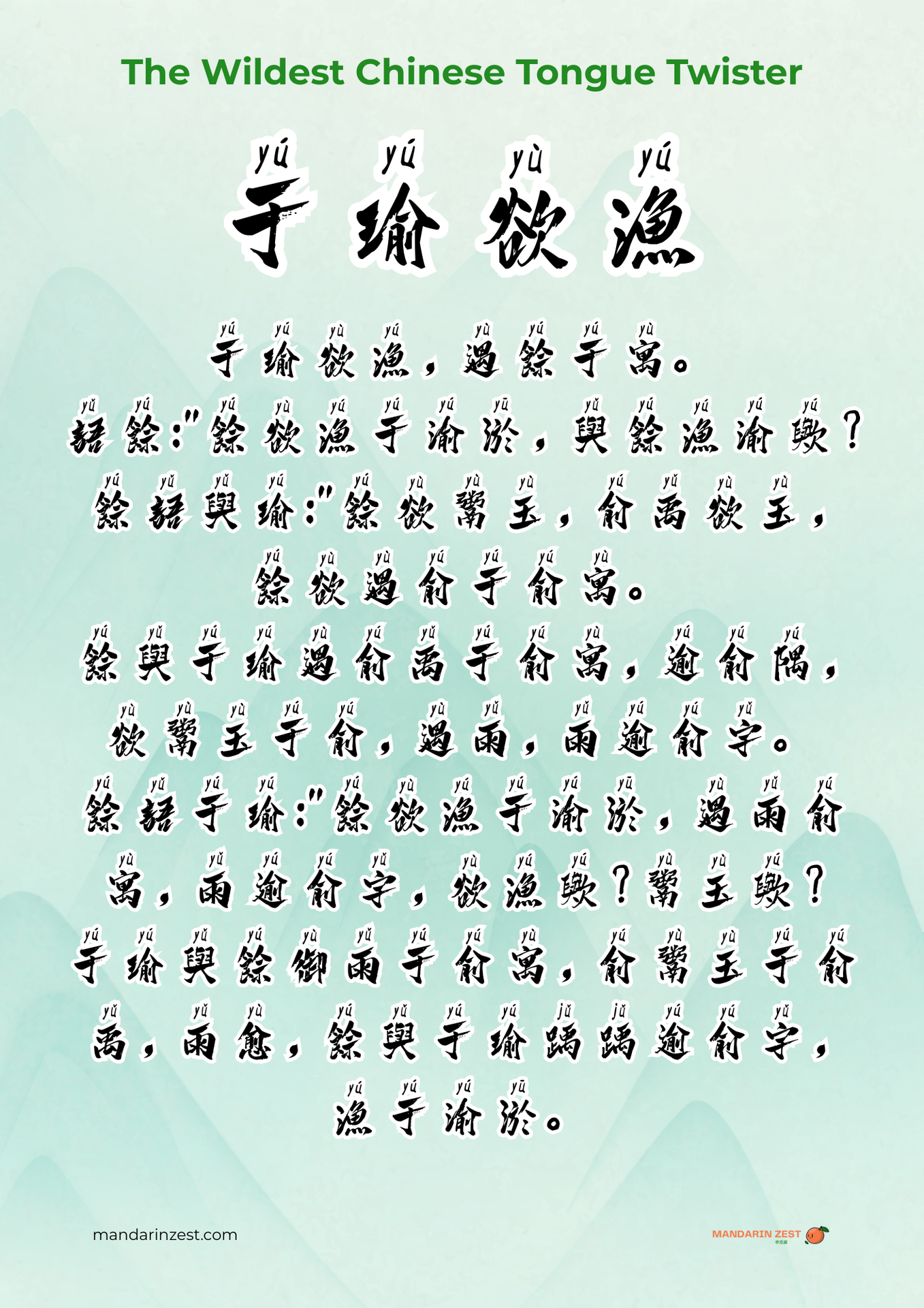
English translation:
Yu Yu wants to fish. He meets Yu at Yu's residence. He says to Yu: "I want to fish at Yuyu (a place name). Will you fish at Yu with me?" Yu says to Yu Yu: "I want to sell jade. Yuyu wants jade. I want to meet Yuyu at Yuyu's residence." Yu and Yu Yu meet Yuyu at Yuyu's residence, pass by the corner of Yu's house, want to sell jade to Yu, encounter rain — the rain passes over Yu's house. Yu says to Yu Yu: "I wanted to fish at Yuyu. We encountered rain at Yuyu's residence, the rain passes over Yuyu's house. Shall we fish? Or sell jade?" Yu Yu and Yu shelter from the rain at Yuyu's residence. Yu sells jade to Yuyu. The rain subsides. Yu and Yu Yu walk slowly past Yuyu's house, and fish at Yuyu.
The "Yu" Characters: One Sound, A Whole World
This is where the linguistic magic becomes visible. Here are the main "yu" characters in the text, with their pinyin tones and meanings:
| Character | Pinyin | Tone | Meaning in this text |
|---|---|---|---|
| 于 | yú | 2nd (rising) | Surname: Yu |
| 瑜 | yú | 2nd (rising) | Surname: Yu (or fine jade) |
| 欲 | yù | 4th (falling) | To want, to desire |
| 渔 | yú | 2nd (rising) | To fish, fishing |
| 遇 | yù | 4th (falling) | To meet, to encounter |
| 余 | yú | 2nd (rising) | I / me (Classical Chinese first person) |
| 寓 | yù | 4th (falling) | Residence, dwelling |
| 语 | yǔ/yù | 3rd (dipping) | To say, to speak to |
| 渝 | yú | 2nd (rising) | Chongqing (place name); also: to change |
| 淤 | yū | 1st (flat) | Silt, muddy water |
| 与 | yǔ | 3rd (dipping) | And / with; to give |
| 欤 | yú | 2nd (rising) | Classical particle (rhetorical question marker) |
| 鬻 | yù | 4th (falling) | To sell |
| 玉 | yù | 4th (falling) | Jade |
| 俞 | yú | 2nd (rising) | Surname: Yu |
| 禹 | yǔ | 3rd (dipping) | Surname: Yu (also: the legendary Emperor Yu) |
| 逾 | yú | 2nd (rising) | To cross over, to pass by |
| 隅 | yú | 2nd (rising) | Corner |
| 雨 | yǔ/yù | 3rd/4th | Rain (noun 3rd tone; verb "to rain" 4th tone) |
| 宇 | yǔ | 3rd (dipping) | House, eaves |
| 御 | yù | 4th (falling) | To shelter from, to ward off |
| 愈 | yù | 4th (falling) | To recover, to get better |
| 踽踽 | jǔjǔ | 3rd (dipping) | Walking slowly and alone |
That last one — 踽踽 (jǔjǔ) — is the only pair of characters in the entire text that doesn't use a "yu" sound. Everything else is some variation of yū, yú, yǔ, or yù.
Why This Matters for Mandarin Learners
The text exists precisely because it makes tones unavoidable. You cannot guess from context — every sentence contains multiple "yu" sounds with different meanings that only the tone distinguishes.
Read 余欲渔于渝淤 aloud and consider what you're producing:
Yú yù yú yú Yú yū
Six syllables. Four different tones. Five different meanings. Without correct tonal production, the sentence becomes complete noise.
This is the extreme end of something that runs through everyday Mandarin. Tones aren't decoration — they're the primary carrier of meaning. The four tones (plus neutral tone) are what allow Mandarin to maintain a functional vocabulary from a limited set of syllables. English has roughly 15,831 distinct syllables; Mandarin has approximately 400 syllables without tones, and about 1,600 with them. Every syllable does more work. 于瑜欲渔 is just the most extreme illustration of that principle.
The Characters Involved: A Radical and Structure Note
Several characters in this text share components, which is worth noticing:
The 鱼 (fish) radical: 渔 (yú, to fish) contains 鱼 (yú, fish) as its left component — 氵(water radical) + 鱼 = fishing. If you know how Chinese radicals work, this character is immediately logical.
玉 (jade): One of the oldest and most culturally significant characters in Chinese. Appears in this text as both a commodity (the jade being sold) and potentially within 瑜 (yú), which originally meant "a flawed jade" — a gem with a small imperfection. The cultural weight of jade in Chinese history means this character appears across vocabulary far beyond buying and selling.
雨 (rain): Appears twice in this text — once as a noun (3rd tone: 雨, yǔ, rain) and once as a verb (4th tone: 雨, yù, to rain). This single character carrying different tones for its noun and verb forms is a feature of Classical Chinese that learners encounter in modern vocabulary too — 看 (kàn, to look) vs 看 (kān, to watch over/guard), 长 (cháng, long) vs 长 (zhǎng, to grow/elder).
New to Chinese? Start Here.
The no-fluff roadmap for absolute beginners — what to learn first, what to skip, and how to actually stick with it past week two.
The Metaphorical Meaning
Beyond the pronunciation exercise, 于瑜欲渔 carries a moral — which is part of why it appears in teacher qualification materials rather than just as a party trick.
According to Baidu Chinese (2025), the text metaphorically suggests that one should pay attention to order and method when doing things, being busy yet orderly, otherwise it might lead to major trouble.
Look at the story: two people set out with separate intentions (fishing vs. selling jade), get tangled in a series of overlapping plans and meetings, are interrupted by rain, and have to shelter and reconsider. The situation resolves only when they stop and organise their priorities — first sell the jade, then wait for the rain to pass, then go fishing. The chaos of the journey mirrors the linguistic chaos of the text itself: multiple things that sound the same but mean completely different things, requiring careful attention to context and order to navigate.
It's a story about tone, literally and metaphorically.
How to Practice This Text
If you want to use 于瑜欲渔 as a pronunciation exercise — which is its primary purpose — here's the approach:
Start with the character table, not the text. Go through the "yu" characters above and drill each one in isolation with its correct tone. You need to have 欲 (yù, 4th), 余 (yú, 2nd), and 语 (yǔ, 3rd) as automatic before the text will be useful.
Read it slowly with full tone marks. The point is not speed — at least not initially. The point is tonal precision. Read each syllable with its full tonal contour before worrying about fluency.
Record yourself. This text is specifically used in professional speech training because it reveals tonal weaknesses immediately. If you record yourself reading it, you'll hear where your tones flatten or drop. Pinyin exists precisely to mark these distinctions on the page — use it.
Compare your production to a native speaker. Pleco has text-to-speech for individual characters. Listen to each "yu" character's tone in isolation before attempting the full text.
Other Chinese Tongue Twisters Worth Knowing
于瑜欲渔 is extreme, but it's not alone. The Mandarin Zest blog already covers 10 Chinese tongue twisters for pronunciation practice — a more accessible entry point for learners at earlier stages.
The most famous Chinese tongue twister is probably 施氏食狮史 (Shī Shì Shí Shī Shǐ) by linguist Zhao Yuanren — a 92-character poem written entirely in the sound "shi" across different tones, telling the story of a poet named Shi who eats ten lions. It makes 于瑜欲渔 look manageable by comparison.
Both texts illustrate the same fundamental point: Mandarin's tonal system is not a quirk of the language. It's the architecture that makes the language function. Without tones, Chinese would have thousands of homophones and very little disambiguation. With tones, each syllable carries four times the lexical load of an equivalent English syllable.
Understanding this — really internalising it — changes how you approach the language. Tones aren't pronunciation ornaments. They're meaning.
Vocabulary Summary
| Chinese | Pinyin | Meaning |
|---|---|---|
| 绕口令 | ràokǒulìng | tongue twister |
| 同音字 | tóngyīnzì | homophone characters |
| 声调 | shēngdiào | tone (of a syllable) |
| 普通话 | pǔtōnghuà | Mandarin / Standard Chinese |
| 渔 | yú | to fish |
| 玉 | yù | jade |
| 雨 | yǔ | rain |
| 寓 | yù | residence |
| 遇 | yù | to encounter |
| 余 | yú | I / me (Classical Chinese) |
| 逾 | yú | to cross / to pass |
| 踽踽 | jǔjǔ | walking slowly, alone |
Our Materials
Check out our dedicated materials, designed by teachers for learners.