Colour in Chinese culture does something that colour in Western cultures rarely does: it carries philosophical, medical, political, and cosmological meaning simultaneously. The same shade can be lucky at a wedding and catastrophic at a funeral. A colour that represents imperial authority for three thousand years can also be the colour of a toxic green hat that no Chinese man would accept as a gift.
This guide covers the full picture — the lucky and unlucky colours, the historical and philosophical roots of each, the fascinating case of 青 (qīng) that didn't distinguish between green and blue, the colour vocabulary you'll need in Chinese, and the idioms where colour does its most interesting linguistic work.
First: Colour Vocabulary in Chinese
Most articles about this topic contain almost no Chinese. Since this is a Mandarin learning blog, let's fix that immediately.
| Colour | Chinese | Pinyin | Notes |
|---|---|---|---|
| Red | 红色 | hóngsè | Most culturally significant colour |
| Yellow | 黄色 | huángsè | Imperial colour |
| Green | 绿色 | lǜsè | Modern word for green |
| Blue | 蓝色 | lánsè | Modern word for blue |
| White | 白色 | báisè | Associated with mourning |
| Black | 黑色 | hēisè | Associated with darkness |
| Gold | 金色 | jīnsè | Wealth and prosperity |
| Purple | 紫色 | zǐsè | Power and spirituality |
| Pink | 粉色 | fěnsè | Romance, femininity |
| Orange | 橙色 | chéngsè | Modern orange colour term |
| Grey | 灰色 | huīsè | Neutral, balance |
| Green-blue | 青色 | qīngsè | The classical colour between green and blue |
The suffix 色 (sè) means "colour" — so every colour word ends with it. 颜色 (yánsè) means "colour" as a noun: 你喜欢什么颜色?(nǐ xǐhuān shénme yánsè?, what colour do you like?) is a basic but useful conversational phrase that appears in HSK 1-2 vocabulary.
红 (Hóng) — Red: The Most Important Colour
Red is the luckiest colour in Chinese culture — unambiguously, consistently, across virtually all contexts and regions. Understanding why, and how deeply it runs through Chinese life, is essential for any learner.
What red means
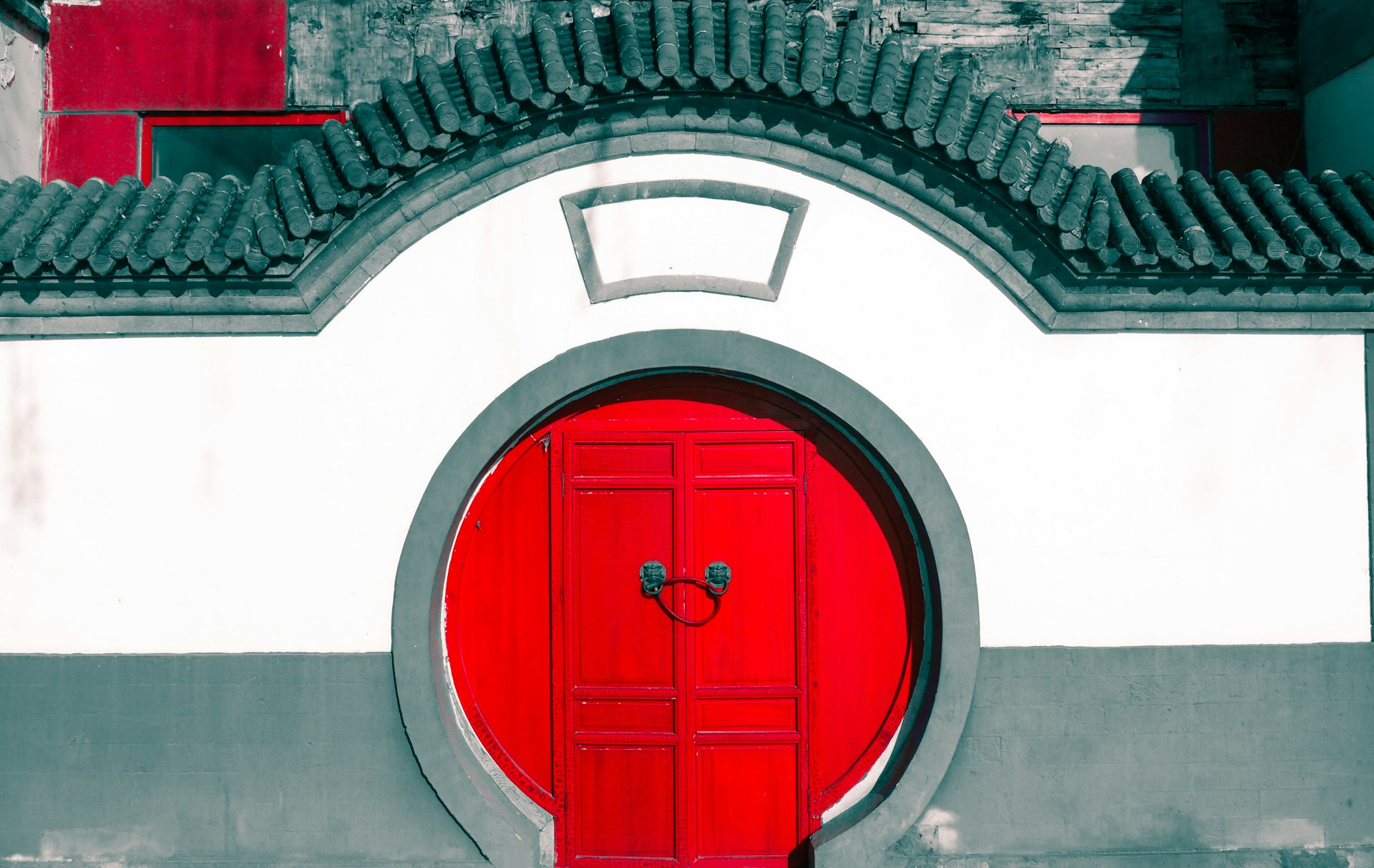
In Chinese culture, red (红色, hóngsè) represents luck, celebration, prosperity, vitality, and protection from evil. Its dominance in the colour culture is remarkable:
- Chinese New Year decorations are overwhelmingly red
- Traditional wedding dresses are red (not white — more on that below)
- Red envelopes (红包, hóngbāo) contain cash gifts for festivals, weddings, and celebrations
- The national flag is red
- The walls of the Forbidden City are red
- Red lanterns hang outside temples and at festivals throughout the year
The character 红 itself is revealing: it uses the silk radical 纟on the left — in ancient China, red silk was one of the most precious and celebratory materials a person could possess, and the character for "red" literally encodes this connection to silk. Understanding how radicals connect to meaning transforms characters like 红 from abstract shapes into legible cultural history.
Red in Chinese idioms
Red is so culturally loaded that it appears across a remarkable range of idioms and expressions:
开门红 (kāi mén hóng) — "opening the door red." A good start, an auspicious beginning. Used when a new business, project, or year gets off to a strong start.
走红 (zǒu hóng) — "to walk red." To become famous, to trend, to have a moment of popularity. When a celebrity or trend suddenly explodes, they 走红.
红火 (hónghuǒ) — "red fire." Thriving, prosperous, booming. A business described as 红火 is doing extremely well.
红眼病 (hóng yǎn bìng) — "red eye disease." Jealousy. The same metaphor as "green with envy" in English, but using red instead.
These idioms appear throughout Chinese expressions and philosophy — red is one of the most fertile source characters in the idiom lexicon.
Red and the question of pink and orange
The original Chairman's Bao article notes that "Chinese red" traditionally includes shades of pink, orange, and dark brown. This is worth unpacking. In classical Chinese colour theory, the boundaries between what English counts as separate colours were drawn differently. What mattered was the emotional and symbolic register of a colour — and red's warm, life-giving, celebratory register extended across a broader spectrum of warm tones than modern colour science would group together.
黄 (Huáng) — Yellow: The Imperial Colour
Yellow (黄色, huángsè) was the most exclusive colour in imperial China — reserved for the emperor and the highest court officials. The roof tiles of the Forbidden City are yellow; the imperial dragon robe was yellow; the Yellow Dragon Flag was the national flag of the Qing dynasty.
Why yellow?
The homophonic connection: 黄 (huáng, yellow) sounds like 皇 (huáng, emperor). This sonic coincidence was almost certainly a factor in establishing yellow's imperial status in Chinese cultural history — the same phonetic logic that makes 四 (sì, four) unlucky because it sounds like 死 (sǐ, death).
Yellow is also the colour of earth in the Five Elements (五行, wǔxíng, the philosophical system of wood, fire, earth, metal, water). Earth is the central, stable element — and the colour of earth is the colour of the central, supreme ruler.
Yellow in modern China
The association between yellow and imperial power has faded since the Qing dynasty ended in 1912. Today, yellow retains positive cultural associations — warmth, harmony, late summer — but also carries a modern negative connotation: 黄色 (huángsè) is used as a euphemism for pornographic or obscene content, in the same way that English used "blue" for risqué material historically. This is worth knowing: asking whether something is 黄色 means something entirely different from asking about its colour.
青 (Qīng) — The Classical Colour Between Green and Blue
This is the most linguistically fascinating colour in Chinese and the one most Western learners don't know about. In classical Chinese, there was no separate word for green and blue. Instead, a single colour term 青 (qīng) covered both — a large stretch of the colour spectrum that English divides into two.
青 described the colour of spring vegetation, of mountain shadows, of clear water, of a cloudless sky. It was the colour of growing things, of nature in its vital state.
Today, modern Chinese has separate words: 绿色 (lǜsè, green) and 蓝色 (lánsè, blue). But 青 persists in:
- 青春 (qīngchūn) — youth, literally "green spring"
- 青天 (qīngtiān) — blue/clear sky
- 青菜 (qīngcài) — green vegetables
- 青铜 (qīngtóng) — bronze (literally "green copper")
- 青年 (qīngnián) — young people, youth
And in the idiom 青出于蓝 (qīng chū yú lán) — "green comes from blue." This means the student has surpassed the teacher. The image: indigo dye (蓝, lán) is processed into a deeper, richer blue-green (青) that surpasses the original material. The student who truly learns exceeds their master.
This word history reflects something important about how Chinese language encodes perception — the categories aren't the same as English, and colour is one of the places where the difference is most visible.
Join the Mandarin Zest Club
Join the Mandarin Zest Club and become part of a welcoming international community of Chinese learners from all over the world. Practice together, stay motivated, and connect with people who share your goals for learning Mandarin.

白 (Bái) — White: The Colour of Mourning
In Western cultures, white is the colour of weddings, purity, and new beginnings. In Chinese culture, white (白色, báisè) is primarily associated with death, mourning, and funerals. White chrysanthemums, white envelopes, white funeral clothing — these are the associations that make white the most contextually sensitive colour in Chinese culture.
This explains why the shift toward Western-style white wedding dresses in modern China is culturally complex — traditional Chinese brides wore red. Many modern Chinese weddings include both: a white dress for the Western-influenced ceremony, a red dress for the traditional Chinese celebration.
White in Chinese idioms
White generates a surprising range of idioms:
白费力气 (bái fèi lìqi) — "white-wasted effort." To waste effort on something. The 白 here carries the meaning "in vain, for nothing" — a common secondary meaning of 白.
白手起家 (bái shǒu qǐ jiā) — "to start a family with white hands." To build something from nothing, to be a self-made person. 白 here means "empty, bare."
明白 (míngbái) — "bright white." To understand. One of the most common words in Chinese.
The secondary meaning of 白 as "clear, obvious, plain, or empty" is worth knowing because it appears constantly in vocabulary beyond colour: 白 in 白天 (báitiān, daytime), 白痴 (báichī, idiot), 白开水 (bái kāishuǐ, plain boiled water).
黑 (Hēi) — Black: Darkness and the Underground
Black (黑色, hēisè) is associated in Chinese culture with darkness, the unknown, and what is hidden from official view. Unlike in Western fashion culture where black often represents sophistication, in Chinese cultural symbolism black retains its association with what is concealed and potentially threatening.
Black in Chinese idioms and compound words
黑市 (hēishì) — black market. Direct parallel to English.
黑名单 (hēi míngdān) — blacklist. Literally "black name list."
黑心 (hēixīn) — "black heart." Malicious intent, corrupt motives.
黑白 (hēibái) — "black and white." Can mean the literal colours or moral clarity (right and wrong). 黑白分明 (hēibái fēnmíng, black and white are clear) means something is unambiguous, morally clear.
In Traditional Chinese Medicine and the Five Elements theory, black is associated with water and the kidneys — a different valence from the cultural symbolism. The Five Elements system uses colour differently from folk culture: in TCM, black water represents deep reserves, storage, and the potential of new life rather than death.
绿 (Lǜ) — Green: Health, Growth, and One Very Specific Warning
Green (绿色, lǜsè) is generally a positive colour in Chinese culture — associated with spring, health, growth, and purity. Environmental movements in modern China use green as their primary colour. Green tea (绿茶, lǜchá) is the most culturally central beverage in Chinese life.
However: 绿帽子 (lǜ màozi, green hat) is something you should never give a Chinese man as a gift, and never describe him as wearing. A "green hat" in Chinese slang indicates that a man's partner is cheating on him. The origin is historical — men of certain occupations in ancient China were required to wear green headwear, and the association stuck as a mark of shame.
This is also useful as an example of how Chinese expressions carry cultural weight that goes well beyond the literal meaning. A green hat is a hat. 绿帽子 is an insult.
紫 (Zǐ) — Purple: Power, Spirituality, and a Daoist Omen
Purple (紫色, zǐsè) has historically carried associations with imperial authority and spiritual significance in Chinese culture. The Forbidden City's formal name is 紫禁城 (Zǐjìnchéng) — the Purple Forbidden City — where 紫 connects to the North Star (紫微星, Zǐwēi Xīng), the celestial pole around which all stars revolve, which in Chinese astronomical tradition represented the imperial axis.
The Daoist saying 紫气东来 (zǐ qì dōng lái) — "purple air comes from the east" — is used to mean that good fortune is approaching. Purple light at dawn was considered an auspicious omen. In modern Chinese culture, purple retains an aura of romance, mystery, and artistic sensibility.
Colours in Chinese: An Idiom Summary
| Idiom | Pinyin | Meaning | Colour |
|---|---|---|---|
| 开门红 | kāi mén hóng | A good start | 红 red |
| 走红 | zǒu hóng | To become famous | 红 red |
| 红眼病 | hóng yǎn bìng | Jealousy | 红 red |
| 红火 | hónghuǒ | Thriving, booming | 红 red |
| 白费力气 | bái fèi lìqi | Wasted effort | 白 white |
| 白手起家 | bái shǒu qǐ jiā | Self-made, built from nothing | 白 white |
| 黑市 | hēishì | Black market | 黑 black |
| 黑名单 | hēi míngdān | Blacklist | 黑 black |
| 黑心 | hēixīn | Malicious intent | 黑 black |
| 绿帽子 | lǜ màozi | Cheating partner (insult) | 绿 green |
| 青出于蓝 | qīng chū yú lán | Student surpasses teacher | 青 green-blue |
| 紫气东来 | zǐ qì dōng lái | Good fortune is coming | 紫 purple |
Practical Guide: Colours for Gift-Giving and Occasions
If you're visiting China, attending a Chinese event, or sending a Chinese friend something, here's the practical colour guidance:
Safe for all occasions: Red, gold
Great for weddings: Red (traditional), gold, pink
Avoid at weddings: White, black
Safe for birthdays: Red, gold, pink, yellow
Avoid for gifts to men: Anything green and hat-shaped (specific but real)
For funerals: White (appropriate), black (acceptable), avoid red
For business contexts: Red and gold communicate celebration and success; avoid white for formal meetings if possible
New to Chinese? Start Here.
The no-fluff roadmap for absolute beginners — what to learn first, what to skip, and how to actually stick with it past week two.
The Five Elements Colour System (五行, Wǔxíng)
Chinese traditional medicine and philosophy assign colours to a system of five elements that goes back over two thousand years. This is separate from folk colour symbolism — the Five Elements system (五行, wǔxíng) assigns:
| Element | Chinese | Colour | Season | Organ |
|---|---|---|---|---|
| Wood | 木 mù | Green 青/绿 | Spring | Liver |
| Fire | 火 huǒ | Red 红 | Summer | Heart |
| Earth | 土 tǔ | Yellow 黄 | Late summer | Spleen |
| Metal | 金 jīn | White 白 | Autumn | Lungs |
| Water | 水 shuǐ | Black 黑 | Winter | Kidneys |
This system underpins Traditional Chinese Medicine diagnostics, seasonal eating practices, feng shui (风水, fēngshuǐ) interior design, and calendrical thinking. The Five Elements also connect to the Five Lucky Numbers and to the symbolic weight of specific colours in specific seasons.
Colours in the Chinese Zodiac
Each of the twelve Chinese zodiac animals has associated lucky and unlucky colours in the traditional system — though these vary by source and are best treated as cultural guidance rather than fixed rules.
The underlying logic connects to the Five Elements: each zodiac sign belongs to an element, which has a corresponding colour, which then generates lucky and unlucky colour associations. A Water sign's lucky colours will lean toward black and blue; a Fire sign's toward red and purple.
FAQ
Red (红色, hóngsè) — consistently, across virtually all contexts. It represents luck, celebration, vitality, and protection.
White is traditionally associated with funerals and mourning. The contrast with Western cultures — where white is used at weddings — is one of the most striking colour symbolism reversals between East and West.
It's the classical Chinese colour term that covered both green and blue before the modern words 绿 (lǜ, green) and 蓝 (lán, blue) became standard. It persists in words like 青春 (youth), 青菜 (green vegetables), and the idiom 青出于蓝 (the student surpasses the teacher).
Culturally, yes — yellow retains associations with power and authority, and historically it was reserved for the emperor. But it's also now used for entirely ordinary things. Be aware that 黄色 (huángsè) in modern slang means pornographic or obscene, which is a different semantic layer entirely.
White and black are the most contextually sensitive — avoid them at celebrations and weddings. The green hat (绿帽子) association is real and specific. Beyond those: use red and gold freely, especially in celebratory contexts.