
If you’re learning Mandarin, you’ve probably seen pinyin everywhere! It’s way more than just a pronunciation tool: it’s your universal bridge to mastering spoken and written Chinese. Pinyin is your first and most helpful friend as you start your Chinese journey.
Think about it: you’ll spot pinyin in your textbooks, in dictionaries, on travel apps, and when you type Chinese on your phone or computer.
Whether you’re just starting out or looking to level up your Mandarin, pinyin shapes how you pronounce words, remember vocabulary, and use the language. And you’ll keep using Pinyin throughout your learning journey.
What Exactly Is Pinyin?
Let’s break it down simply: Pinyin is the official way to write Mandarin sounds, and it uses the same 26 Latin letters you already know from English! Most of these letters have pronunciations that are the same or similar to their English counterparts, which makes learning pinyin a breeze for you.
For example, the letters “b,” “p,” “m,” “f” in pinyin sound almost identical to how you say them in English. This means you can read and pronounce Chinese words without having to memorize hundreds of characters first!
Core Components of Pinyin
Every pinyin syllable has just two basic parts, plus one super important thing: tone. Let’s break them down one by one.
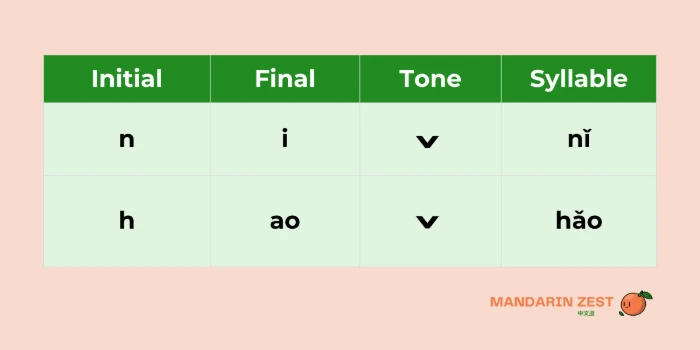
1. Initials (consonant sounds)
These are the consonant sounds that start most Mandarin syllables. Think of them like the “starting sounds” in English words.
Examples: b, p, m, f, d, t, n, l, g, k, h, j, q, x…
2. Finals (vowel sounds)
These are the vowel sounds that make up the main part of the syllable, like the “middle and end sounds” in English.
Examples: a, o, e, i, u, ü, ai, ei, ao, an, ang…
3. Tones: the most important part
This is the most important part of pinyin! Mandarin is a “tonal language,” which means the same sound can mean completely different things depending on how you say it (high, low, rising, falling). There are 4 main tones + 1 neutral (light) tone, here’s how to remember them:
- First tone: High and steady (like saying “mā” with a flat voice—think of a straight line!)
- Second tone: Rising (like saying “má” as if you’re asking a question—your voice goes up!)
- Third tone: Fall-rise (like saying “mǎ”—your voice goes down first, then up!)
- Fourth tone: Falling (like saying “mà” firmly—your voice goes down quickly!)
- Neutral tone: Light and short (like saying “ma” softly—no emphasis!)
Let’s use a simple example to see how tones change meaning:
- mā (妈) = mother (first tone—flat and steady)
- má (麻) = hemp (second tone—rising, like a question)
- mǎ (马) = horse (third tone—fall then rise)
- mà (骂) = scold (fourth tone—falling, firm)
Do You Really Need Pinyin?
Let’s cut to the chase: Pinyin is the most important and most useful tool in learning Chinese. It’s not just a “nice-to-have”, it’s a must-have that simplifies every step of your Mandarin journey. Here’s why it matters so much:
1. To learn correct pronunciation
Pinyin takes the guesswork out of pronunciation, even if you don’t know how to write the exact Chinese characters, knowing their pinyin lets you say them correctly and express yourself clearly.
When you’re learning a new character, mastering its pinyin is the first step: it teaches you how to speak and read the character, laying the groundwork for building your vocabulary. Skipping pinyin means you’ll likely develop bad pronunciation habits that are hard to break, making it harder for native speakers to understand you.
2. To type Chinese easily
Every modern Chinese keyboard uses pinyin and typing Chinese with pinyin is almost the same as typing English, since both use the Latin alphabet you already know.
Even better, there’s a fun and helpful quirk: Chinese has many homophones (words that sound the same but have different meanings and characters), so if you don’t know the exact characters, just typing the pinyin is often enough for native Chinese speakers to understand you.
For example, if you know “nihao” means “hello” but can’t remember the characters 你好, Chinese people will still know what you mean and you don’t even need to get the tones right in this situation!
3. To look up words quickly
IStuck on a new word during your learning journey? Most Chinese dictionaries (including popular apps) use pinyin for searching. If you only know what a character looks like but don’t know its pinyin, you’ll struggle to find its meaning. But with pinyin, you can look up any word in seconds, making it easy to expand your vocabulary and keep your learning on track.
4. To avoid misunderstandings
We mentioned Chinese has many homophones, and that’s where pinyin (and its tones) becomes crucial. Mastering pinyin’s tones helps you avoid mix-ups that could lead to awkward or confusing moments.
For example, the wrong tone can turn “mother” (妈 mā, first tone) into “scold” (骂 mà, fourth tone)—a big difference! Pinyin teaches you to hear and say tones correctly, so you can communicate clearly and avoid misunderstandings.
Final Thoughts: Pinyin Is Non-Negotiable for Mandarin Learners
Pinyin is the most important and useful tool for learning Chinesewith no exceptions. It’s not optional; it’s essential to your success.
Pinyin allows you to pronounce right, to type effortlessly, solving the biggest pain points of Mandarin learning. It’s not a crutch; it’s the foundation that makes every step faster and smoother.
Skip it, and you’ll slow your progress; master it, and you’ll unlock every aspect of the language.
FAQ
Pinyin is the official way to write Mandarin sounds using the 26 Latin letters (the same as English), with most letter pronunciations similar to English. It’s the most important tool for learning Chinese.
It’s possible, but it’s much harder and slower. You’ll struggle with pronunciation, typing Chinese (since keyboards use pinyin), and looking up new words. Pinyin makes all these easier and speeds up your learning.
If you master the alphabet, you can usually learn Pinyin within a week. Because it is very similar to the alphabet, you basically only need to learn tones, the main new thing about it!
Even if you don’t know the alphabet well, you can usually grasp the basics of Pinyin within two weeks.

Xinyan Gong
Xinyan, originally from Xiamen, focuses on SEO and content creation, with experience in optimizing online content and developing engaging digital materials. She is committed to improving online visibility and delivering high-quality, targeted content.