
You sit down to write your first Chinese character. You stare at it. It has lines going in every direction — horizontal, vertical, diagonal, curving — and you have no idea which one comes first.
Most beginners do what feels natural: start from the top-left, roughly, and hope for the best. The result looks almost right but slightly off, like a photocopy of a photocopy. And more importantly, it takes much longer than it should.
Here's the thing: Chinese stroke order isn't random. It follows a clear set of rules, and once you know them, you don't need to memorise the stroke order of every character individually. You can work it out. This guide gives you those rules — all of them, with examples — plus the foundational knowledge of stroke types that makes everything click.
What Is Stroke Order (笔顺, Bǐshùn)?
Stroke order (笔顺, bǐshùn) is the standardised sequence in which the individual strokes of a Chinese character are written. Every character has a "correct" order, and while minor regional variations exist, the rules governing that order are consistent and learnable.
A stroke is a single, continuous movement of the pen — from when it touches the paper to when it lifts. Some strokes are simple (a straight horizontal line), others more complex (a vertical line with a hook at the bottom), but each one is a single, unbroken motion.
Why does the order matter? Three reasons.
Speed. The rules follow the natural movement of the hand, reducing backtracking and awkward wrist rotations. Students who master stroke order can write characters faster and with less effort — especially helpful during exams or timed assignments. Teachers often notice that students who ignore stroke order struggle with fatigue during long writing tasks, as their hands have to work harder to correct mistakes or adjust to unnatural movements.
Memory. Writing a character in the correct sequence reinforces the visual shape in your memory. The order creates a kind of motor memory — your hand learns the character, not just your eyes.
Recognition. Handwriting recognition on phones and tablets — a genuinely useful tool for looking up unfamiliar characters — relies on correct stroke order to identify what you're writing. Wrong order, wrong character.
Learn Chinese Characters the right way!
Chinese characters are often seen as one of the most intimidating parts of learning Mandarin. This guide was created to change that.
The 8 Basic Stroke Types: Your Building Blocks
Before you learn the rules, you need to know what strokes actually are. There are 41 basic and compound Chinese strokes, but they are generally categorised into eight types, also known as the 永字八法 (yǒngzìbāfǎ — the Eight Principles of Yong). This name comes from the fact that the character 永 (yǒng, "eternal") contains all eight basic stroke types. It's the perfect training character — practice 永 correctly and you've practised every stroke at once.
Here are the eight strokes:
| Stroke | Chinese | Pinyin | Description |
|---|---|---|---|
| Horizontal | 横 | héng | Left to right, slight upward angle |
| Vertical | 竖 | shù | Top to bottom, straight down |
| Left-falling | 撇 | piě | Top-right to bottom-left, sweeping |
| Right-falling | 捺 | nà | Top-left to bottom-right, with a weighted foot |
| Dot | 点 | diǎn | Short, decisive downward flick |
| Turning | 折 | zhé | Changes direction in one continuous motion |
| Hook | 钩 | gōu | Added at the end of another stroke, flicks upward |
| Rising | 提 | tí | Short diagonal rising from lower-left to upper-right |
The horizontal stroke (héng) is drawn from left to right with a slight upward angle — it is rarely perfectly flat. The rising stroke (tí) rises from lower-left to upper-right, like a sharp diagonal moving upward. It appears most commonly inside the left component of a character. Notice that 土 written alone ends in a flat horizontal, but 土 as a left radical ends in a rising tí instead.
Many beginners are surprised to learn that what looks like a complex character is really just five or six of these basic strokes, stacked and combined. Once you can identify the strokes in a character, working out the order becomes logical — not guesswork.
The 8 Rules of Chinese Stroke Order
These rules apply the vast majority of the time. There are rare exceptions, but if you follow these consistently, you'll be correct for more than 95% of characters you encounter.
Rule 1: Top to Bottom (从上到下, Cóng Shàng Dào Xià)
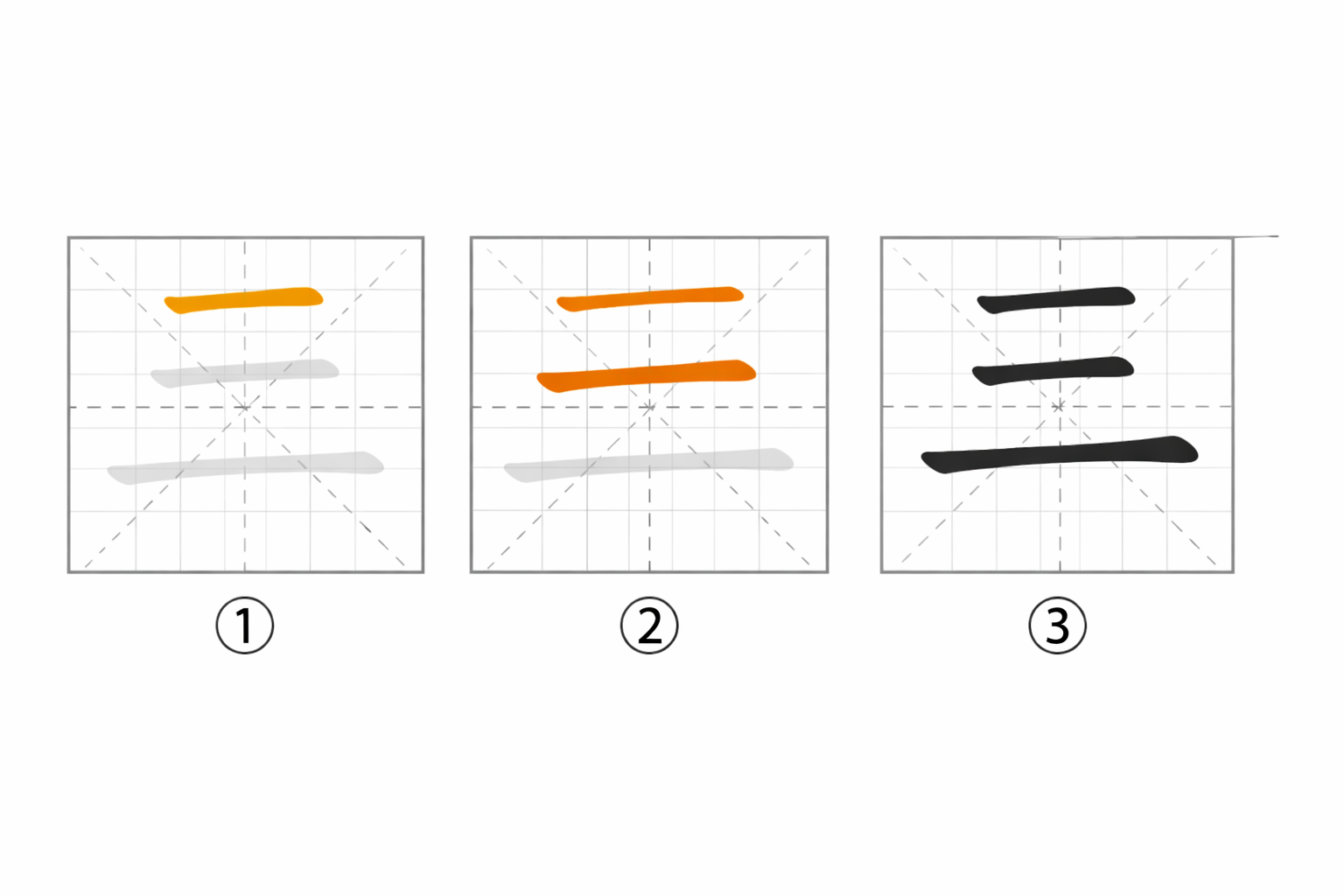
The most basic rule in Chinese writing is to start at the top of a character and work downwards. This approach creates a natural balance in the character structure. For example, in the character 三 (sān, meaning "three"), each horizontal stroke is drawn in sequence from top to bottom.
Examples:
- 三 (sān, three): stroke 1 → stroke 2 → stroke 3, each horizontal line from top to bottom
- 王 (wáng, king): three horizontals top to bottom, then the vertical through the middle
- 土 (tǔ, earth): top horizontal → bottom horizontal → vertical
This rule is the most universal. When in doubt, start at the top.
Rule 2: Left to Right (从左到右, Cóng Zuǒ Dào Yòu)
Strokes are written from left to right, mirroring the way many scripts are read. This rule is applied in characters such as 你 (nǐ, "you"), where the left radical is drawn first before completing the strokes on the right.
Examples:
- 川 (chuān, river): left vertical → middle vertical → right vertical
- 们 (men, plural marker): left radical 亻 first, then the right component 门
- 明 (míng, bright): left component 日 (sun) → right component 月 (moon)
When a character has clearly separated left and right components, always complete the left side before touching the right.
Rule 3: Horizontal Before Vertical (先横后竖)
When a character contains both horizontal and vertical strokes, always start by writing the horizontal strokes first, followed by the vertical ones. This rule applies in most cases, such as in the character 十 (shí), where the horizontal stroke comes before the vertical stroke.
Examples:
- 十 (shí, ten): horizontal → vertical
- 王 (wáng, king): all three horizontals → the vertical through the middle
- 大 (dà, big/large): horizontal → left-falling → right-falling
The logic here is that horizontal strokes form the "skeleton" of the character's width — it's easier to judge where to place the vertical once the horizontal baseline is established.
Rule 4: Left-Falling Before Right-Falling (先撇后捺)
For diagonal strokes, the right-to-left diagonal (撇, piě) is written before the left-to-right diagonal (捺, nà). This helps maintain even character spacing. For example, in 人 (rén, person), the left diagonal stroke is written first, followed by the right diagonal stroke. In 八 (bā, eight), the first stroke is the right-to-left diagonal, followed by the left-to-right diagonal.
Examples:
- 人 (rén, person): left-falling piě → right-falling nà
- 文 (wén, language/culture): horizontal → left-falling → right-falling
- 父 (fù, father): left-falling → right-falling → two dots
Think of it as the pen naturally sweeping left first, then completing the rightward stroke.
Rule 5: Outside Before Inside (先外后内)
When a character has an enclosing structure — such as a box or frame — the enclosing strokes are generally written before the enclosed content. This ensures that the frame is neatly laid out before the interior is filled in.
Examples:
- 月 (yuè, moon/month): the left and top strokes (the frame) → then the two horizontal strokes inside
- 同 (tóng, same): outer frame → inner content
用 (yòng, to use): outer frame → inner strokes
Rule 6: Enter Before Closing (先进后关)
This is a refinement of Rule 5, specifically for fully enclosed characters — those where a stroke "closes" the bottom of a box. For the basic framing component 囗 (wéi), first do a top-to-bottom stroke, then draw a right angle, and finally finish it off by closing out the bottom. Since you do the closing stroke last, you first complete the enclosed component in the box before sealing it up.
Examples:
- 口 (kǒu, mouth): left side → top and right side → bottom closing stroke
- 国 (guó, country): outer frame top and sides → all inner content → bottom closing stroke
- 日 (rì, sun): outer frame → inner horizontal → bottom closing stroke
The mnemonic: think of it like packing a box. You fill it before you tape it shut.
Rule 7: Centre Before Sides (先中间后两边)
For vertically symmetrical characters, the central component is written first, followed by the elements on the sides. This rule helps ensure even spacing and proportion. For example, in 小 (xiǎo, small), the centre stroke is written first, followed by the two side dots.
Examples:
- 小 (xiǎo, small): centre vertical hook → left dot → right dot
- 水 (shuǐ, water): central vertical → left strokes → right strokes
- 山 (shān, mountain): centre vertical → left vertical → right vertical
This rule ensures the character is visually balanced — if you drew the sides first, there'd be no anchor to space them around.
Rule 8: Dots and Minor Strokes Last
Smaller elements, such as dots, are added last to avoid interference with the main strokes. For instance, in 玉 (yù, jade), the small dot is added only after the main strokes. This order emphasises the primary structure before finishing with finer details.
Minor strokes at the top or top-left of the character are written first, but any minor strokes on the inside of the character, or in the upper-right portion, are written last.
Examples:
- 玉 (yù, jade): all main strokes → final dot
- 我 (wǒ, I/me): main strokes → final dot
发 (fā, to send): main strokes → top-right dot last
Learn Chinese Characters the right way!
Chinese characters are often seen as one of the most intimidating parts of learning Mandarin. This guide was created to change that.
Putting It All Together: Reading a Character You've Never Seen
Let's apply the rules to a character you may not know yet: 爱 (ài, love).
It looks complex. But break it down:
- Top component comes first (Rule 1 — top to bottom): the 爫 part at the top
- Middle section next: the 冖 cover stroke, then 心 (heart) inside it (Rule 5 — outside before inside)
- Final strokes: the two dots on the bottom of 心 come last (Rule 8 — minor strokes last)
You haven't memorised the stroke order of 爱. You worked it out from the rules. That's the goal.
Common Mistakes Beginners Make (And How to Avoid Them)
Guessing instead of applying rules. When you don't know the stroke order of a character, don't guess randomly — apply the rules above in priority order. Top to bottom, left to right. That alone will get you close on most characters.
Skipping stroke order practice altogether. Many beginners focus entirely on vocabulary and reading, treating character writing as optional. Even if you never plan to write by hand in daily life, the motor practice of tracing stroke order dramatically improves how quickly you visually recognise characters when reading.
Treating all strokes as individual lines. Remember that hooks, turns, and rising strokes are single continuous movements — not two separate strokes. 竖钩 (shù gōu, vertical with hook) is one stroke, not a vertical and then a separate hook.
Not using a grid. Practicing characters without the 田字格 (tiánzìgé) grid is like practising handwriting without lines. The four-quadrant grid trains you to centre and proportion characters correctly. Our [character writing practice book] includes pre-printed grids for every HSK 1 and 2 character.
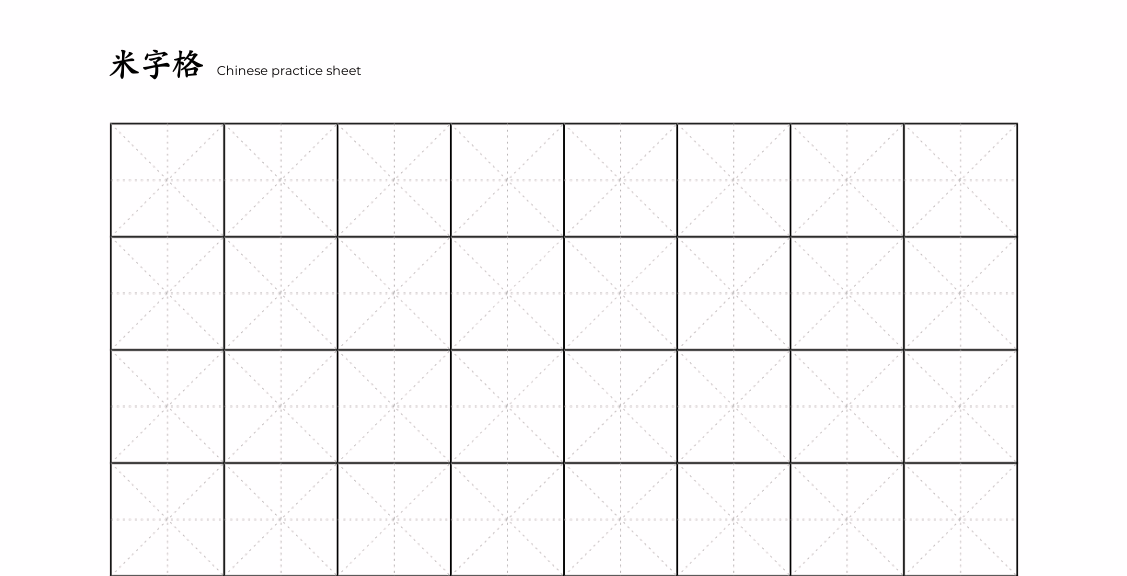
Download practice sheets for free:
chinese_practice_sheets_light_dotted.pdf.pdf
How to Practice Stroke Order Effectively
Start with high-frequency characters. Don't try to learn the stroke order of 3,000 characters. Focus on the 150 characters in HSK 1 — the most commonly used and the foundation of everything else. Master those, and the rules become automatic.
Write each character three to five times, in order. Once for learning, once for checking, and once to feel it become natural. More than five and you're drilling without absorbing.
Use resources that show stroke order, not just characters. A character written on a flashcard tells you nothing about stroke order. Use animated resources like Skritter or the stroke-order animations in Pleco, or a physical guide like the [Mandarin Zest character writing practice book] which shows stroke sequences step by step.
Check yourself with phone handwriting recognition. Draw a character using your finger on your phone keyboard (most Chinese input apps support this). If the phone recognises what you wrote, your stroke order was probably correct. If it outputs the wrong character, your order is off.
Your Stroke Order Quick-Reference Sheet
| Rule | When it applies | Example |
|---|---|---|
| Top before bottom | Always | 三 (three): top stroke first |
| Left before right | Multi-component characters | 明 (bright): 日 before 月 |
| Horizontal before vertical | Intersecting strokes | 十 (ten): — before | |
| Left-falling before right-falling | Diagonal pairs | 人 (person): 丿 before 乀 |
| Outside before inside | Enclosing frames | 月 (moon): frame before inner strokes |
| Fill before closing | Fully enclosed characters | 国 (country): inner content before bottom line |
| Centre before sides | Symmetrical characters | 小 (small): centre hook first |
| Main strokes before minor | Dots and small elements | 玉 (jade): dot added last |
Our HSK 1 Materials
Are you planning to take the HSK 1 exam? Check out our dedicated materials, designed by teachers for learners.