
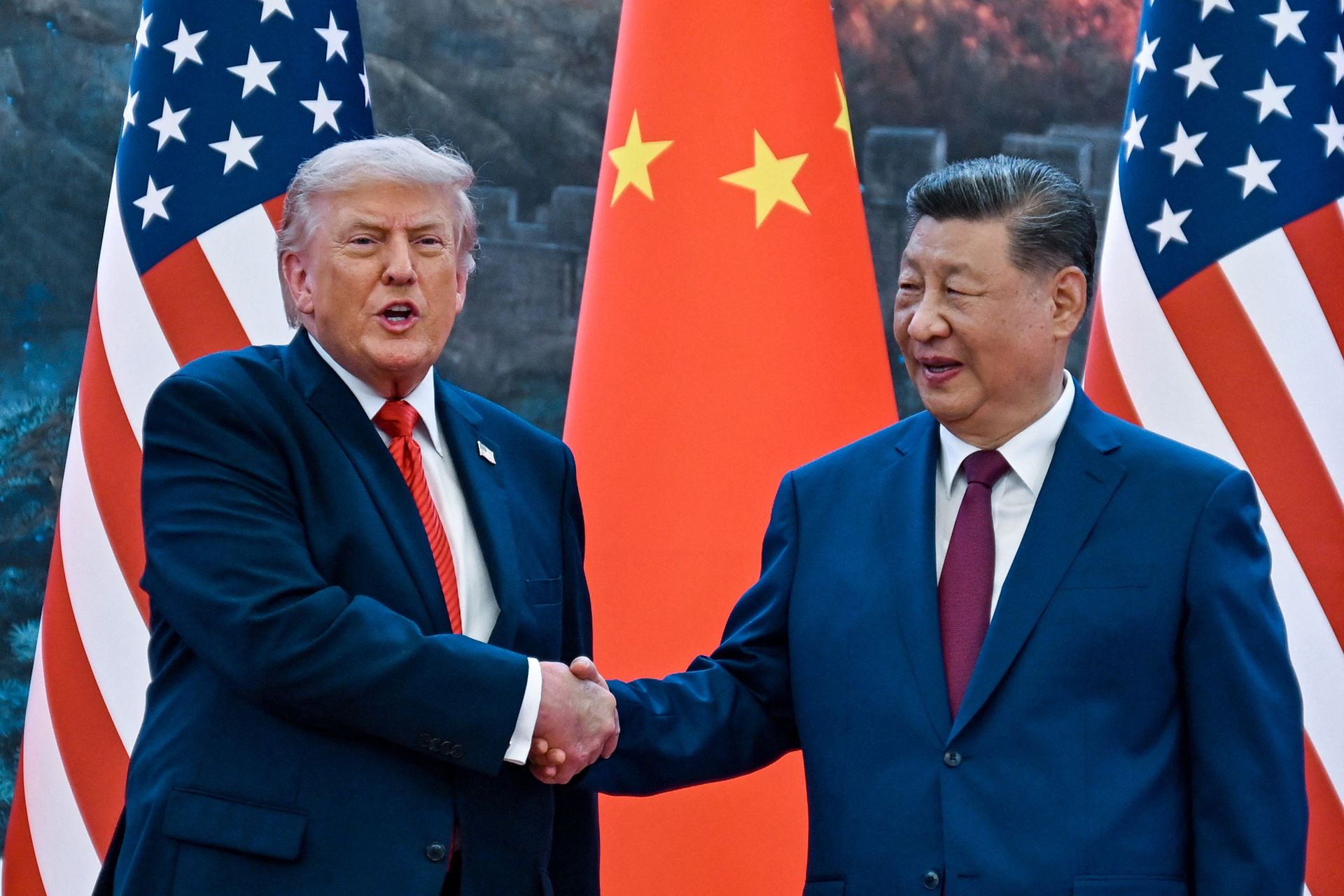
When US President Donald Trump touched down in Beijing on May 13, 2026 — greeted by Chinese Vice President Han Zheng, 300 uniformed schoolchildren chanting "Welcome" in Mandarin, and skyscrapers lit up with Chinese characters — the symbolism was hard to miss. The world's two most powerful nations, whatever their frictions, cannot stop talking to each other. And in a world shaped by that conversation, Mandarin is fast becoming one of the most strategic skills a person can possess.
This isn't an abstract prediction. It's playing out in boardrooms, embassies, supply chains, and job listings right now. If you've been on the fence about learning Mandarin, 2026 is the year to get off it. Here are ten compelling reasons why.
Join the Mandarin Zest Club
Join the Mandarin Zest Club and become part of a welcoming international community of Chinese learners from all over the world. Practice together, stay motivated, and connect with people who share your goals for learning Mandarin.

1. The Trump-Xi Summit Just Reminded the World That China Is Unavoidable
In May 2026, Trump made a high-profile state visit to Beijing — his first to China during his second term — accompanied by 17 of America's most powerful CEOs, including Nvidia's Jensen Huang. The message was unmistakable: regardless of tariff wars, chip export restrictions, and geopolitical rivalry, the US business community cannot afford to disengage from China.
Total bilateral goods trade between the US and China reached a record $759 billion in 2025, up 4.2% year-on-year, even amid years of "decoupling" rhetoric. Tesla's Shanghai Gigafactory produced over 950,000 vehicles that year — more than half the company's global output. Boeing estimates China will need 8,500 new commercial aircraft over the next 20 years, representing a $1.4 trillion market opportunity.
A bipartisan US Senate delegation led by Senator Steve Daines had already visited Beijing in early May, the first such group since Trump took office. Mandarin-speaking professionals who can navigate this relationship — in trade, diplomacy, technology, or finance — are precisely the people both sides are looking for.
2. China Is the World's Second-Largest Economy — and Still Growing
China's GDP surpassed 140 trillion yuan ($20 trillion) for the first time in 2025, growing at 5% year-on-year and meeting its official target. The country accounted for an estimated 30% of world economic expansion that year, making it the single largest contributor to global growth. Goldman Sachs raised its forecast for China's 2026 real GDP growth to 4.8% — well above consensus estimates.
To put it plainly: China is the world's second-largest economy, and it is not going anywhere. Any industry with global exposure — finance, logistics, manufacturing, technology, energy, agriculture — has significant China exposure by definition. Professionals who speak Mandarin have direct access to the world's most consequential economic story.
3. The Belt and Road Initiative Has Woven Chinese Into 150 Countries
China's Belt and Road Initiative (BRI) — the most ambitious infrastructure programme in modern history — now spans 150 countries, representing nearly 75% of the world's population and over half of global GDP. In the first half of 2025 alone, Chinese companies signed BRI construction contracts worth $66.2 billion and invested a further $57.1 billion in projects across Asia, Africa, Europe and beyond — the highest six-month engagement ever recorded.
Africa saw the largest surge, with Chinese construction engagement reaching $30.5 billion in H1 2025 — five times the figure from H1 2024. By the end of 2025, cumulative BRI investment had reached $1.39 trillion. Hundreds of ports, railways, industrial zones, power grids, and digital corridors built by Chinese firms are now operating from Kenya to Kazakhstan, from Indonesia to Serbia.
Wherever the BRI operates, Mandarin is the language of the contractor, the engineer, the financial terms, and the negotiating table. For anyone working in infrastructure, energy, logistics, or international development, Mandarin is increasingly the language of work — not just an academic curiosity.
4. Mandarin Is a Direct Salary Multiplier
The job market has started pricing Mandarin fluency into compensation in measurable ways. Professionals with business-level Mandarin are seeing 15–25% higher compensation than their monolingual counterparts, according to LinkedIn's Global Workforce Survey. The same data suggests Mandarin-speaking professionals experience 74% faster career advancement — and three times more international assignment opportunities.
Specialist roles in AI and technology requiring Chinese language skills increased by 47% in recent years, and Chinese language proficiency is now becoming mandatory for 38% of senior roles in multinational corporations with China operations. On Glassdoor, over 9,000 US-based job listings currently require Mandarin — spanning finance, law, healthcare, technology, logistics, and media.
The skill gap is real: demand for Mandarin-speaking professionals consistently outpaces supply in Western markets. That gap is your competitive advantage.
5. China Leads in Technology — and Mandarin Unlocks That World
China is no longer just manufacturing the world's goods — it's designing them. Chinese tech companies including Huawei, ByteDance (TikTok), BYD, and DeepSeek are global players reshaping their industries. DeepSeek's AI model, which sent shockwaves through Silicon Valley in early 2025, was so significant that the US State Department issued a diplomatic cable warning about it.
China and Taiwan together dominate global semiconductor supply chains. Chinese companies lead the world in electric vehicle production, solar panel manufacturing, battery technology, and 5G infrastructure. If you work in engineering, product development, supply chain, or technology policy, speaking Mandarin gives you direct access to the most dynamic innovation ecosystem on the planet — without relying on intermediaries or translations.
Join our discord server!
Join the Mandarin Zest community on Discord. Discover Chinese pop culture and internet trends, chat with fellow learners, and interact with teachers and fluent moderators.

6. Mandarin Is the Most Spoken Language in the World
With approximately 1.1 billion native speakers, Mandarin Chinese is the most widely spoken language on Earth by native speaker count. Beyond mainland China, significant Mandarin-speaking populations live in Taiwan, Singapore, Malaysia, Indonesia, and throughout the Chinese diaspora in North America, Europe, and Southeast Asia.
That's over a billion potential customers, partners, colleagues, and clients — all more accessible if you can speak to them in their own language. No AI translation tool, however impressive, replaces the trust, nuance, and relationship depth that comes from a conversation in someone's native tongue.
7. China's Cultural Influence Is Going Global
Chinese culture — film, music, gaming, cuisine, literature, fashion — is reaching global audiences at an unprecedented scale. Chinese games like Genshin Impact have accumulated hundreds of millions of players worldwide. Chinese short-form video, driven by TikTok's parent company ByteDance, has fundamentally changed how the world consumes content. Chinese streaming platforms are producing dramas with international fanbases.
Understanding China's cultural output from the inside — reading the original texts, watching without subtitles, understanding the references — enriches the experience dramatically. It also opens up creative and media careers that are growing fast: content localisation, international marketing, cross-cultural consultancy, and cultural diplomacy are all fields where Mandarin fluency is a rare and valuable asset.
8. Learning Mandarin Makes You Cognitively Sharper
This is the benefit that doesn't show up on a CV but pays dividends for life. Mandarin is structurally unlike any European language. It is tonal — meaning the same syllable in different tones carries entirely different meanings. It uses a logographic writing system with thousands of characters. It builds words through compound logic rather than conjugation or declension.
Research consistently shows that learning a language this different from your native tongue builds cognitive flexibility, working memory, and attention control. The mental effort required to master tones, characters, and an entirely alien sentence structure trains the brain in ways that simpler language study cannot. People who speak Mandarin as a second language are, in a measurable sense, exercising mental muscles most people never use.

9. It's Never Been Easier to Learn
A decade ago, serious Mandarin study required a classroom, an expensive tutor, or a stint living in China. Today, the ecosystem for language learning is extraordinary. Apps like HSK Online, Duolingo Chinese, HelloChinese, and Pleco offer structured learning from beginner to advanced. Platforms like iTalki connect learners with native-speaking tutors anywhere in the world at low cost. YouTube is full of native-content immersion material. AI conversation partners can now simulate real dialogue at any level, giving learners speaking practice on demand.
For dedicated learners, the Foreign Service Institute estimates around 2,200 hours to reach professional working proficiency in Mandarin — challenging, but not impossible. Many learners reach conversational fluency in 18–24 months of consistent daily study. The tools available today make that journey faster, cheaper, and more enjoyable than it has ever been.
10. The World Is Becoming Multipolar — and Mandarin Is the Language of That Shift
Perhaps the most important reason of all. The post-Cold War era of unipolar American dominance is giving way to a more complex, multipolar world in which China is a primary node. The APEC summit hosted in China in 2026 — which drew a US delegation to Shanghai and Suzhou — is one of many signs that global governance, trade architecture, and multilateral diplomacy are increasingly shaped by Beijing.
The African Union, ASEAN, the SCO, the BRICS grouping — these are the forums shaping the 21st century for billions of people, and China is central to all of them. Professionals who understand China from the inside — its language, its logic, its cultural framework — are positioned to operate in this new world in ways that monolingual Western professionals simply cannot.
Mandarin is not just a career asset. It is a lens through which to understand the most consequential geopolitical story of our era.
Our HSK 1 Materials
Are you planning to take the HSK 1 exam? Check out our dedicated materials, designed by teachers for learners.
The Bottom Line
From the state visit in Beijing to the record-breaking Belt and Road contracts, from DeepSeek's AI disruption to the $759 billion US-China trade relationship, 2026 is making the case for Mandarin louder than ever. It is the language of the world's most populous nation, its most dynamic manufacturing base, its most active infrastructure investor, and one of its two dominant geopolitical powers.
The question is no longer whether Mandarin matters. It's whether you want to be part of the world that speaks it.
加油。(Jiā yóu. — Go for it.)