
The question lands in Chinese learning communities constantly, and the answers tend to cluster at two unhelpful extremes: influencers claiming you can achieve "fluency" in twelve weeks, and skeptics insisting it takes decades of immersion before you'll say anything useful.
Both are wrong, and both miss the more interesting question underneath: three months of what, exactly? Three months of passive Duolingo, or three months of deliberate, structured daily study? Three months aiming for conversational fluency, or three months aiming to read your first graded reader? The target matters as much as the timeline.
Here's an honest attempt at the real answer — what three months of serious Chinese study can and cannot produce, what the research actually says, and how to make the most of twelve weeks if you're committed to spending them well.
What the FSI Data Actually Says
The U.S. Foreign Service Institute, which trains diplomats in dozens of languages, classifies Mandarin Chinese as a Category IV language — the hardest category, alongside Arabic, Japanese, and Korean. Their estimate for professional working proficiency: approximately 2,200 hours of study.
That number is not a reason to despair. It's a reason to calibrate.
If you study for three hours every day for three months, you'll accumulate roughly 270 hours. That's 270 hours out of the approximately 2,200 the FSI suggests for professional working proficiency — about 12% of the journey, if you're counting toward that standard.
But 270 hours is also a genuinely significant amount of time. The question is what 270 deliberate hours of Chinese study actually produces — and the answer is: more than most people think, provided those hours are spent well.
New to Chinese? Start Here.
The no-fluff roadmap for absolute beginners — what to learn first, what to skip, and how to actually stick with it past week two.
What Three Months Can Realistically Produce
Solid HSK 1–2 foundation
The New HSK 1 vocabulary list covers 500 words. HSK 2 extends to 772 words. Combined, that's the core vocabulary of everyday Chinese — greetings, numbers, time, family, food, transport, basic descriptions.
At a pace of 10 new vocabulary items per day, you cover HSK 1 in 50 days and HSK 2 in another 77. Three months of consistent vocabulary work gets you through both lists with time for review. The free New HSK vocabulary lists give you the full word set in frequency order.
Functional tones and pronunciation
Three months is enough to develop solid tonal awareness — not perfection, but the ability to distinguish and produce the four tones with reasonable accuracy. This matters because tones in Mandarin aren't decoration. They're the primary carrier of meaning. Getting them right from the start is significantly easier than correcting bad habits later.
Basic character recognition
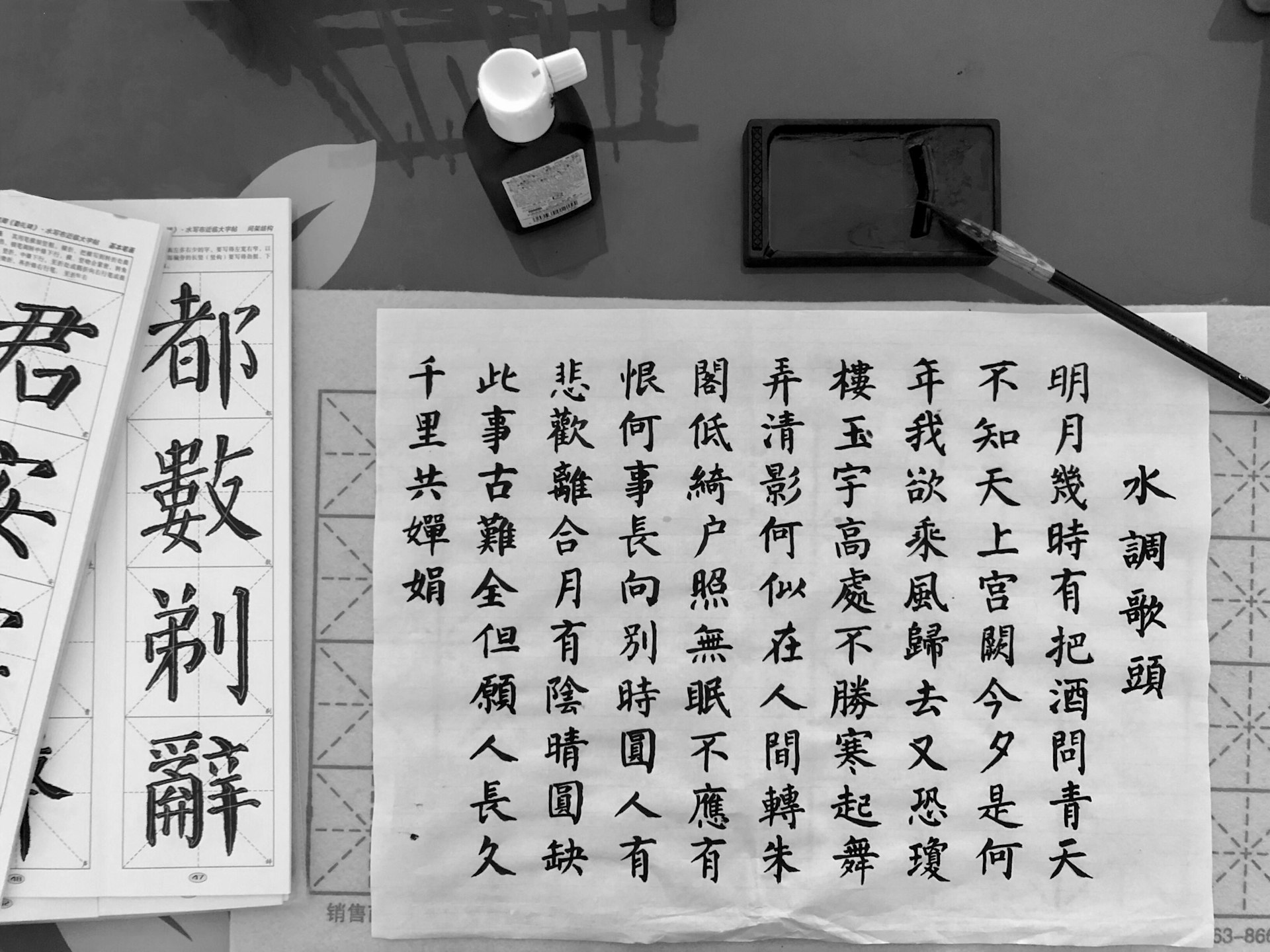
At ten characters a day, you can learn 900 characters in three months — comfortably covering everything in HSK 1–2 and beginning HSK 3. This won't make you a reader of native content, but it gives you the foundation that everything else builds on. The character learning approach that actually works — understanding radicals rather than memorising arbitrary shapes — makes this rate achievable for most learners.
Basic conversational survival phrases
Greetings, introductions, asking for directions, ordering food, numbers, telling the time, expressing basic preferences. Three months of consistent speaking practice produces genuine survival-level conversational ability. You won't be discussing philosophy. You will be able to navigate a Chinese city, have a short conversation with a native speaker, and hold your own in the basic social exchanges of everyday life.
A reading start, not reading fluency
This one is worth being precise about. Matthew McKeever's Medium essay — probably the most honest account of what three months of character study produces — found that 600 words gave him access to simple literary texts in parallel translation, in roughly the same way a rusty French learner can follow Molière with an English crib. That's genuinely meaningful. It's not independent reading. It's a foothold.
What Three Months Cannot Produce
Fluency
"Fluency" is used so loosely it's nearly meaningless, but if it means the ability to have extended, comfortable conversations on a range of topics without significant strain — three months won't get you there in Mandarin. The cognitive processing load of Mandarin (tones, characters, unfamiliar grammar structures) makes it one of the hardest languages for native English speakers to achieve conversational fluency in, and three months is genuinely not enough time for most people.
Anyone claiming otherwise is usually either redefining fluency to mean something very minimal, or working at a pace most people can't sustain while holding down a normal life.
Comfortable independent reading
Three months gives you characters. It doesn't give you reading fluency. Reading Chinese at speed — taking in characters without deliberate decoding effort — requires significantly more exposure than twelve weeks produces. Graded readers are where this begins to develop, but developing it takes considerably longer than three months.
Automatic listening comprehension
Listening to native-speed Mandarin and understanding it without strain is one of the last skills to develop. Three months will give you some listening ability. It won't give you comfortable comprehension of natural conversation or media.

The Honest Numbers: What Does "Three Months" Actually Mean?
This depends entirely on hours per day, which most "three months" claims are vague about.
30 minutes a day: 45 hours total. Enough to learn basic pronunciation and maybe 300 words. Not enough to build any real foundation.
1 hour a day: 90 hours. You'll have solid HSK 1 vocabulary, basic tones, and some character recognition. A genuine start.
2 hours a day: 180 hours. This is where meaningful progress happens. Solid HSK 1–2 foundation, several hundred characters, basic conversational ability.
3+ hours a day: 270+ hours. This is what intensive study programs produce in a semester. Real foundation for continued learning. Approaching HSK 2–3 depending on how effective the hours are.
The claim that you can "learn Chinese in 3 months" is almost always describing the 3-hour-a-day version, and often written by someone with prior language learning experience, more time than average, and unusually high motivation. It's not impossible. It's not typical.
What Actually Determines Three-Month Progress
The research on language learning consistently shows that outcomes vary less by total hours than by the quality of those hours and the learner's consistency. Three months of mediocre daily study beats three weekends of intense cramming. And what separates effective study from ineffective study for Mandarin specifically:
Characters from day one. Waiting until "later" to learn characters is the single most common delay strategy and the most costly. Start them immediately. The stroke order rules and the character writing practice need to be part of the routine from week one, not week six.
Spaced repetition, not cramming. Vocabulary learned and reviewed with spaced repetition is retained. Vocabulary crammed and not reviewed fades within days. Anki (free) does this automatically — it's the most efficient vocabulary tool available for Mandarin and the one that makes 10 characters a day sustainable.
Grammar structure, not just vocabulary. The 15 essential grammar structures for beginners are what allow vocabulary to become sentences. A HSK 1 learner who understands these structures can produce functional Chinese. One who doesn't will have 500 words they can't combine.
Speaking output, regularly. The biggest gap in most three-month self-study accounts: solo learners do input (reading, listening, flashcards) and avoid output (speaking). This produces lopsided learners who understand more than they can say. Speaking needs to happen from the start, even badly.

The Hardest Part: Month Two
Almost every serious account of early Mandarin study describes the same inflection point: somewhere in week four to six, the early excitement fades, the characters start blurring together, and the gap between what you know and what you'd need to know to do anything interesting with the language becomes apparent.
This is the wall. Most people who "tried Chinese for a few months" stopped here.
The learners who get through it are not the ones with the most natural aptitude. They're the ones with something external keeping them accountable: a study partner, a group, a fixed commitment in their week. The motivation-building research is consistent: people who learn languages with communities significantly outperform solo learners on long-term retention and persistence, largely because the community provides the accountability that gets them through the hard middle.
This is exactly the problem the Mandarin Zest Club is designed to solve. Two to four structured group study sessions per week, organised by level, with vocabulary lists and grammar focus prepared for each session. Fixed points in the week where you're using Chinese with other people — which is both the most effective practice and the hardest thing to arrange alone. The first three months of Chinese study are when community matters most, because they're when motivation is most likely to fail.
Join the Mandarin Zest Club
Join the Mandarin Zest Club and become part of a welcoming international community of Chinese learners from all over the world. Practice together, stay motivated, and connect with people who share your goals for learning Mandarin.

A Realistic Three-Month Plan
If you're committed to spending three months seriously on Mandarin, here's what a realistic high-effort plan looks like.
Week 1–2: Foundation
- Learn pinyin and all four tones before anything else
- Start 10 new vocabulary words per day from the HSK 1 list
- Begin stroke order practice — write each character you learn by hand
- Learn to introduce yourself and the numbers
Week 3–6: Core vocabulary build
- Continue 10 new words daily, add daily Anki review of everything learned
- Work through basic grammar structures — subject-verb-object, time expressions, 不 vs 没
- Start 15 minutes of listening practice daily (HSK 1 level audio)
- Add at least one speaking practice session per week — language exchange, tutor, or study group
Week 7–10: Consolidation and first reading
- Slow new vocabulary to 8 per day, increase review of existing vocabulary
- Complete HSK 1 vocabulary; begin HSK 2
- Start your first graded reader — simple text with known vocabulary
- Increase speaking practice to 2–3 sessions per week
Week 11–12: Stress test
- Review everything from the previous ten weeks
- Attempt an HSK 1 practice test
- Try reading a simple authentic Chinese text with dictionary support
- Have a full conversation — even a basic one — with a native speaker
At the end of twelve weeks of this, done consistently: you will not be fluent. You will have a real foundation. The difference between three months done this way and three months done casually is the difference between having something to build on and starting again from scratch.
What Comes After Three Months
Three months is a good time frame for an initial commitment. It's also where most people who succeed at the beginning start asking better questions than "can I learn Chinese?" — they start asking "what do I work on next?"
The honest answer to that question is: HSK 2–3 vocabulary, your first proper graded readers, and more speaking. The full self-study roadmap covers the full arc from day one to advanced — and if you've made it through three solid months, the next six months are where things start to get genuinely interesting.
The Bottom Line
Three months of serious study produces a real HSK 1–2 foundation: functional survival vocabulary, basic tonal pronunciation, several hundred characters, and the grammatical framework to combine them.
Three months of casual effort produces: some familiarity with Chinese, the ability to read pinyin, and a handful of phrases.
Neither produces fluency. One produces a platform for the next three months, which produces the platform for the six after that. Chinese is a long game. Three months is a genuinely good start — and the only version of "learn Chinese in three months" that actually delivers anything worth having.
Our Materials
Check out our dedicated materials, designed by teachers for learners.