
It's the question every prospective Mandarin learner asks before committing: how long is this actually going to take?
And it's a question that almost everyone answers either too optimistically ("you'll be conversational in six months!") or too discouragingly ("Mandarin takes a lifetime to master"). Neither is useful. Neither is accurate.
This guide gives you the honest, research-backed answer, including realistic timelines for different goals and study intensities, the factors that speed up or slow down your progress, and a free tool to calculate your own personalised timeline.
What the Research Actually Says
The most cited data on language learning timelines comes from the US Foreign Service Institute (FSI) — the training arm of the US State Department, which has been tracking how long it takes career diplomats to reach professional working proficiency in foreign languages since the 1970s.
Their finding for Mandarin Chinese: approximately 2,200 class hours to reach professional working proficiency (roughly equivalent to CEFR C1 or HSK 5–6).
For context, French or Spanish takes around 600–750 class hours. Mandarin sits in the FSI's most demanding category — Category IV, "Super-Hard Languages" — alongside Arabic, Japanese, and Korean. It requires roughly three to four times longer than a European language to reach the same level.
That sounds daunting. But a few important caveats:
- FSI figures are for professional working proficiency — a high bar that most learners don't actually need to reach their goals
- FSI students study full-time, around 25 hours per week — so 2,200 hours translates to roughly 88 weeks of intensive study
- Most casual learners study 30–60 minutes per day, which changes the timeline dramatically but doesn't change the total hours required
- FSI data reflects classroom instruction — self-study learners often make faster progress hour-for-hour with the right materials
Realistic Timelines by Goal
Not every learner needs the same level of Mandarin. Here are honest timelines for common goals, assuming consistent daily study with structured, HSK-aligned materials:
Basic Travel and Survival Chinese (HSK 1–2)
Greetings, numbers, food, transport, simple questions and answers
| Daily study | Time to reach HSK 1–2 |
|---|---|
| 20–30 minutes | 4–6 months |
| 45–60 minutes | 2–3 months |
| 90+ minutes | 6–8 weeks |
At this level you can navigate basic situations in China, understand simple responses, and make yourself understood on everyday topics. It's a meaningful, achievable milestone — and reaching it quickly is one of the most motivating things you can do early in your studies.
Conversational Mandarin (HSK 3–4)
Comfortable daily conversation, expressing opinions, discussing most everyday topics
| Daily study | Time from zero |
|---|---|
| 20–30 minutes | 18 months – 2.5 years |
| 45–60 minutes | 12–18 months |
| 90+ minutes | 8–12 months |
HSK 4 is the level most learners describe as "conversational." You can have real, extended conversations on a wide range of topics, understand most of what native speakers say to you in everyday contexts, and read everyday Chinese text with reasonable comfort. This is also the minimum level required for undergraduate study at most Chinese universities.
Advanced / Professional Proficiency (HSK 5–6)
Near-fluent conversation, academic and professional use, complex reading
| Daily study | Time from zero |
|---|---|
| 30 minutes | 5–8 years |
| 60 minutes | 3–5 years |
| 90+ minutes | 2–3 years |
HSK 5–6 is where most learners can describe themselves as genuinely advanced. You can follow native-speed conversation, read Chinese newspapers and books without constant dictionary use, and communicate in professional or academic settings. This is the level international companies and Chinese universities typically require for non-native employees and postgraduate students.
Near-Native / Full Fluency (HSK 7–9)
Nuanced expression, classical references, professional translation-level proficiency
Realistically, 5–10+ years for most learners, even with intensive study. This level involves deep cultural knowledge, idiomatic precision, and command of classical Chinese references that even educated native speakers respect. It's the goal of translators, academics, and devoted enthusiasts — not the threshold for enjoying the language or using it professionally.
🧮 Get Your Personalised Timeline
General estimates are useful — but your timeline depends on your specific starting level, your study hours per week, and your target goal.
Enter your current level, how many hours per week you can realistically study, and your target — and the calculator gives you a personalised projection. It takes 30 seconds and is considerably more useful than a generic chart.

What Speeds Up Learning Chinese
The headline figure — 2,200 hours — is an average. What you do with those hours matters enormously. These factors consistently produce faster progress:
Starting with the right structure
The single biggest predictor of speed is whether you're following a structured, systematic curriculum or cobbling together random resources. Learners who follow the HSK framework with proper materials move through levels noticeably faster than those who drift between apps, phrasebooks, and YouTube playlists.
The HSK 1 vocabulary list gives you 500 high-frequency words in order of usefulness. A good textbook introduces them progressively with grammar explanations and listening practice. A character workbook builds the writing and recognition skills the language requires. This kind of structure compounds: every hour of study builds on the last, rather than covering disconnected ground.
Daily consistency over intensity
Language acquisition research is unambiguous on this: short, daily practice beats long, irregular sessions by a significant margin. 30 minutes every day for a year produces better outcomes than 3.5 hours every weekend for a year — even though the total time is identical.
The reason is consolidation. Sleep and time allow the brain to process and encode what you've learned. Long gaps between study sessions allow forgetting to undo your work. Daily contact with the language keeps neural pathways active and reduces the review overhead that eats into productive learning time.
Starting characters immediately
Learners who delay character study — planning to "get to it later" once they're comfortable with pinyin and spoken vocabulary — consistently take longer to reach fluency than those who learn characters from day one. Characters are not a separate module of Chinese learning; they're central to how the language is structured and how vocabulary is organised.
The good news: 500 characters, studied in frequency order with proper stroke order practice, is achievable in 6–10 weeks of daily effort. Getting this done early creates a foundation that accelerates everything that follows.
Learn Chinese Characters the right way!
Chinese characters are often seen as one of the most intimidating parts of learning Mandarin. This guide was created to change that.

Reading in context early
Most learners start reading far later than they should. Graded readers — stories written at your exact HSK level — provide the contextual exposure that turns memorised vocabulary into functional language. Fifteen minutes of graded reading per day, starting as early as HSK 2, produces measurably faster vocabulary consolidation than isolated study alone.
Immersion and real exposure
The FSI's 2,200-hour figure is for classroom instruction. Learners who supplement structured study with genuine immersion — Chinese TV, conversations with native speakers, listening to podcasts, engaging with Chinese social media — often reach conversational level faster, because immersion exposes you to natural patterns that classroom materials don't always capture.
join our discord server!
Join the Mandarin Zest community on Discord. Discover Chinese pop culture and internet trends, chat with fellow learners, and interact with teachers and fluent moderators.

What Slows Down Learning Chinese
Using the wrong tools
Apps designed for European languages — or designed primarily to keep you engaged rather than to teach — waste the hours they consume. Time spent on gamified apps that don't teach characters, don't explain grammar, and don't use HSK-frequency vocabulary is not time spent learning Chinese. It's time spent feeling like you're learning Chinese.
The specific costs: no character instruction means you can't read. No grammar means you can't construct new sentences. No systematic vocabulary means you're learning words you'll rarely encounter.
Studying without a clear vocabulary target
Chinese has tens of thousands of characters. Without a clear framework for which ones to learn first, learners waste significant time on low-frequency vocabulary while missing common words they'd encounter constantly. The HSK frequency-ordered lists solve this directly — they tell you exactly what to learn at each stage.
Inconsistency
Missing a week of study doesn't just pause your progress — it actively reverses it. Spaced repetition, which is the most effective method for vocabulary retention, works by reviewing words just before you forget them. A week without review means you'll spend the following week re-learning words you'd already covered, rather than moving forward.
Unrealistic expectations leading to discouragement
This is perhaps the most common reason learners quit. They expect conversational ability in three months, don't achieve it, and conclude they have no aptitude for languages. The problem isn't aptitude — it's the expectation.
Mandarin is a genuine multi-year commitment. Understanding that from the start, and setting intermediate goals (HSK 1 in 3 months, HSK 2 in 6 months) rather than vague fluency goals, keeps motivation alive through a long journey.
Does Your Native Language Matter?
Yes — significantly. Mandarin's 2,200-hour figure applies to native English speakers. Speakers of languages that are already closer to Chinese see meaningfully shorter timelines:
- Japanese speakers — already know thousands of Chinese characters (kanji), making reading acquisition dramatically faster
- Korean speakers — significant shared vocabulary and character knowledge (hanja), though the writing system differs
- Cantonese speakers — share the same character system; grammar and vocabulary overlap is substantial
- European language speakers — starting from further away; the 2,200-hour estimate applies most directly here
If you're a native English, French, German, or Spanish speaker, plan for the full timeline. If you're coming from Japanese or Korean, you have a meaningful head start on the character side.

A Note on "Fluency"
"How long to fluency" is a question with a frustrating answer because "fluency" means different things to different people.
If fluency means: I can have a real conversation with a native speaker on everyday topics without constant fumbling — that's roughly HSK 4, achievable in 12–24 months with consistent daily study.
If fluency means: I can watch Chinese films without subtitles and read novels comfortably — that's closer to HSK 5–6, which is a 3–5 year project for most learners.
If fluency means: I'm indistinguishable from an educated native speaker — for a non-native learner starting as an adult, that may not be fully achievable, and it's almost certainly not a useful goal for most learners.
Set a specific, level-based goal rather than a vague fluency goal. "Pass HSK 3 within 18 months" is actionable and measurable. "Become fluent" is neither.
The Right Materials Make the Timeline Realistic
Here's the practical bottom line: the timeline estimates above assume you're studying with structured, HSK-aligned materials. Learners who aren't typically take significantly longer to reach the same milestones.
For beginners starting from zero:
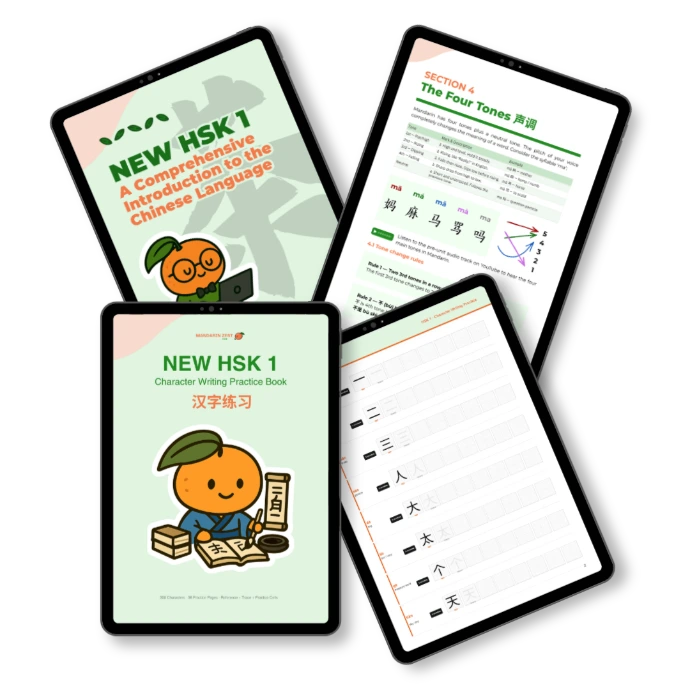
- New HSK 1: A Comprehensive Introduction — your structured textbook foundation, covering all HSK 1 vocabulary and grammar progressively
- New HSK 1: Character Writing Practice Book — daily character practice with stroke order, the piece most beginners skip and later regret
- HSK 1 Complete Learning Bundle — both together, the complete starting kit. Use code HORSEYEAR2026 for 10% off
For learners building toward HSK 3–4:
- HSK 1–2 Grammar Guide — clear, structured grammar reference for the patterns your textbook introduces
- Graded readers from HSK 3 upward — the contextual reading practice that makes vocabulary stick
Free tools:
- The complete New HSK vocabulary lists — your master reference for what to learn at each level
- Quick HSK Level Test — know exactly where you are before you plan where you're going
The best Chinese materials!
Chinese doesn’t have to be complicated
with the right tools and structure, it actually makes sense.
Final Thoughts
Learning Mandarin is a long-term commitment — longer than most people expect, and more rewarding than most people imagine.
The learners who reach genuine proficiency are not those who had the most talent or the most time. They're the ones who set realistic goals, used structured materials, studied a little every day, and kept going long after the initial excitement wore off.
The timeline is real. The path is clear. And every hour you invest compounds into something genuinely valuable.
FAQ
You can reach a solid HSK 3–4 conversational level in a year if you study 60–90 minutes per day with structured materials and genuine consistency. That's a meaningful achievement — real conversations, comfortable reading of everyday Chinese, a recognised international certification. Whether that constitutes "learning Mandarin" depends on your definition of the goal.
It's consistently ranked as one of the most challenging — alongside Arabic, Japanese, and Korean — by the FSI. But "hardest" doesn't mean "impossible." Millions of non-native speakers have reached fluency. The difficulty is a matter of degree and time, not insurmountable complexity.
For most people's schedules, 30–60 minutes of focused, structured study per day is the sustainable sweet spot. Less than 20 minutes is too little for meaningful progress. More than 90 minutes often leads to burnout for learners balancing other commitments. Consistency over months and years matters more than session length.
Significantly, yes — if you actively use Chinese rather than retreating to expat communities. Immersion in a Chinese-speaking environment adds passive exposure on top of active study, accelerates listening comprehension dramatically, and provides constant real-world practice. Learners who study in China typically reach conversational level 30–50% faster than equivalent learners at home.
No. Adult learners have real advantages over children: explicit grammar instruction works better for adults, vocabulary study is more efficient, and motivated adults can apply focused study time that children can't. The disadvantage is accent acquisition — adult learners rarely achieve a native-sounding accent — but for most goals, this doesn't matter.
Consistent daily study with structured HSK-aligned materials, from the very first week. Characters from day one. Spaced repetition for vocabulary review. Graded reading as soon as possible. Real listening exposure daily. And realistic expectations that keep motivation alive for the multi-year journey Chinese requires.