
Duolingo is probably the most downloaded language learning app in history. It's free, it's colourful, it gives you streaks and badges and little notifications that guilt you into coming back. And for Mandarin Chinese specifically, it promises to take you from zero to conversational with nothing more than a few minutes a day on your phone.
Let's talk about why that promise is, to put it kindly, optimistic.
This isn't a hit piece. Duolingo works reasonably well for some languages, particularly European ones with shared Latin roots, familiar alphabets, and structural similarities to English. But Mandarin Chinese is a different beast entirely, and the app's fundamental design philosophy collides with what learning Chinese actually requires in ways that make it, for serious learners, a genuinely poor use of time.
Here's the honest assessment.
What Duolingo Actually Is (And What It's Optimised For)
Before getting into Chinese specifically, it helps to understand what Duolingo is actually built to do.
Duolingo is a publicly traded technology company. Its business model is built on advertising revenue and premium subscriptions (Duolingo Plus/Super Duolingo). Its core metric isn't "percentage of users who become fluent", it's daily active users and time spent on the platform.
This matters because it shapes every design decision the app makes.
The gamification, streaks, leagues, experience points, the increasingly aggressive owl notifications — exists to keep you on the app, not to optimise your language acquisition. The lessons are kept short, easy, and rewarding because hard things make people quit, and people who quit don't watch ads or renew subscriptions. The feeling of progress is carefully engineered to be more satisfying than actual progress.
Think of it like a dating app. A dating app's stated goal is to help you find a relationship, but a dating app that successfully matched everyone would lose most of its users. The incentive is to keep you swiping, not to get you matched. Duolingo's incentive is to keep you tapping, not to get you fluent.
This is the lens through which to evaluate everything that follows.

The Specific Problems with Duolingo for Chinese
Most of Duolingo's limitations apply across all languages, but they hit Chinese particularly hard. Here's why.
1. It Doesn't Actually Teach You Characters
This is the most damaging flaw for Chinese specifically. Learning to read and write Chinese characters is not optional, it's foundational. Characters are how Chinese is written. They appear in every text, every sign, every phone message, every piece of written communication in Chinese. Recognising them under time pressure, in context, at reading speed, is a non-negotiable skill for anyone who wants to actually use the language.
What does Duolingo do?
It flashes characters on screen and asks you to tap the correct English translation from a multiple-choice list. It never asks you to recall a character from memory. It never teaches stroke order. It never explains how characters are built from radicals. It never drills the kind of active recognition that real reading requires.
What you develop from Duolingo character "learning" is the ability to recognise a character when it appears in a controlled, low-stakes context with the answer nearby. This is useless in the real world, and worse, it gives you false confidence that you know characters you'd fail to recognise in an actual Chinese text.
Proper character learning requires deliberate writing practice, stroke order, understanding of radical structure, and spaced repetition with active recall. Duolingo provides none of these.
2. It Doesn't Teach Grammar
Mandarin Chinese has a grammatical system that is genuinely unlike European languages. Aspect markers (了, 着, 过) replace verb tenses. Measure words are required for counting anything. Topic-prominence means sentences are structured differently from English at a fundamental level. Particles like 吧, 嘛, 啊 carry pragmatic meaning that changes entire sentences. Ba-sentences (把) express things English verbs handle differently.
None of this is explicitly taught in Duolingo. There are no grammar explanations. No rules. No structural analysis. The app exposes you to patterns through repetition and hopes you absorb them the way a child absorbs language, through immersion.
But you are not a child, you are not immersed, and you are getting 10 minutes per day of Duolingo, not 16 hours per day of Chinese-speaking caregivers. Adult language learners acquire grammar dramatically faster through explicit instruction than through pattern exposure alone. Duolingo denies you that instruction, and the result is that learners complete courses without being able to construct a sentence they haven't seen before.
3. It Doesn't Teach Natural Chinese
The sentences Duolingo teaches are famously peculiar. "The elephant drinks juice." "My turtle is sad." These are not random quirks, they're a consequence of the app's design. Duolingo needs sentences that are unambiguous in multiple-choice format, can be illustrated with simple images, and work across hundreds of languages in the same template.
The result is a vocabulary and sentence repertoire that has no resemblance to how Chinese people actually talk. Natural Mandarin is full of particles, ellipsis, implied subjects, contracted expressions, and colloquial structures that Duolingo never touches. Learners who rely on Duolingo often find that real Chinese, in films, conversations, or even simple texts from Chinese friends, is almost unrecognisable compared to what they practiced.
4. The Streak is the Product
Here is perhaps the most honest thing to say about Duolingo: the streak is not a feature that helps you learn. It is the product Duolingo is selling you.
The streak counter, that number that tells you how many consecutive days you've used the app, is psychologically engineered to become more important than the language itself. Duolingo sells "streak freezes" so you don't lose your streak when you miss a day. Losing a streak is designed to feel like genuine loss , a documented psychological effect Duolingo's designers are fully aware of and deliberately exploit.
The result is that millions of learners maintain 300-day, 500-day, 1000-day streaks doing the absolute minimum each day to preserve the number. The streak becomes the goal. The language is an afterthought. These same learners cannot hold a basic conversation in the language they've been "learning" for years.
This is not an accident. It is the design.
5. The Progress Feeling Is Not the Same as Progress
This is the most insidious problem of all. Duolingo is expertly designed to make you feel like you're learning. The sound effects, the XP notifications, the level-up animations, the "You're on fire!" messages, all of these activate the same reward pathways as genuine achievement.
But what you're actually doing, in cognitive terms, is pattern-matching in a closed, controlled environment with the answers nearby and no real stakes. This is about as cognitively demanding as a word search puzzle. The challenge is low enough that learners almost always succeed, which generates positive feelings , but the low challenge is precisely why nothing transfers to real-world Chinese.
Real language learning involves failure, confusion, struggle, and repeated return to things you thought you knew. It is uncomfortable in ways Duolingo has been deliberately engineered to avoid, because discomfort makes people quit the app.
Is There Anything Duolingo Is Good For?
To be fair: yes, a little.
Pure beginners discovering whether they enjoy Chinese — Duolingo is a low-stakes way to spend 10 minutes deciding if Mandarin sounds interesting to you. If you're genuinely uncertain whether to commit to learning Chinese, Duolingo can help you make that decision. Just don't confuse the decision phase with actual study.
Maintaining very basic exposure during travel or breaks — If you're on holiday with no time to study, five minutes of Duolingo is marginally better than zero Chinese. Marginally.
Pronunciation exposure in the very earliest days — Hearing Mandarin tones for the first time, repeated many times, is not nothing. Duolingo's audio is generally accurate and can help train an absolute beginner's ear before they move to proper materials.
That is roughly the extent of it. For any learner who is serious about actually developing Mandarin proficiency, Duolingo should not be your primary study tool, and arguably shouldn't be a study tool at all.
Join our discord server!
Join the Mandarin Zest community on Discord. Discover Chinese pop culture and internet trends, chat with fellow learners, and interact with teachers and fluent moderators.

What to Use Instead
If you've been using Duolingo and you want to actually learn Chinese, here's what the pivot looks like:
For Vocabulary: The HSK Framework
The New HSK vocabulary lists give you a clear, frequency-ordered set of words to study, building progressively through to advanced levels. Unlike Duolingo's unpredictable vocabulary selection, the HSK lists are based on real-world frequency. The complete New HSK vocabulary lists are free.
For Characters: A Writing Workbook
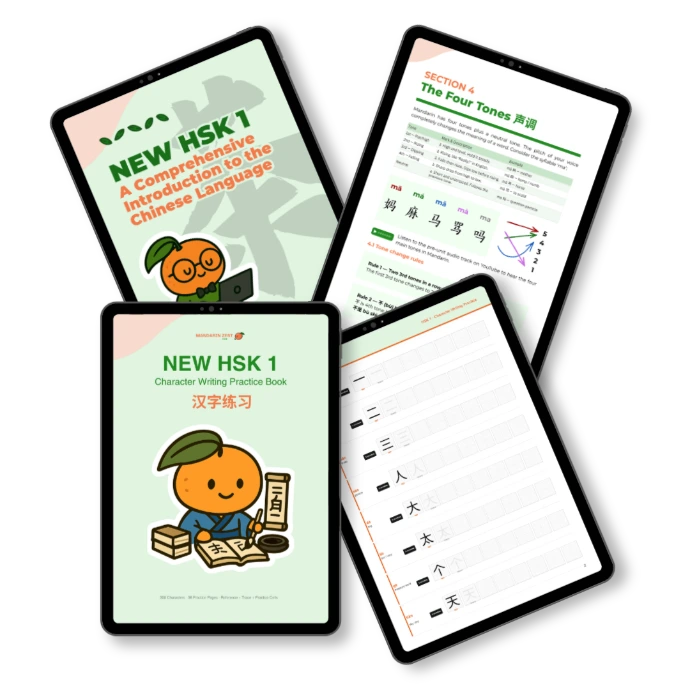
Nothing replaces writing characters by hand for building genuine recognition and retention. Stroke order, radical understanding, and active recall are what make characters stick. The HSK 1 Character Writing Practice Book from Mandarin Zest gives you structured, progressive character practice, the kind Duolingo cannot and does not provide.
For Grammar: A Structured Textbook
Explicit grammar instruction is not optional in Chinese. A good HSK-aligned textbook introduces grammar patterns clearly, with examples and exercises, so you understand the rules rather than guessing at them. The HSK 1 Comprehensive Introduction does exactly this, built specifically for the New HSK framework.
For Vocabulary Review: Anki or Pleco
Spaced repetition with active recall, not multiple-choice tapping — is what makes vocabulary stick long-term. Anki (free) and Pleco (free core app) both implement this far more effectively than Duolingo's gamified exercises.
For Reading: Graded Readers
Once you have a foundation, graded readers provide the contextual reading practice that produces real fluency. Stories written at your exact HSK level, using only vocabulary you know, deliver the comprehensible input that actually develops reading skill. Browse Mandarin Zest's graded reader range from HSK 2 upward.
Final Thoughts
Duolingo is an excellent product. It is beautifully designed, psychologically sophisticated, and extraordinarily good at what it is actually optimised for: keeping you on the app.
It is considerably less good at what it claims to be optimised for: teaching you a language.
For Chinese specifically, a language where characters require deliberate writing practice, where grammar requires explicit instruction, where tones require careful ear training, and where the gap between "feeling like you're learning" and "actually learning" is largest, the mismatch between Duolingo's design and the demands of the language is at its most damaging.
The learners who reach genuine Mandarin proficiency are not the ones with the longest Duolingo streaks. They're the ones who accepted that learning Chinese is genuinely difficult, found structured materials that match that difficulty, and put in the uncomfortable work that real acquisition requires.
Delete the app if you want. Or keep the streak if it makes you happy. But if you want to actually learn Chinese, you're going to need something more.
The best Chinese materials!
Chinese doesn’t have to be complicated
with the right tools and structure, it actually makes sense.
FAQ
Technically you might pass an HSK 1 exam if you supplemented Duolingo heavily with other study — but Duolingo alone won't get you there. The app doesn't cover the full 500-word HSK 1 vocabulary list, doesn't teach character writing, and doesn't prepare you for the exam's reading section. Many learners with long Duolingo streaks find they can't pass HSK 1.
Seeing a character and selecting it from a multiple-choice list is recognition in an artificially easy context — not character literacy. Real character learning requires you to recall and produce characters without prompting. Duolingo never tests this. Most learners who use Duolingo cannot write any of the characters they've been "learning."
This is difficult to answer without knowing how you've used it, but the honest assessment for most streak-holders: you've developed some phonetic familiarity with Mandarin sounds, a limited vocabulary of the words Duolingo chose to teach (which don't follow any systematic frequency order), and a strong conditioned response to a cartoon owl. Try reading a simple Chinese text or holding a basic conversation and see how it goes. The result is usually sobering.
For a beginner deciding whether they want to learn Chinese: marginally yes. For anyone who has decided and wants to actually make progress: not necessarily. Duolingo creates habits and expectations that can make transitioning to real study harder, not easier — because real study involves struggle that Duolingo has trained you to avoid.
Duolingo has added AI conversation practice features in recent versions. These are more genuinely useful than the core lessons, because they provide real generative practice rather than multiple-choice tapping. However, they don't address the fundamental absence of character instruction, stroke order, grammar explanation, or systematic vocabulary coverage.