
If you grew up speaking only English, Mandarin will humble you in ways that learning Spanish, French, or German never did — and it's worth understanding exactly why before you try to estimate how long it will take you. This isn't a language where your existing vocabulary gives you a head start. It's not one where you can sound out a new word and have a rough guess at its meaning. English gives you almost nothing to lean on here, and that changes the entire shape of the timeline.
If you've searched this question before, you've probably run into a scary number: 2,200 hours. That's the figure the U.S. Foreign Service Institute (FSI) — the school that trains American diplomats — uses to estimate how long it takes an English speaker to reach professional fluency in Mandarin. It sounds like a life sentence, especially if you're picturing yourself starting in your 40s, 50s, or 60s.
Here's the good news: that number is true, and also almost useless for the average adult learner. It describes a diplomat studying Chinese full-time, five days a week, in an immersive classroom, often followed by a posting in China. It has almost nothing to do with what your Tuesday evening study session looks like.
Join the Mandarin Zest Club
Join the Mandarin Zest Club and become part of a welcoming international community of Chinese learners from all over the world. Practice together, stay motivated, and connect with people who share your goals for learning Mandarin.

The Short Answer
There isn't one number, because "learn Chinese" isn't one goal. But here's a realistic range based on government language data, second-language acquisition research, and the accounts of long-term learners:
- Basic travel survival phrases: 20–50 hours
- Simple daily conversation (ordering food, small talk, basic needs): 3–6 months of consistent study
- Comfortable, functional conversation on familiar topics: 1.5–3 years
- Reading a newspaper with effort, holding a real conversation without much strain: 4–6 years
- Genuinely comfortable in the language, even if not native-level: 8–10 years
- Truly native-level command: most learners who start as adults never fully close this gap — and that's fine, because almost nobody needs to.
That last point matters more than any of the numbers. Fluency is not a finish line you cross once. It's a spectrum, and most of what makes language learning feel discouraging is measuring yourself against the wrong end of it.
Why the FSI's 2,200 Hours Isn't the Number You Should Be Planning Around
The 2,200-hour figure represents the time needed to reach "Professional Working Proficiency," a level where you can handle complex work-related conversations with real structural accuracy.
Three things get lost when people quote this number casually:
It assumes full-time, structured classroom study. Diplomats training at FSI are often doing this as their full-time job, with five or six hours of class a day, taught by trained instructors, often followed by a stint living in-country. Almost nobody learning Chinese as a hobby or a personal goal is doing this.

It targets a specific, high bar. Professional Working Proficiency (Level 3 on the government's five-point scale) means you could function in a diplomatic or business setting. Most learners don't need or want this level — they want to travel confidently, talk with family, read a menu, or simply keep their mind sharp. That's a much shorter road.
It doesn't account for how differently adults can now study. The FSI scale predates spaced-repetition apps, AI conversation partners, streaming Chinese media, and searchable dictionaries you can point your phone camera at. None of these replace real study, but they meaningfully cut down wasted time compared to the classroom-and-textbook model the FSI numbers were built around.
Why English Speakers Specifically Struggle More Than Other Learners?
The best Chinese materials!
Chinese doesn’t have to be complicated
with the right tools and structure, it actually makes sense.
Language difficulty isn't universal — it's relative to what you already know. The U.S. government's language schools rank Mandarin among the hardest languages for English speakers to learn, requiring roughly three to four times longer than French, Spanish, or Italian to reach an equivalent level. That gap isn't about Mandarin being inherently harder than every other language on earth. It's about how far it sits from English specifically.
Here's what that distance actually looks like in practice:
No cognates to lean on.
When an English speaker learns Spanish, a huge percentage of vocabulary is recognizable on sight — "información" is obviously "information." Mandarin shares almost no vocabulary roots with English. Every single word has to be learned from zero, with no shortcuts from prior knowledge.
A completely different sound system.
English uses stress and intonation for emphasis and emotion, not to change a word's dictionary meaning. Mandarin uses pitch to distinguish entirely different words — the syllable "ma" said with four different tones produces four unrelated meanings. English speakers' ears and mouths simply haven't been trained to treat pitch this way, and retraining that instinct takes real, dedicated time that a French or Spanish learner never has to spend.
A writing system with no alphabet.
English speakers have never had to learn to read this way. Spanish, French, German — all of it uses the same 26 letters English does, just rearranged. Chinese characters aren't phonetic; you generally can't sound one out just by looking at it. Literacy in Chinese is functionally a second, parallel skill from spoken fluency, in a way it simply isn't for English speakers learning most other languages.
Worried about the Chinese characters? Read more at:
How Long Does It Actually Take to Learn 500 Chinese Characters?
Grammar that reorganizes how you build a sentence.
Chinese grammar is, in some respects, simpler than English (no verb conjugation, no grammatical gender, no plural forms). But word order and sentence logic work differently enough — how time, topic, and emphasis are structured — that direct word-for-word translation from English regularly produces sentences that are grammatically wrong or simply not how a native speaker would say it.
Put together, this is why the same "I'm fluent in three months" claims you see for Spanish or Italian simply don't apply here, and why comparing your Mandarin progress to a friend's progress in French will only discourage you for no good reason. You're not doing the same task.
A More Useful Scale: The Real Milestones
Instead of a single number, it helps to think in stages. Here's roughly what each one requires and what it actually feels like.
New to Chinese? Start Here.
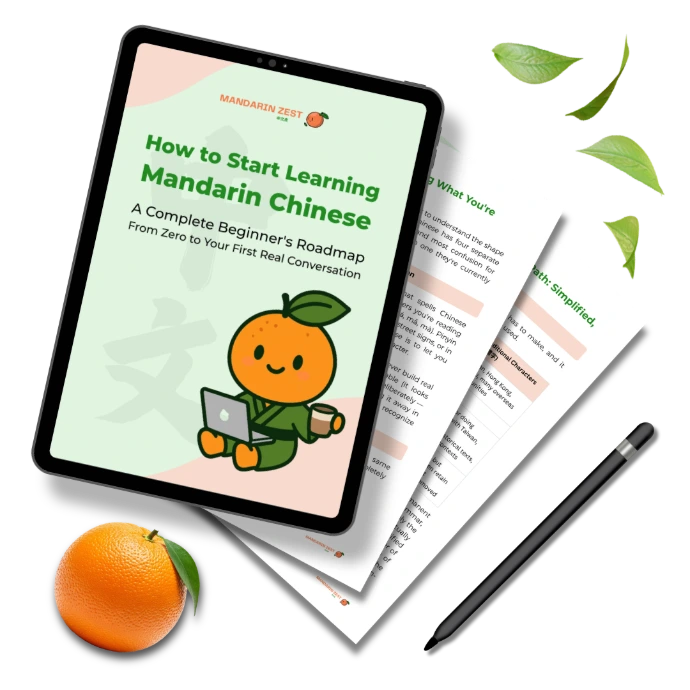
The no-fluff roadmap for absolute beginners — what to learn first, what to skip, and how to actually stick with it past week two.
Stage 1: Foundations (0–150 hours)
You learn pinyin (the Romanized spelling system), get a handle on the four tones, and build a working vocabulary of a few hundred words. You can introduce yourself, order food, count, and ask simple questions. This stage is humbling — tones especially trip up English speakers, because English doesn't use pitch to distinguish word meaning the way Mandarin does. Confusing "mā" (mother) with "mǎ" (horse) is a rite of passage, not a sign you're bad at this.
Stage 2: Basic Conversation (150–500 hours)
Vocabulary grows to 1,000–1,500 words, and you start recognizing several hundred characters. You can hold short conversations about familiar topics, though you'll frequently need people to slow down or repeat themselves. This is usually where hobbyist learners land after a year or two of steady part-time study — a meaningful, satisfying level, even though it's nowhere near fluent.
Stage 3: Functional Fluency (500–1,200 hours)
This is the stage most learners actually want to reach: comfortable small talk, the ability to navigate daily life in a Chinese-speaking environment, following the gist of slower TV shows or podcasts, and reading simple texts. Vocabulary is in the 2,500–4,000 word range. Many learners who study consistently for 3–5 years, especially with some immersion, arrive here.
Stage 4: Advanced Fluency (1,200–2,200+ hours)
Full, natural conversation across a wide range of topics, following native-speed speech, reading with only occasional dictionary use. This is the FSI's professional target, and it typically takes committed learners somewhere between 5 and 10 years of consistent effort to reach — not the "88 weeks" often quoted, because almost nobody actually studies 5 hours a day for two straight years.
Stage 5: Native-Level Mastery
For adult learners, this is a lifelong pursuit rather than a destination, and that's true even for people who go on to work professionally in Chinese. It's worth naming honestly rather than pretending it's a realistic short-term goal, because chasing it as a near-term benchmark is one of the fastest ways to burn out.
The Number Nobody Talks About: Your Actual Weekly Hours

Here's the calculation that matters more than any research figure: how many hours a week can you realistically commit, and for how many years?
A 55-year-old with a full-time job, a household, and other commitments studying 4–5 hours a week will need roughly 4–6 years to reach functional fluency (Stage 3) — not because they're a slower learner, but because the math of hours-needed-divided-by-hours-available works out that way.
Are you an older learner? Read more at:
Mandarin After 50: Why More Adults Are Taking on Chinese—and Loving the Journey
That's not a discouraging fact. It's a planning fact, and it's the one most SEO articles skip because "20 years to fluency" doesn't make a good headline, even though for many part-time adult learners, something closer to that is the honest math for true advanced fluency.
The upside: consistency beats intensity. Thirty minutes a day, seven days a week, produces better long-term retention than a single three-hour cram session on the weekend, because spaced, repeated exposure is how the brain actually encodes new language patterns — regardless of your age.
What the "You're Too Old to Learn a Language" Myth Gets Wrong
It's worth addressing this directly, because it's the single biggest thing keeping capable adults from ever starting.
The research does not support the idea that adults can't reach high fluency. What changes with age is mostly how you learn, not whether you can. Adults typically lose some of the effortless phonological absorption young children have (which is part of why accents are harder to fully shed), but adults gain enormous advantages children don't have:
- Existing literacy skills — you already understand grammar, sentence structure, and how languages work as systems, so you're not learning the concept of language from scratch.
- Metacognitive control — adults are far better at deliberately organizing study, using memory techniques, and self-correcting.
- Motivation and follow-through — a 50-year-old who chooses to study Chinese does so with a level of intentionality a bored teenager in a mandatory class rarely has.
- Life experience as context — abstract grammar concepts, cultural nuance, and idiom often land faster when you have decades of real-world reference points to hang them on.
Multiple studies on adult second-language acquisition have found that motivated adult learners can and do reach high levels of proficiency — the myth that a "critical period" makes this impossible past childhood applies mainly to accent-free native pronunciation, not to overall fluency or comprehension.
What Almost Every Article on This Topic Leaves Out
Having looked at a lot of these guides, here's what's consistently missing:
1. The honest, lived-experience timeline. Hour-counts are useful for planning, but they don't capture what the journey actually feels like. Long-term learners often describe something like this rule of thumb: after about two years you can bluff your way through a casual conversation with someone who isn't paying close attention; by five years you have real, if imperfect, basic fluency; by ten years the language starts to feel comfortable rather than effortful; and full native-level mastery is something most adult learners never fully reach — nor need to. That framing is more useful than any hour-count, because it sets expectations honestly instead of promising fluency by a fixed deadline.
2. The intermediate plateau. Almost every learner hits a stretch — usually somewhere in Stage 2 or 3 — where progress seems to stall even though study hasn't stopped. Knowing this in advance prevents a lot of people from quitting right before things click.
3. Studying alone vs. studying with others. Solo app-based study is popular because it's convenient, but it's also where most adult learners quietly stall out. Real conversation practice consistently accelerates progress more than solo drilling, and it's also simply more enjoyable to sustain for years. A study group or club adds two things apps can't: consistent speaking practice and social accountability, which is often the actual difference between someone who studies for three months and someone who's still at it three years later.
4. What "fluent" should mean for you, specifically. Almost every generic article treats fluency as a single universal target. But someone learning Chinese to talk with a bilingual grandchild has a completely different finish line than someone learning it for business. Defining your own target — HSK 3 for solid conversational ability, HSK 5 for near-professional use, or simply "comfortable ordering food and chatting on a trip to Beijing" — makes the whole timeline question far less abstract and far less intimidating.
A More Useful Benchmark Than the FSI Scale: HSK Levels
If you want something more concrete to aim for than "Professional Working Proficiency," consider China's own standardized Chinese Proficiency Test, the HSK, which has clear, learnable milestones:
- HSK 1–2: Basic phrases, simple needs — roughly 100–300 hours
- HSK 3: Can handle most daily communication — roughly 300–600 hours
- HSK 4: Fluent conversation on a wide range of topics — roughly 600–1,200 hours
- HSK 5–6: Near-native reading and abstract discussion — 1,200–2,500+ hours
For most hobbyist learners, HSK 3 or 4 represents a genuinely satisfying, life-enriching level of ability — and it's reachable in a few years of steady part-time study, not a decade.
Common Mistakes That Add Years to Your Timeline
- Skipping tones early on. It feels optional at first. It isn't — bad tonal habits are far harder to unlearn later than to build correctly from day one.
- Over-focusing on character writing before speaking. Character recognition matters, but obsessively practicing handwriting early on slows down the speaking and listening progress that keeps you motivated.
- Translating from English in your head. Chinese sentence structure — especially around time and word order — often works differently than English, and direct translation habits create awkward, hard-to-break patterns.
- Studying vocabulary in isolation. Flashcard lists without context are notoriously hard to retain. Words learned inside real sentences and conversations stick far better.
- Avoiding real conversation out of embarrassment. This is the single biggest slow-down for adult learners, and it's almost always fear of sounding foolish rather than lack of ability. Everyone who has ever become fluent in a second language sounded foolish for a while first.
The Realistic Bottom Line
Learning Mandarin as an adult American is a genuinely difficult, genuinely achievable, multi-year project — not a weekend hack and not a 20-year Everest climb, depending on what you're actually aiming for. If your goal is comfortable, functional conversation, plan on roughly 2–4 years of consistent part-time study. If you want near-professional fluency, plan on 5–10 years. Either way, the biggest predictor of success isn't age, and it isn't raw talent — it's consistency, real speaking practice, and having people around you who keep you showing up.
That last part is, frankly, the piece most solo learners are missing — and it's exactly what a good study group is built to solve.
Our HSK 1 Materials
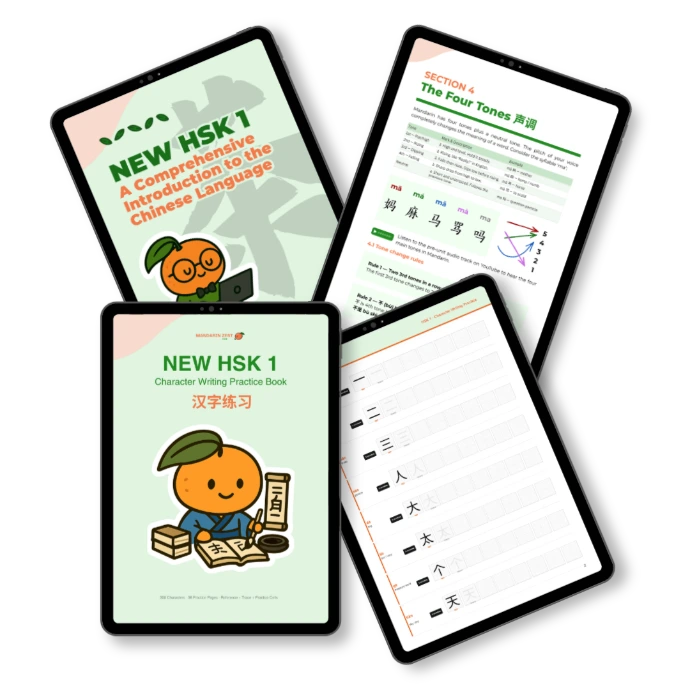
Are you planning to take the HSK 1 exam? Check out our dedicated materials, designed by teachers for learners.