
It's easy to think there's a "right age" to learn a language. But that simply isn't true. Every year, people in their 40s, 60s, and even 80s start learning Mandarin Chinese for the very first time. Many gain confidence and find that learning Chinese becomes one of the most rewarding things they've ever done.
The old idea that language learning is only for the young is slowly starting to disappear. Around the world, more and more adults are returning to the classroom or picking up a language for the first time — and many of them are well beyond retirement age.
What does research tell us about learning Chinese later in life? And perhaps most importantly: how can you build a habit that lasts, instead of losing motivation after the first few weeks?
This article explores why more adults are choosing to learn Mandarin and the strategies that can help learners stay motivated and make steady progress.
It is also the reason communities like the Mandarin Zest Study Club were created: to give dedicated learners a space to practice regularly and stay connected with others who share the same goal.
Join the Mandarin Zest Club
Join the Mandarin Zest Club and become part of a welcoming international community of Chinese learners from all over the world. Practice together, stay motivated, and connect with people who share your goals for learning Mandarin.

Why Older Adults Are Choosing to Learn Chinese Today
For many years, the main reasons people learned Chinese were closely connected to career opportunities and business. And that motivation is still very much alive — Mandarin remains a valuable skill in an increasingly connected world. But for many older learners today, the reasons go far beyond professional goals.
Retirement often brings something many people have not experienced in decades: time to explore interests they have put aside. For some, learning Chinese becomes a way to finally pursue a long-held curiosity — whether it is a fascination with calligraphy, majhong or simply a deep interest in a culture they have admired for years.
For others, the motivation is deeply personal. Some grandparents learn Chinese to better connect with grandchildren growing up in bilingual families. Some parents study alongside their children to support their Chinese-language education at home. Many retirees who travel to China, Taiwan, or other Chinese-speaking regions want more than a typical tourist experience — they want to communicate, understand local perspectives, and build genuine connections.
In many cases, learning Mandarin is not about adding another skill to a list of achievements. It is about curiosity and opening a new chapter in life.
The Brain Science: What Learning Chinese Can Do for an Aging Mind

This is where the story becomes especially interesting — and for many older learners, it is one of the most motivating parts of the journey.
Bilingualism has been widely studied as a factor that may support healthy brain aging. Research suggests that people who regularly use more than one language often show signs of cognitive decline later than those who speak only one language.
The benefit does not come simply from having learned another language years ago and leaving it unused — it comes from actively engaging with it. That is why consistent practice and real communication matter far more than simply collecting vocabulary points or maintaining an app streak.
So what is happening inside the brain? Every time you move between two languages, your brain has to manage competing systems: choosing the right words, switching attention, and ignoring information that is not needed at that moment. Over time, this repeated mental exercise strengthens skills linked to executive function, including focus, working memory, and cognitive flexibility.
Scientists often describe this ability as building cognitive reserve — the brain’s capacity to adapt and continue functioning despite the changes that naturally come with aging. In simple terms, regularly challenging your brain may help keep it more resilient over time.
Learning Chinese may add another interesting dimension because it differs from many other languages adults choose to study: its writing system. Unlike alphabet-based languages, Chinese characters require learners to connect visual patterns with meaning, sound, and memory. This creates a unique kind of mental challenge, engaging different areas of the brain and adding another layer of stimulation to the learning process.
Why Chinese Characters Are a Unique Brain Challenge

If you have ever looked at Chinese characters and thought, “How could I possibly remember all of these?” — that reaction is completely understandable. Chinese writing is very different from the alphabet-based systems most adults are familiar with. But that difference is also what makes it such a fascinating mental exercise.
Unlike languages where letters mainly represent sounds, Chinese characters combine visual structure with meaning and pronunciation. Learning them requires the brain to recognize patterns and connect visual information with language. Some studies on Chinese literacy suggest that reading characters engages a broader network of brain regions than reading alphabetic scripts, partly because learners rely not only on sound but also on visual and spatial information.
For older learners, this challenge can actually become one of the most rewarding parts of studying Chinese. Practicing characters is not simply memorizing vocabulary — it involves training visual memory and developing attention to detail. In many ways, it shares similarities with activities such as drawing, playing puzzles, or learning a musical instrument, where the brain is constantly building new connections.
Mandarin also adds another layer of difficulty through its tones. The same syllable can have completely different meanings depending on the pitch, requiring learners to develop careful listening skills and a stronger awareness of sound differences. When combined with reading and writing characters, Chinese engages multiple types of memory at once: auditory, visual, and motor.
The Social Side: Chinese as a Bridge to a Bigger World
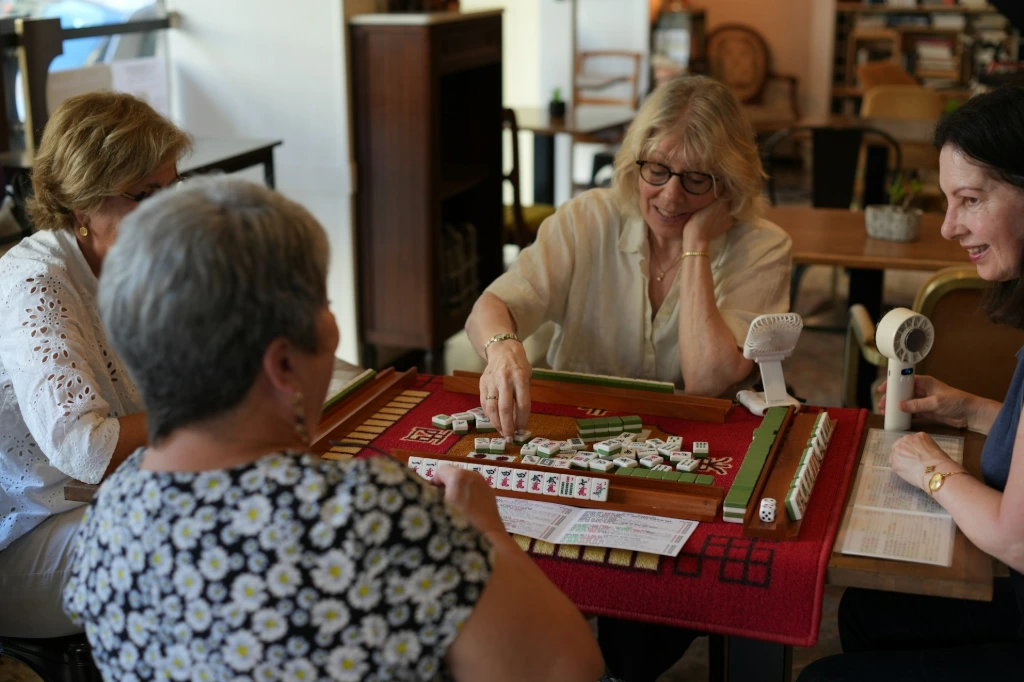
One of the most overlooked benefits of learning a language later in life is its ability to bring people together.
Retirement, an empty nest, or simply the natural changes that come with aging can sometimes mean fewer opportunities to meet new people and build new connections. Learning a language offers a unique solution because it is, by nature, a social activity. You do not learn Mandarin only by studying alone — you learn it through conversations, teachers, classmates, and communities.
Chinese is especially powerful in this regard because it opens the door to a truly global network. Mandarin is spoken not only in mainland China, but also in Taiwan, Singapore, and Chinese communities around the world. Many learners discover that their studies lead them to friendships with people from different cultures and backgrounds — connections that might never have happened otherwise.
For older learners, these relationships can become an important part of the experience. Research on healthy aging consistently highlights the role of social connection in overall wellbeing. Having regular opportunities to communicate, learn something new, and share progress with others can provide a sense of purpose and belonging.
A weekly Mandarin practice session is therefore about more than memorizing vocabulary or improving pronunciation. It is a regular moment of curiosity, conversation, and connection — a chance to keep learning while staying connected to the wider world.
New to Chinese? Start Here.
The no-fluff roadmap for absolute beginners — what to learn first, what to skip, and how to actually stick with it past week two.

Practical Tips for Getting Started as an Older Learner
Whether you join a study group or begin learning on your own, a few simple principles can make a big difference — especially for adult learners.
Start with small, achievable goals.
“Become fluent” is an exciting goal, but it can feel overwhelming. Instead, focus on clear milestones: having a five-minute conversation about your daily life within a few months, understanding a favorite TV show, or working toward a specific HSK level within a year. Small wins build confidence and keep motivation alive.
Focus on speaking and listening from the beginning.
Reading and writing are important parts of Chinese, but for many adult learners, the biggest motivation comes from being able to actually communicate. Don’t wait until you feel ready to speak — speaking is how you become ready. Making mistakes is not a sign of failure; it is part of the learning process.
Take tones seriously, but don’t fear them.
Mandarin tones can feel unfamiliar at first, but they become much easier with regular exposure and practice. Building good habits early prevents frustration later, and practicing with real people is often much more effective than simply repeating sounds on an app.
Learn through things you genuinely enjoy.
The best learning materials are often the ones you naturally want to return to. Chinese dramas, music, podcasts, books, or topics you already love can transform practice from a task you have to complete into something you look forward to.
Make learning social.
Consistency is much easier when you are learning alongside others. A teacher, conversation partner, or study group provides encouragement and a reason to keep showing up. For many learners, this social element is what turns a short-term interest into a long-term habit.
Be patient with yourself — especially with memory.
Adults may need more repetition to remember new vocabulary, but that does not mean they are worse language learners. Older learners often have advantages that children do not: stronger learning strategies, clearer motivation, better problem-solving skills, and the discipline to follow a routine.
Learning Chinese later in life is not about competing with younger learners. It is about finding a method that fits your goals, your interests, and your lifestyle — and giving yourself enough time to enjoy the journey.
Our HSK 1 Materials
Are you planning to take the HSK 1 exam? Check out our dedicated materials, designed by teachers for learners.