
Today is Dragon Boat Festival — 端午节 (Duānwǔ jié) — one of China's four major traditional holidays, alongside Spring Festival, Qingming, and Mid-Autumn Festival.
If you've seen the races on social media, received a box of zongzi from a Chinese friend, or simply noticed the date on your calendar, here's everything you actually need to know about it — the story, the traditions, the regional variations, and the Mandarin vocabulary to talk about it properly.
What Is Dragon Boat Festival?
Dragon Boat Festival, also called Duanwu Festival, is one of the four grandest traditional festivals in China, falling on the 5th day of the 5th month in the Chinese lunar calendar. With a history of over 2,000 years, it is celebrated by eating zongzi and holding dragon boat racing.
In 2026, the Dragon Boat Festival falls on Friday, June 19. In mainland China, the official break runs from June 19 to June 21, creating a three-day holiday period. In 2009, it was inscribed on UNESCO's Representative List of the Intangible Cultural Heritage of Humanity.
In English you'll see Dragon Boat Festival, Duanwu Festival, or Double Fifth — since it always lands on the fifth day of the fifth lunar month. In Hong Kong, the Cantonese name is often written as Tuen Ng Festival.
The Story: Qu Yuan and the Miluo River
Every major Chinese festival has a story at its heart. Dragon Boat Festival's is one of the most memorable.
The festival commemorates the death of the patriotic poet Qu Yuan (屈原), who lived in the 3rd century BC during the Warring States period. Qu Yuan, a minister of the State of Chu, committed suicide by drowning himself in the Miluo River after his beloved homeland was defeated in a vital battle against the rival state of Qin, thus losing its independence.
The local people, to prevent the fish from eating his body, paddled their boats and threw rice balls into the river, giving rise to the current dragon boat races and the tradition of eating zongzi.
Qu Yuan was not just a statesman — he's considered the father of Chinese poetry. His masterwork, Li Sao (离骚, lísāo), is one of the earliest long poems in Chinese literature. Dragon Boat Festival is, among other things, a day of mourning for a poet who chose death over the humiliation of seeing his country fall.
There's a reason this story resonated across two thousand years: it's about loyalty, integrity, and what you do when the institutions you serve fail. Qu Yuan had the option of exile, compromise, or survival in diminished circumstances. He chose none of them. The festival that commemorates him is, at its roots, a meditation on moral courage.
The Traditions: What Actually Happens
Dragon Boat Racing (赛龙舟, sài lóngzhōu)
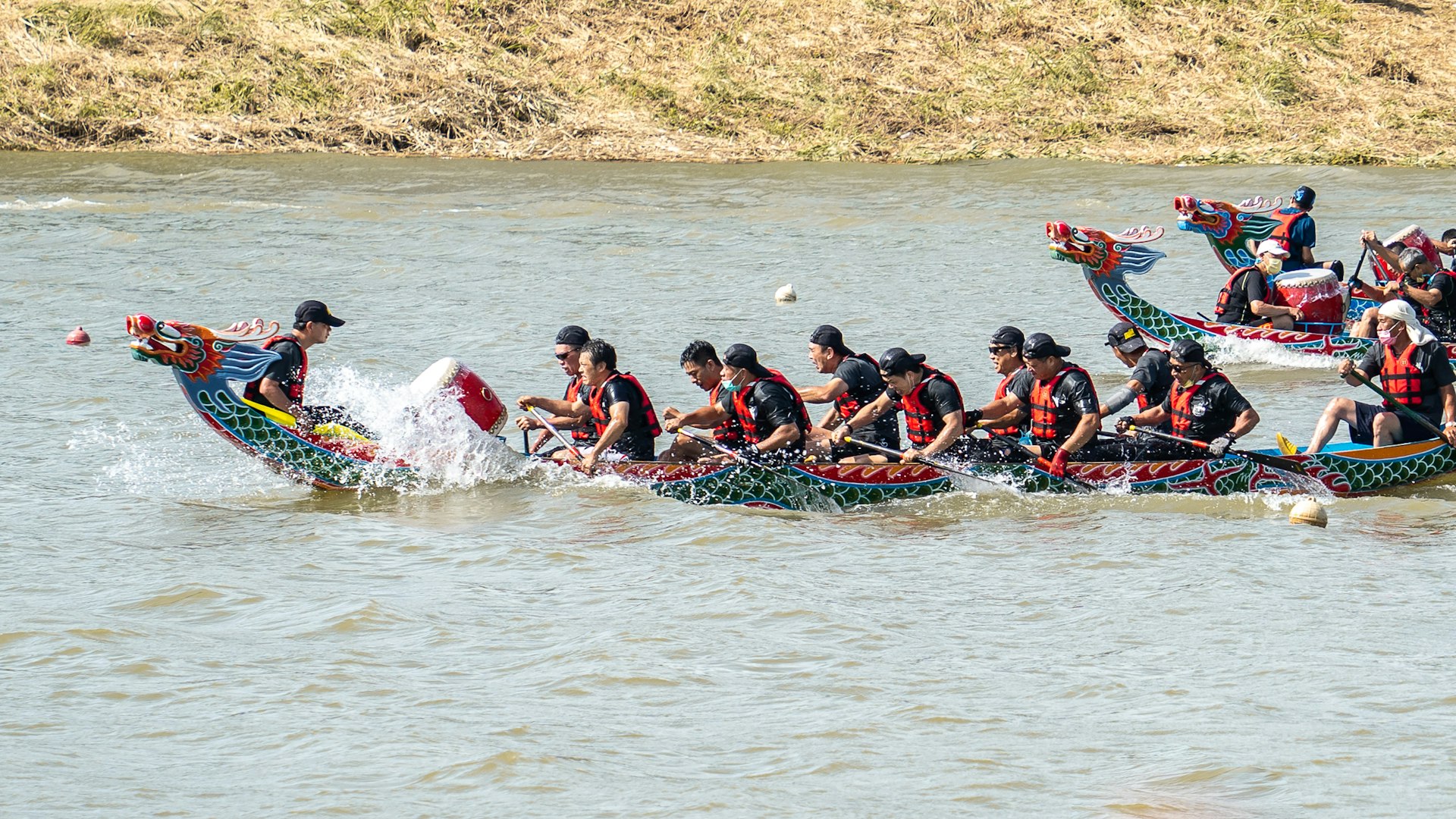
The races are the most visually spectacular element of the festival. Long, narrow boats decorated with carved dragon heads and tails are paddled by teams of rowers to the beat of a drum. The drummer sits at the front setting the pace; the steersman guides from the rear; and the paddlers synchronise their strokes in a collective effort that can reach considerable speed.
Dragon boat clubs now operate in cities across the world, making this one of the most globally spread Chinese cultural traditions. It's not unusual to see Dragon Boat races in London, New York, Sydney, or Brussels in June.
Zongzi (粽子, zòngzi)
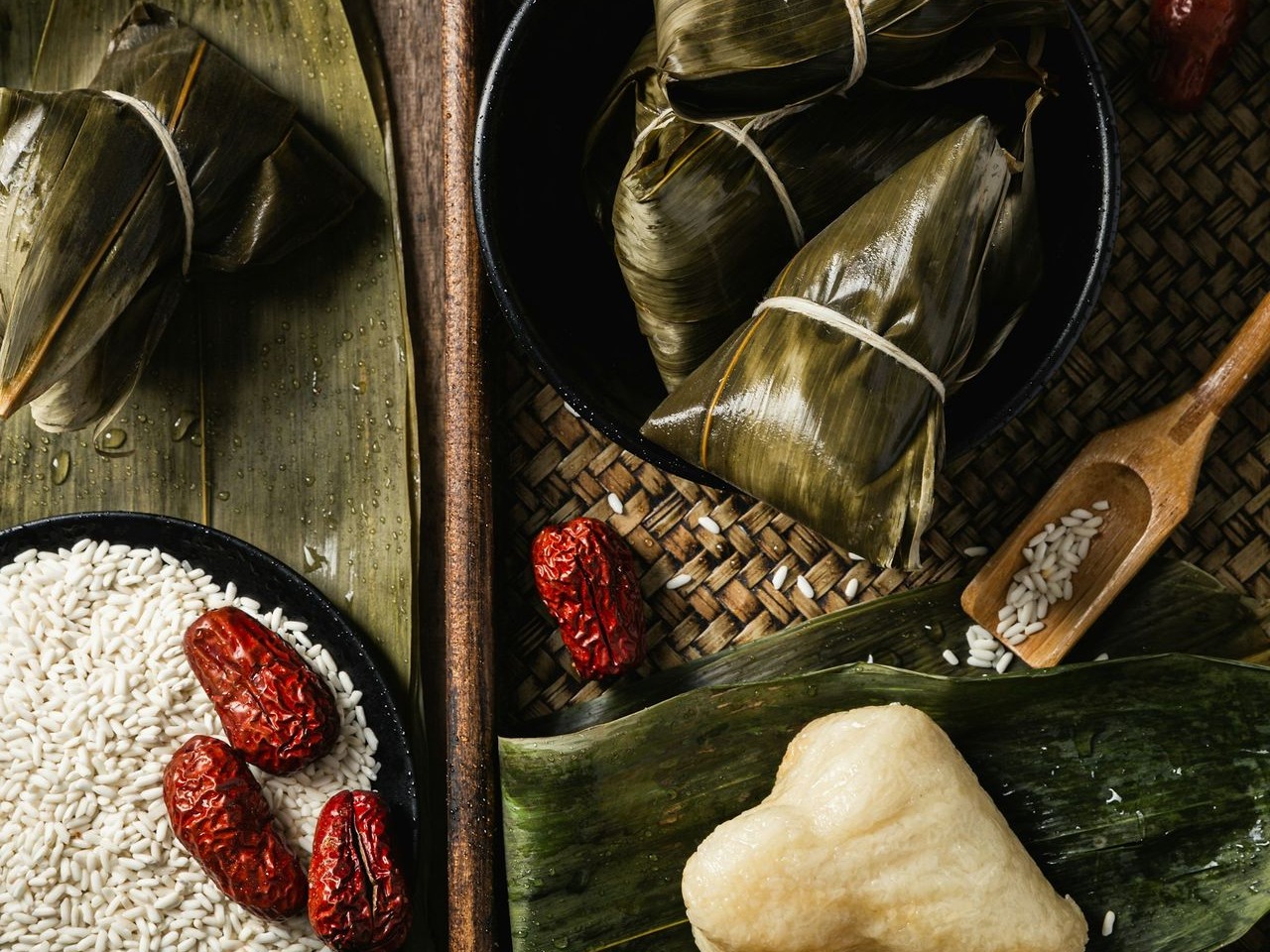
There are said to be hundreds of regional variations of zongzi across China, with differences in leaf type, filling, shape, and cooking method.
The basic structure is always the same: glutinous rice packed around a filling and wrapped in bamboo or reed leaves, then steamed or boiled. But the fillings vary enormously by region:
- Northern China: usually sweet — red bean paste, dates, or plain glutinous rice
- Southern China (Cantonese style): savoury — pork belly, salted egg yolk, mushrooms, chestnuts
- Fujian style: large, cone-shaped, often with pork or oysters
- Jiaxing style (from Zhejiang, possibly the most famous nationally): rectangular, with fatty pork and salted egg yolk
The savoury vs sweet divide is one of China's great culinary debates — roughly the zongzi equivalent of whether pineapple belongs on pizza. Strong opinions on both sides.
Hanging Calamus and Mugwort (挂艾草, guà àicǎo)
Less known outside China, but genuinely ancient: families hang bundles of calamus (菖蒲, chāngpú) and mugwort (艾草, àicǎo) above their doors. Both plants have strong scents and were traditionally believed to ward off evil spirits and disease — particularly relevant in the fifth lunar month, which was historically considered an unlucky, pestilence-prone period of the year.
This tradition connects Dragon Boat Festival to an older layer of Chinese folk religion that predates the Qu Yuan story, linking it to seasonal rituals around the summer solstice and the protection of households from summertime illness.
Wearing Colourful Silk Threads (五彩绳, wǔcǎi shéng)
Wearing colourful silk threads is one of the key traditions of the Dragon Boat Festival. Children (and increasingly adults) tie braided threads in the five traditional colours — red, yellow, blue, white, and black — around their wrists, ankles, or necks. They're worn from the festival until the first rain, when they're tossed into running water, believed to carry away illness and bad luck with them.
Realgar Wine (雄黄酒, xiónghuáng jiǔ)
Traditionally, realgar wine — a yellow rice wine flavoured with realgar, a form of arsenic sulfide — was drunk during the festival and applied to children's skin and foreheads to ward off insects and evil. This practice is now largely discontinued (realgar is toxic), but it survives as a cultural memory and appears in historical descriptions of the festival.
How Dragon Boat Festival Is Celebrated Today
In the 21st century, the Dragon Boat Festival has evolved without losing its essential spirit. It continues to serve as a powerful reminder of cultural identity, community bonds, and the importance of honoring the past. For Chinese communities around the world, the festival is a touchstone of heritage, a reason to gather with family, and a source of shared pride.
In practical terms, what does this look like today?
In mainland China, it's a three-day national holiday — families gather, zongzi are made or bought (supermarkets and bakeries sell them for weeks beforehand), dragon boat races are broadcast on television, and riverside celebrations happen in cities across the country. Guangdong province, with its long dragon boat tradition, takes the races particularly seriously.
In Hong Kong, the international dragon boat races draw competitive teams from around the world — it's one of Hong Kong's most internationally visible cultural events.
In Taiwan, the festival is a public holiday and the dragon boat races at Sun Moon Lake are among the most photographed in the world.
Among overseas Chinese communities globally, the festival is one of the most reliably celebrated — partly because of the universality of zongzi (easy to make or find in any city with a Chinatown), and partly because dragon boat racing clubs have become a genuinely popular sport in many Western cities, attracting participants with no Chinese heritage at all.
join our discord server!
Join the Mandarin Zest community on Discord. Discover Chinese pop culture and internet trends, chat with fellow learners, and interact with teachers and fluent moderators.

Essential Dragon Boat Festival Vocabulary
| Character | Pinyin | Meaning |
|---|---|---|
| 端午节 | Duānwǔ jié | Dragon Boat Festival |
| 赛龙舟 | sài lóngzhōu | dragon boat racing |
| 龙舟 | lóngzhōu | dragon boat |
| 粽子 | zòngzi | sticky rice dumplings |
| 屈原 | Qū Yuán | Qu Yuan (the poet) |
| 艾草 | àicǎo | mugwort |
| 菖蒲 | chāngpú | calamus |
| 五彩绳 | wǔcǎi shéng | five-colour silk threads |
| 汨罗江 | Mìluó Jiāng | Miluo River |
| 农历五月初五 | nónglì wǔ yuè chū wǔ | 5th day of the 5th lunar month |
| 节日快乐 | jié rì kuài lè | Happy Festival! |
| 端午节快乐 | Duānwǔ jié kuài lè | Happy Dragon Boat Festival! |
How to Wish Someone Happy Dragon Boat Festival
The most natural greeting is simply:
端午节快乐! (Duānwǔ jié kuài lè!) — Happy Dragon Boat Festival!
You'll also hear:
粽子好吃吗? (Zòngzi hǎochī ma?) — Are the zongzi delicious?
This works as a casual festival greeting in exactly the same way that "吃了吗?" (have you eaten?) works as a general Chinese expression of care — it's a warm, food-centred acknowledgement of the day.
Why Qu Yuan Still Matters
It's worth pausing on why a 2,300-year-old poet's drowning is still a national public holiday.
Qu Yuan occupies a specific place in Chinese cultural memory: the honest official who was exiled because he told the truth, who watched his country fall because those in power preferred comfortable lies to difficult advice, and who chose death rather than either silence or collaboration with the victors.
In Chinese political and cultural discourse, he represents a recurring archetype: the loyal remonstrator, the person who speaks up at personal cost. The festival in his memory is not just about history — it's a recurring meditation on integrity, on what it costs to tell the truth to power, and on the kind of person worth commemorating.
That this survives as a public holiday — that China annually takes three days to remember a man who drowned himself in protest — is one of the more quietly remarkable facts about Chinese cultural memory.
The best Chinese materials!
Chinese doesn’t have to be complicated
with the right tools and structure, it actually makes sense.
Final Thoughts
Dragon Boat Festival is one of those holidays that rewards attention. On the surface it's colourful boats, sticky rice, and a three-day weekend. Underneath it's a 2,300-year-old story about loyalty, moral courage, and what we choose to remember and why.
端午节快乐 to everyone celebrating today — and to those eating zongzi: the savoury ones are clearly better.
FAQ
Because it follows the Chinese lunisolar calendar, falling on the 5th day of the 5th lunar month — which translates to a different date on the Gregorian calendar each year, usually in late May or June. In 2026 it's June 19; in other years it can be as early as late May.
Yes — it's a public holiday in mainland China, Hong Kong, Macau, and Taiwan. Dragon boat racing clubs exist in cities across Europe, North America, and Australia, and zongzi are widely available in any city with a significant Chinese community.
端午节快乐 (Duānwǔ jié kuài lè) — Happy Dragon Boat Festival. Alternatively, some people say 端午安康 (Duānwǔ ān kāng) — wishing you peace and health at Dragon Boat Festival — which is considered slightly more appropriate given that the festival commemorates a tragedy rather than a joyful occasion.
Far from it. Northern Chinese zongzi tend to be sweet (red bean paste, dates); southern Chinese zongzi are typically savoury (pork, salted egg yolk). The shape, leaf type, filling, and cooking method vary enormously by region.
It was officially designated a national public holiday in 2008, alongside Qingming Festival and Mid-Autumn Festival. Before that it was celebrated culturally but not officially.