
If you've spent any time around Chinese couples — or watched Chinese TV dramas, or asked a Chinese friend about their relationship — you've probably noticed something: the three words that anchor romantic expression in Western culture are conspicuously rare.
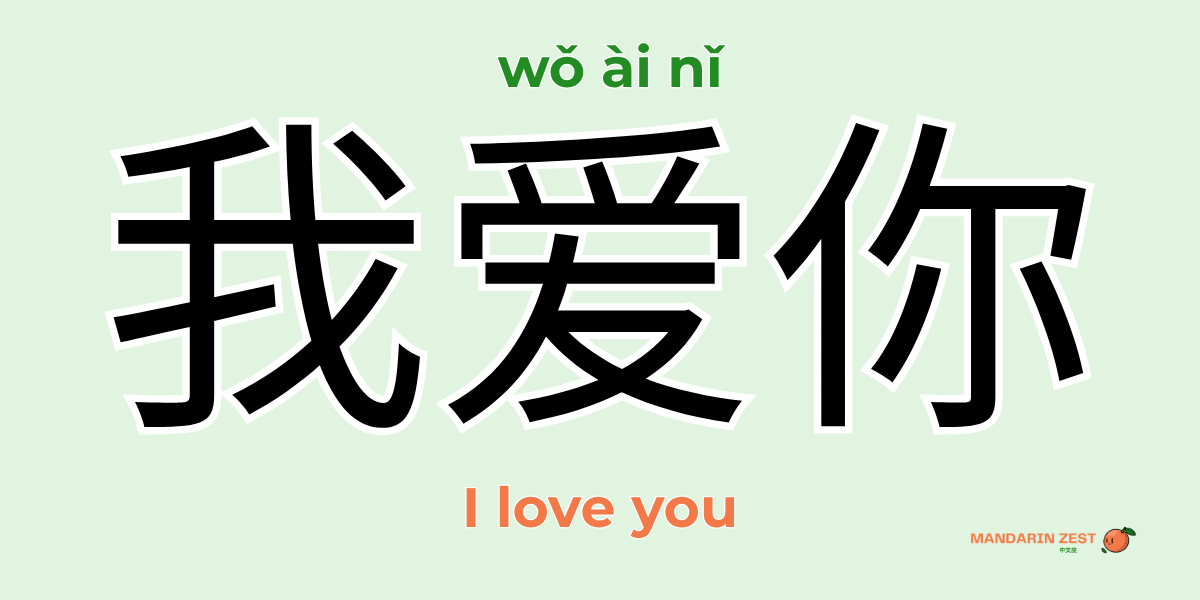
我爱你 (wǒ ài nǐ, I love you) exists. Chinese speakers know it. But in everyday life — in real conversations, in real relationships, between real people — it's not said the way Westerners say it. Not habitually. Not easily. Often not at all.
This isn't a gap in the language. It's a window into a fundamentally different way of expressing what matters most.
First: 我爱你 Is Real — It's Just Not Casual
Let's clear up a common misconception. 我爱你 is a genuine, deeply felt expression in Chinese. It exists, it's understood, and when it is said, it carries enormous weight precisely because it isn't said lightly.
The difference is one of register and frequency, not existence. In English, "I love you" has been stretched to cover everything from deep romantic devotion to mild appreciation ("I love this coffee"). It's said to partners, parents, friends, and pets, multiple times a day, in person and in text.
In Chinese, 我爱你 has never been diluted that way. It sits at the most serious end of emotional expression — the kind of thing said once, deliberately, at a significant moment. Not as daily maintenance. Not as a reflex at the end of a phone call.
Saying 我爱你 casually in Chinese doesn't sound romantic. It sounds strange — either overly dramatic or like a line learned from a Western film.
Why? The Cultural Roots
Emotional reserve as a virtue
Chinese culture places high value on emotional restraint, particularly in expressing positive feelings. This isn't emotional coldness — it's a different emotional grammar, rooted in Confucian values that prize humility, indirectness, and the demonstration of feeling through action over declaration.
The concept of 含蓄 (hánxù) — roughly translatable as "implicit," "understated," or "restrained" — runs deep through Chinese interpersonal culture. Direct emotional statements, especially about love, can feel exposing, performative, or even presumptuous. The unspoken is often considered more authentic than the loudly declared.
Love shown through action, not words
In Chinese relational culture, love is communicated through what you do — far more than what you say. Has your mother cooked your favourite dish when you came home? Has your partner stayed up to wait for you? Have they noticed, without being told, that you were tired or stressed?
This is the language of love in Chinese culture: attentiveness, care, sacrifice, provision. The classic Chinese parental expression of affection isn't "I love you" — it's "吃了吗?" (Chī le ma?, Have you eaten?). Three syllables that carry an entire world of care.
Historical and generational factors
Public emotional expression was suppressed through significant periods of Chinese 20th-century history. The Cultural Revolution (1966–1976) actively discouraged sentimentality and personal emotional expression in favour of collective ideology. Generations raised in that era passed on its emotional habits — restraint, practicality, demonstration over declaration.
Younger Chinese generations, influenced by global media, K-dramas, and shifting social norms, are gradually more expressive. But the cultural current still runs toward showing rather than saying.
What Chinese People Say Instead
This is where it gets genuinely fascinating. Chinese has a rich vocabulary of affection and care that operates entirely below the level of "I love you" — and for most couples, these are the real expressions of love.
我喜欢你 (Wǒ xǐhuān nǐ) — I like you
In Chinese romantic culture, 喜欢 (xǐhuān, to like) carries far more romantic weight than the English translation suggests. Confessing 我喜欢你 is a genuine romantic declaration — the standard phrase for telling someone you have feelings for them at the start of a relationship.
Where English speakers say "I like you" as a lesser form of love, Chinese speakers say 我喜欢你 as a heartfelt admission with real emotional stakes. It's where many relationships begin.
我爱你 (Wǒ ài nǐ) — used rarely, but powerfully
When it does appear — in a marriage proposal, in an anniversary message, in a moment of crisis or gratitude — 我爱你 lands with a weight that "I love you" in English often doesn't, precisely because of its rarity. It hasn't been worn smooth by constant use.
我想你 (Wǒ xiǎng nǐ) — I miss you
One of the most genuinely romantic expressions in Chinese. 我想你 — I miss you / I'm thinking of you — is said far more freely than 我爱你, and in Chinese relational culture carries deep emotional resonance. Missing someone, longing for them, keeping them in your thoughts — this is love made concrete and directional.
吃了吗?(Chī le ma?) — Have you eaten?
This deserves its own entry because it's perhaps the most quintessentially Chinese expression of care. On the surface it's a mundane question about food. In practice it's often a way of saying: I'm thinking about you. I care whether you're okay. You matter to me.
It's been semi-ironically reclaimed by younger Chinese people as the ultimate parental love language — recognised, teased about, and genuinely moved by, all at once.
注意身体 (Zhùyì shēntǐ) — Take care of yourself
Said by parents, partners, and close friends at the end of a conversation, before a trip, during an illness. It translates literally as "pay attention to your body" — but it functions as an affectionate farewell that encompasses: I care about you, I want you to be well, you're important to me. A full emotional statement in four syllables.
路上小心 (Lùshàng xiǎoxīn) — Be careful on the way
Another care-coded farewell. Said when someone is about to travel, commute, or drive somewhere. Again: the literal meaning is practical (be careful on the road), but the emotional meaning is: I'll be worried until you're home. You matter to me.
辛苦了 (Xīnkǔ le) — You've worked hard / You must be tired
Said to acknowledge someone's effort and sacrifice. To a partner who's been working late, to a parent who cooked dinner, to a friend who went out of their way. It recognises what someone has done and expresses appreciation without being sentimental. It says: I see you. I see what you did. It wasn't nothing.
我养你 (Wǒ yǎng nǐ) — I'll take care of you / I'll provide for you
A deeply romantic statement in Chinese — especially from one partner to another — that carries connotations of commitment, protection, and lifelong devotion. It's love expressed as a promise of practical care: I will be responsible for your wellbeing. Not often heard in Western romantic vocabulary, but in Chinese culture it can be one of the most profound things one person says to another.

In Chinese TV Dramas: The Confession Scene
If you've watched Chinese dramas (国产剧, guóchǎn jù), you'll have noticed that romantic confession scenes often don't contain 我爱你 at all. Instead:
- A character might say 我喜欢你 after seasons of tension
- They might say 我不想失去你 (Wǒ bù xiǎng shīqù nǐ, I don't want to lose you)
- Or simply: 你是我最重要的人 (Nǐ shì wǒ zuì zhòngyào de rén, You are the most important person to me)
These statements land with enormous emotional weight because of the cultural context — the restraint that preceded them makes the declaration significant.
Modern China: Things Are Changing
Younger Chinese people, especially in cities, are more verbally expressive than previous generations. The influence of Western media, Korean entertainment, and social media has shifted norms — particularly online.
520 (wǔ èr líng) has become a quasi-Valentine's Day in China: the numbers 5, 2, 0 sound like 我爱你 (wǒ ài nǐ) in Chinese, and May 20th has become a day for couples to express love, exchange gifts, and — yes — say 我爱你 more freely than they might on an ordinary day.
Similarly, 1314 (yī sān yī sì) sounds like 一生一世 (yīshēng yīshì, "one lifetime, one world" — forever), and appears in romantic messages as a declaration of permanence.
The digital layer of Chinese romance has its own vocabulary of love codes, emoji, and indirect expressions — layered on top of an older, more reserved emotional grammar.
join our discord server!
Join the Mandarin Zest community on Discord. Discover Chinese pop culture and internet trends, chat with fellow learners, and interact with teachers and fluent moderators.

A Complete Vocabulary of Chinese Affection
Here's a consolidated reference of the expressions covered in this article, plus a few more worth knowing:
| Expression | Pinyin | Literal meaning | Emotional meaning |
|---|---|---|---|
| 我爱你 | Wǒ ài nǐ | I love you | Deep, serious love — said rarely |
| 我喜欢你 | Wǒ xǐhuān nǐ | I like you | Romantic confession — more common |
| 我想你 | Wǒ xiǎng nǐ | I miss you / I think of you | Longing, care |
| 吃了吗? | Chī le ma? | Have you eaten? | I care about you |
| 注意身体 | Zhùyì shēntǐ | Take care of yourself | I worry about you |
| 路上小心 | Lùshàng xiǎoxīn | Be careful on the way | I'll worry until you're safe |
| 辛苦了 | Xīnkǔ le | You've worked hard | I see your effort |
| 我养你 | Wǒ yǎng nǐ | I'll provide for you | Lifelong commitment |
| 你是我最重要的人 | Nǐ shì wǒ zuì zhòngyào de rén | You're my most important person | Deep devotion |
| 我不想失去你 | Wǒ bù xiǎng shīqù nǐ | I don't want to lose you | Fear of loss / love |
| 一生一世 | Yīshēng yīshì | One lifetime, one world | Forever |
| 心疼你 | Xīnténg nǐ | My heart aches for you | Tender concern, deep care |
| 我在乎你 | Wǒ zàihu nǐ | I care about you | I take you seriously |
What This Teaches Language Learners
For Mandarin learners, this topic isn't just culturally fascinating — it's linguistically revealing.
It shows that language is never just a code for translating ideas between cultures. The same concept — loving someone — is expressed, structured, and given weight entirely differently in Chinese. Understanding this gap between 我爱你 and "I love you" teaches you something no vocabulary list can: that fluency isn't just knowing the words. It's knowing when to use them, when not to, and what the silences mean.
The expressions in the table above — 辛苦了, 吃了吗, 注意身体 — appear constantly in everyday Chinese conversation. Recognising them as expressions of care rather than literal questions or instructions is the kind of cultural-linguistic fluency that takes learners from technically correct to genuinely understood.
The best Chinese materials!
Chinese doesn’t have to be complicated
with the right tools and structure, it actually makes sense.
Final Thoughts
The reason Chinese people don't say "I love you" the way Westerners do isn't a deficit of feeling — it's a different emotional architecture. One where love is demonstrated in a bowl of rice, a worried question about your commute, and a reminder to eat enough. Where restraint signals depth. Where the unsaid carries as much weight as the said.
Understanding this doesn't just make you a better Mandarin speaker. It makes you a better reader of Chinese relationships — in the language, in the culture, and eventually, in your own interactions with Chinese speakers who show you they care in exactly these quiet, practical, unmistakable ways.
FAQ
Rarely, in traditional families — particularly among older generations. Parental love in Chinese culture is expressed through sacrifice, provision, and attention to practical needs. The running joke among Chinese young people is that hearing 我爱你 from a Chinese parent is so unusual it would cause a heart attack. Younger, more internationally influenced parents are increasingly more verbally expressive.
Yes — extensively. Chinese entertainment (pop music, films, dramas) is often more verbally expressive than everyday life, borrowing from both Western conventions and dramatic tradition. Hearing 我爱你 in a song or drama is common; saying it to your actual partner over breakfast is not.
The natural response is 我也爱你 (Wǒ yě ài nǐ, I love you too). But in everyday contexts where 我喜欢你 is more common, the response might be 我也是 (Wǒ yě shì, Me too) or simply 我也喜欢你 (Wǒ yě xǐhuān nǐ).
宝贝 (bǎobèi) means "treasure" or "baby" and is one of the most common terms of endearment between Chinese couples and from parents to children. Other common terms of endearment include 亲爱的 (qīn'ài de, dear/darling) and 老公/老婆 (lǎogōng/lǎopó, husband/wife — used affectionately even outside formal marriage in modern usage).
Yes, gradually. Younger urban Chinese are more verbally and physically expressive than previous generations. Social media, global entertainment, and shifting generational norms are all pushing toward more open emotional expression. But the cultural current of 含蓄 (restraint) still shapes how most people communicate care — especially with parents and older family members.