
If you've just started learning Mandarin, you've probably already encountered the most common piece of discouraging advice about Chinese: "It's a tonal language. The same word means completely different things depending on how you say it."
This is true. But the way it's usually delivered makes tones sound like an impossible obstacle, when they're actually one of the most learnable parts of Mandarin — provided you approach them correctly from the start.
This guide covers everything a beginner needs to know about Mandarin tones: what they are, how each one sounds, how to practise them effectively, and the mistakes that hold most learners back.
What Are Tones in Mandarin Chinese?
In English, pitch is used for emotion and emphasis — a rising pitch at the end of a sentence signals a question; a flat, falling tone signals a statement. The words themselves don't change meaning based on pitch.
In Mandarin Chinese, pitch is lexical — it's part of the word itself. Change the pitch, and you change the word entirely.
Mandarin has four tones, plus a neutral (or "fifth") tone used in certain unstressed syllables. Every syllable in Mandarin is pronounced with one of these tones, every time. There are no exceptions.
The classic example used to illustrate this is the syllable mā/má/mǎ/mà:
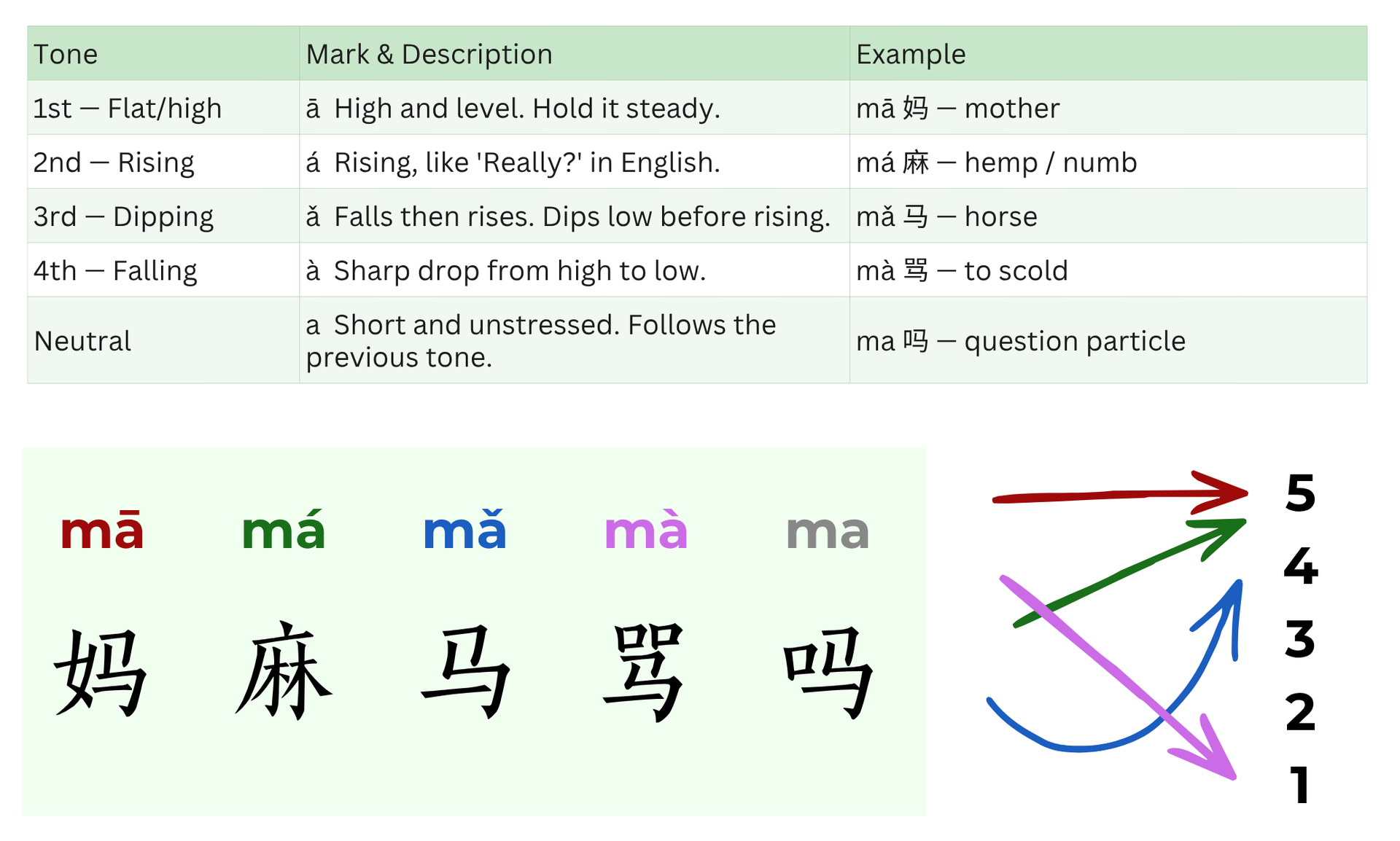
Say the wrong tone and you've said a completely different word. This is why getting tones right from the very beginning is so important — and why it's worth spending real time on them before you move on to vocabulary and grammar.
The Four Tones: How Each One Sounds
Tones are described in terms of pitch contour — the shape your voice makes as you pronounce the syllable. Chinese linguists use a 1–5 scale where 1 is the lowest pitch and 5 is the highest.
First Tone (一声) — High and Flat
Pitch contour: 55 (high, stays high)
The first tone is held at a high, steady pitch — like sustaining a note while singing. It doesn't rise or fall. Think of the steady pitch of a doctor saying "ahhh" while examining your throat, held at the top of your comfortable speaking range.
In pinyin, it's marked with a flat macron: ā, ē, ī, ō, ū
Examples: 妈 mā (mother), 书 shū (book), 飞 fēi (to fly)
Common mistake: Letting it drift downward. The first tone must stay consistently high for its entire duration.
Second Tone (二声) — Rising
Pitch contour: 35 (mid, rises to high)
The second tone rises from a mid pitch to a high pitch — like the natural intonation of a question in English: "What?" or "Really?" It's a genuine, noticeable rise, not a slight uptick.
In pinyin, it's marked with an acute accent: á, é, í, ó, ú
Examples: 麻 má (hemp), 来 lái (to come), 学 xué (to study)
Common mistake: Not rising high enough. The rise needs to be clear and deliberate — all the way up to pitch level 5.
Third Tone (三声) — Dipping
Pitch contour: 214 (mid-low, dips lower, then rises)
The third tone is the most complex — and the most misunderstood. In isolation, it starts at a mid-low pitch, dips to the lowest point, then rises. But in natural speech, the rising portion is often dropped, making it sound more like a low, slightly creaky sound that ends flat or barely rises.
In pinyin, it's marked with a caron (inverted circumflex): ǎ, ě, ǐ, ǒ, ǔ
Examples: 马 mǎ (horse), 水 shuǐ (water), 好 hǎo (good)
Important note on tone sandhi: When two third tones appear in a row, the first one changes to a second tone in pronunciation (though it's still written as a third tone in pinyin). So 你好 (nǐ hǎo) is actually pronounced ní hǎo. This is called tone sandhi and applies automatically in natural speech.
Common mistake: Over-pronouncing the full dip-and-rise in every context. In connected speech, the third tone is mostly just low.
Fourth Tone (四声) — Falling
Pitch contour: 51 (high, falls sharply to low)
The fourth tone drops sharply from high to low — like the firm, definitive tone of giving a command in English ("Stop!") or expressing sudden realisation ("Oh!"). It's short, decisive, and emphatic.
In pinyin, it's marked with a grave accent: à, è, ì, ò, ù
Examples: 骂 mà (to scold), 去 qù (to go), 是 shì (to be)
Common mistake: Not starting high enough, making it sound like a flat falling murmur rather than a sharp drop from the top.
Neutral Tone (轻声) — Unstressed
The neutral tone (sometimes called the fifth tone) is a short, light, unstressed syllable with no fixed pitch contour — it takes its pitch from the syllable before it. It's not marked with any accent in pinyin.
It appears in grammatical particles, certain suffixes, and the second syllable of some compound words.
Examples: 吗 ma (question particle), 们 men (plural suffix, as in 我们 wǒmen — "we"), 的 de (possessive/structural particle)
Tone Marks in Pinyin: A Quick Reference
| Tone | Name | Mark | Example |
|---|---|---|---|
| 1st | High flat | ā | mā (mother) |
| 2nd | Rising | á | má (hemp) |
| 3rd | Dipping | ǎ | mǎ (horse) |
| 4th | Falling | à | mà (to scold) |
| Neutral | Unstressed | a | ma (question particle) |
Tone marks are always placed over the vowel in a pinyin syllable. When a syllable contains multiple vowels, there are rules for which one carries the mark — but as a beginner, your textbook will handle this for you.
How to Practise Tones Effectively
Start with Listening, Not Speaking
Before you try to produce tones, spend time just listening to them. The more you hear the distinction between tones in real Mandarin speech, the more natural your own production becomes. Listen to native speakers, repeat tone pairs, and train your ear before worrying about your mouth.
Practise Tone Pairs
The most effective early drill is tone pair practice — running through all possible combinations of two tones: first-first, first-second, first-third, first-fourth, second-first, second-second, and so on. There are 16 combinations (plus 4 with neutral tone). Drilling these systematically trains your muscle memory for tone transitions in real words and sentences.
Exaggerate at First
When you're new to tones, exaggerate the contours. Make the first tone noticeably high. Make the second tone rise more than feels natural. Make the fourth tone drop sharply. The tendency for beginners is to undershoot — to make half-hearted contours that blur into each other. Exaggeration brings you closer to the correct target than restraint does.
Record Yourself
Hearing your own pronunciation is uncomfortable but essential. Record yourself producing tone pairs, minimal pairs (same syllable, different tones), and then sentences. Compare what you hear to native speaker recordings. Your self-assessment of your own tones is often significantly more optimistic than reality.
Learn Tones With Vocabulary — Not Separately
The biggest practical mistake beginners make is treating tones as a separate topic to "complete" before learning words. Tones and vocabulary must be learned together. Every time you learn a new word, learn its tones as part of the word — not as a separate property. 你好 is nǐ hǎo, not ni hao (figure out the tones later). Build the habit from day one.
Use a Structured Textbook
Random tone exercises from YouTube or apps won't give you the systematic coverage you need. A structured beginner textbook introduces vocabulary with tones marked correctly, includes pronunciation guidance, and gives you reading and listening practice with toned material from the very first lesson.
The best Chinese materials!
Chinese doesn’t have to be complicated
with the right tools and structure, it actually makes sense.
Common Tone Mistakes (And How to Fix Them)
Flattening all tones into near-monotone. Many beginners unconsciously compress their tones — producing a vague approximation of each rather than a clear contour. The fix: exaggerate deliberately during practice until the distinctions feel natural.
Confusing second and third tones. Both involve rising pitch, but the third tone dips first. Minimal pair practice between 2nd and 3rd tone syllables is the most efficient fix.
Losing tones in connected speech. Beginners who produce perfect tones in isolation often drop them when speaking in sentences. The reason: cognitive load. As you focus on vocabulary and grammar, tones slip. The solution is to practise full sentences, not just isolated syllables — and to prioritise tones even when other things feel harder.
Ignoring tone sandhi. The third-tone sandhi rule (third + third → second + third) is the most important, but there are others (e.g. 不 bù changes to bú before a fourth tone). Learning these rules early prevents fossilised errors.
Treating tones as optional. Some learners decide that native speakers will understand them from context, so tones don't really matter. This is true in limited, high-context situations — but it breaks down quickly in real conversation, and it makes listening comprehension much harder because you're not anchoring words to their correct sound patterns.
Do Tones Get Easier?
Yes — significantly. The learners who find tones permanently difficult are almost always those who didn't prioritise them in the first few weeks. The learners who nail tones early find that they become automatic: they stop thinking about them consciously and just hear and produce them correctly.
The window for ingraining tones is roughly the first one to three months of study. After that, it becomes increasingly hard to correct bad habits. This is why every experienced Mandarin teacher will tell you: tones first, everything else second.
Tones and Chinese Characters
One of the reasons character study is so valuable alongside tone practice is that tones are embedded in characters — or more precisely, in the vocabulary words those characters represent. When you learn the character 马 (mǎ, horse), you're learning the tone as part of the word. When you see the character in a graded reader, your brain retrieves the complete sound — including its tone — rather than treating pronunciation as a separate lookup.
This is one of several reasons why early character and reading practice supports tone acquisition, not just vocabulary growth.
join our discord server!
Join the Mandarin Zest community on Discord. Discover Chinese pop culture and internet trends, chat with fellow learners, and interact with teachers and fluent moderators.

Tones are not a barrier to learning Mandarin — they're a feature of it. Learners who treat them as an obstacle to get past end up with persistent pronunciation problems that are difficult to fix. Learners who embrace tones as the foundation they actually are find that Mandarin pronunciation becomes one of the most satisfying and reliable aspects of the language.
Spend your first weeks with tones. Exaggerate them. Record yourself. Drill tone pairs. And always, always learn new vocabulary with its tones attached.
The payoff — being understood clearly, and understanding native speakers far more easily — is worth every minute of that early investment.
FAQ
For native speakers of non-tonal languages (English, French, Spanish, German), tones add a genuine learning challenge — but it's a manageable one. Languages like Thai (5 tones), Vietnamese (6 tones), and Cantonese (6–9 tones depending on the system) are considered more tonally complex than Mandarin. Most learners reach reliable tone production within a few months of focused practice.
In fast, colloquial speech, tones can become compressed or modified — especially in certain dialects and regional accents. Native speakers use context and familiarity to disambiguate. As a learner, you shouldn't use this as a reason to deprioritise tones — context works for native speakers because their entire mental lexicon is tone-anchored; yours isn't yet.
The third tone is consistently reported as the most difficult — both to produce correctly in isolation and to maintain in connected speech. The dipping contour is unlike anything in English, and the tone sandhi rule adds additional complexity. Expect to spend more practice time on the third tone than the others.
When typing Chinese on a phone or computer, you input pinyin without tones and select the correct character from a menu. Tones are handled visually, not typographically, in daily digital use. When you need to write pinyin with tone marks (for study purposes), most word processors support them through special character menus or input shortcuts.
No. Mandarin, Cantonese, Hokkien, and other Sinitic languages each have their own tone systems — they're related but distinct languages, not dialects of a single system. The four tones described in this guide apply specifically to Standard Mandarin (普通话, Pǔtōnghuà), which is what the HSK tests and what most learners study.
No. Written Chinese (characters) doesn't include tone marks. Tones are only shown in pinyin, which is used for learning and reference purposes. This is one reason character literacy and strong tone internalisation go hand in hand — when reading characters, your knowledge of the word tells you the tone, not any written mark.