
For most learners, Chinese characters are the single biggest psychological barrier to Mandarin. They look impossibly complex, there are thousands of them, and they bear no resemblance to any writing system you've seen before.
But here's what experienced learners know: characters are one of the most logical aspects of Chinese — once you understand how they're built. The problem isn't the characters themselves. It's that most people approach them without a system.
This guide gives you that system: a structured, research-backed method for learning Chinese characters (汉字, hànzì) that produces real, lasting results — not just short-term recognition that evaporates under pressure.
Why Chinese Characters Feel Impossible (And Why They're Not)
Characters feel overwhelming because they look like chaos at first glance. But they're not random artistic squiggles. They're systematic constructions built from recurring components — and once you start seeing those components, the chaos becomes pattern.
A few numbers that should make this feel more manageable:
The complete classical Chinese lexicon contains 50,000+ characters — but you will never need most of them. What you actually need:
| Goal | Characters needed |
|---|---|
| HSK 1 | ~300 |
| HSK 3 | ~900 |
| HSK 6 (intermediate proficiency) | ~1,800 |
| Newspaper reading literacy | ~2,500–3,500 |
Working literacy — being able to read books, news, and everyday Chinese text — requires roughly 3,000–4,000 characters. Achieved at a sustainable study pace, that's a two-to-three year project. Ambitious, yes. Impossible, no.
Learn Chinese Characters the right way!
Chinese characters are often seen as one of the most intimidating parts of learning Mandarin. This guide was created to change that.
How Chinese Characters Are Built
Before you start learning characters, understanding their internal structure will save you enormous time. Characters aren't memorised as arbitrary wholes — they're analysed as combinations of meaningful parts.
Strokes: The Absolute Foundation
Every character is constructed from strokes — individual pen movements executed in a specific sequence. There are a limited number of basic stroke types: horizontal (一), vertical (丨), downward-left (丿), downward-right (㇏), dot (丶), and several compound strokes.
Learning the basic strokes before you learn characters gives you the ability to describe, analyse, and write any character you encounter. It's a small investment with large returns.
Radicals (部首, bùshǒu): Meaning Clues
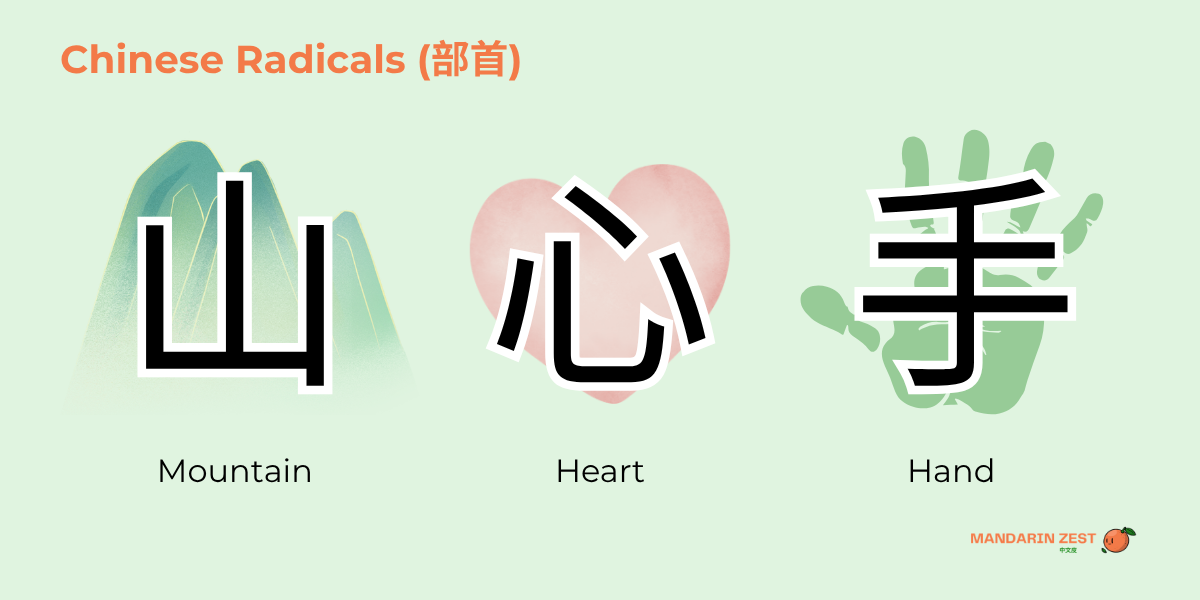
Most characters contain a radical — a component that often signals the character's meaning category. Some examples that appear constantly:
- 氵(water radical) → characters related to liquids, rivers, washing: 海 (sea), 河 (river), 泳 (swim)
- 人/亻(person radical) → characters about people and human actions: 他 (he), 休 (rest), 做 (do)
- 口 (mouth radical) → characters related to speech and eating: 吃 (eat), 叫 (call), 唱 (sing)
- 木 (wood radical) → characters related to trees and wood: 树 (tree), 桌 (table), 椅 (chair)
There are 214 traditional radicals in total. Learning the most common 50–100 gives you powerful pattern-recognition that speeds up learning for every character that follows. Radicals aren't just a memory trick — they're the actual structural logic of the writing system.
Phonetic Components: Sound Clues
Many characters also contain a phonetic component — a part that hints at pronunciation. This system isn't perfectly consistent (centuries of sound changes have blurred many connections), but at intermediate and advanced levels it becomes an increasingly useful clue.
Together, radicals and phonetic components mean that most characters carry information about both meaning and sound. The more you study, the more these patterns reveal themselves — and the faster you learn each new character.
The Structured Method: Five Steps That Work
Step 1: Learn Stroke Order from Day One
Stroke order — the precise sequence in which you draw each stroke of a character — matters more than most beginners expect. Getting it right:
- Makes your handwriting look natural and correct to native readers
- Helps you remember character structure more accurately
- Is essential for handwriting input on smartphones and tablets (which use stroke-order-based recognition)
- Builds the muscle memory that makes writing fast and automatic
The core rules are simple: top to bottom, left to right, horizontal before vertical, outside before inside. A good character writing workbook teaches and reinforces these from the start. Getting stroke order right early is far easier than correcting ingrained bad habits later.
Step 2: Write by Hand — Don't Just Type
This is the advice most learners resist in the age of smartphones. It's also the advice with the strongest research support.
Handwriting characters activates memory pathways that passive screen recognition doesn't. Studies in second language acquisition consistently show that handwriting produces significantly better long-term retention than typing or swiping. The physical act of reproducing a character — recalling each stroke, in order — is a form of active recall, which is the most effective memory consolidation technique available.
You don't need to write each character 50 times. Regular practice, even 10–15 minutes of focused handwriting per day, produces measurably better results than an hour of flashcard swiping.
Step 3: Follow HSK Order, Not Random Order
Don't learn characters based on what looks interesting or what you happen to encounter. Follow the New HSK vocabulary lists, which are sequenced by frequency and real-world usefulness.
The characters in HSK 1 are the ones that appear most often in everyday Chinese — in signs, menus, text messages, and conversation. Learning them first means you start recognising familiar characters almost immediately, which builds confidence and creates the positive feedback loop that sustains long-term study.
Random character learning produces patchy knowledge. Structured, frequency-based learning produces cumulative competence.
Step 4: Use Spaced Repetition for Review
Spaced repetition is a review system where you revisit material at increasing time intervals — just before you're about to forget it. It's the most thoroughly researched and consistently effective technique for long-term vocabulary retention.
Apps like Anki or Pleco implement spaced repetition well for character review. The key distinction: use spaced repetition for reviewing characters you've already learned through writing practice — not as a substitute for that initial learning. Recognition on a screen and active written recall are different cognitive processes, and you need both.
Step 5: Read Characters in Context as Soon as Possible
Character study in isolation — repeating writing drills on individual characters — builds a foundation, but vocabulary is only truly memorised through repeated encounters across different contexts.
As soon as you have a working base of HSK 1–2 characters, start reading graded readers that use those same characters in sentences and stories. This is the step that moves you from memorisation to genuine reading fluency — from knowing a character exists to recognising it instantly on the page without thinking.
The combination of daily handwriting practice + spaced repetition review + contextual reading is what produces real character literacy, not any one of them alone.
The Right Tools at Each Stage
Character Writing Workbooks
A dedicated workbook that covers characters level by level — with stroke order diagrams, writing grids, and HSK-aligned vocabulary — is the essential tool for the foundational stage. It keeps your study structured, ensures you cover the right characters in the right order, and provides the physical writing practice that no digital tool replicates.
Mandarin Zest's HSK 1 Character Writing Practice Book covers all HSK 1 characters with clear stroke order guidance and ample practice grids — structured specifically for independent learners.
Character Reference Posters
Visual environmental exposure is more effective than most learners expect. A comprehensive character chart — covering HSK 1–6 characters — on your wall or desk creates constant passive exposure to characters you're actively studying. This ambient reinforcement adds up significantly over weeks and months.
Graded Readers
Once your character foundation is in place, graded readers are the fastest route to reading fluency. They use controlled vocabulary at your exact HSK level, so you're reading real Chinese rather than isolated drill exercises — which is where characters transition from learned to genuinely known.
Digital Tools (as supplements)
Anki for spaced repetition review, Pleco for dictionary lookups, and handwriting input practice on your phone are all valuable — as supplements to structured study, not replacements for it.
Our HSK Materials
Are you planning to take the HSK exam? Check out our dedicated materials, designed by teachers for learners.
Common Mistakes That Stall Progress
Skipping stroke order. The bad habits you develop in the first few weeks are surprisingly hard to undo. Stroke order matters — learn it from the start.
Learning only through apps. Recognising a character when it's shown to you is not the same as being able to recall and write it. Both skills matter, and apps train only one of them.
Trying to learn too many at once. 10–15 new characters per day is productive and sustainable. Attempting 50 is not — retention collapses under volume without adequate review.
Ignoring radicals. Radicals are the fastest shortcut to understanding and remembering new characters. Learning them early pays dividends for years.
Waiting to start reading. Many learners plan to start reading "once they know enough characters." That day rarely comes on its own. Start reading at your level now — the reading is what makes the characters stick.
Realistic Timelines for Learning Chinese Characters
At a consistent pace of 10 new characters per day with regular review:
| Milestone | Timeframe |
|---|---|
| HSK 1 (~500 characters) | 6–8 weeks |
| HSK 1–3 (~2,000 characters) | ~6 months |
| Newspaper reading literacy (~3,000 chars) | 18–24 months |
| Advanced proficiency (~5,000+ chars) | 3–5 years |
These assume daily consistency. A week without practice sets back retention significantly — the compounding nature of spaced repetition works in both directions. Consistent daily practice of 20–30 minutes will outperform intensive weekend sessions every time.
Final Thoughts
Chinese characters are a mountain — but one with a clear, well-marked path. The learners who struggle are those who try to climb without a route: memorising randomly, relying on passive app recognition, or avoiding handwriting altogether.
Follow the structured method above — strokes first, radicals next, HSK order, daily handwriting, spaced repetition review, and early contextual reading — and what once looked like incomprehensible symbols will gradually become readable text, and eventually, second nature.
That moment when you look at a page of Chinese and understand it is one of the most rewarding experiences in language learning. With the right structure, it is closer than you think.
FAQ
Simplified Chinese (used in mainland China and Singapore) has fewer strokes and is what the HSK tests. Traditional Chinese (used in Taiwan, Hong Kong, and by many overseas communities) is more complex but preserves more of the historical radical structure. For most beginners, Simplified is the practical starting point. Once you're comfortable with Simplified, learning Traditional becomes considerably easier.
It depends on your goals. For passing HSK exams at levels 5 and above, and for any situation requiring handwriting, active writing ability is necessary. For casual reading and digital communication (where you type phonetically and select characters), recognition may be sufficient. That said, the act of writing is so valuable for memorisation that even learners who don't need to write by hand should do it as a study technique.
Educated adult native speakers typically know 5,000–8,000 characters in active use, and can recognise more passively. The Chinese government sets 3,500 characters as the standard for basic literacy.
Yes — native Chinese children spend years in school learning to read and write. But they're also learning grammar, vocabulary, and culture simultaneously, and they're not studying systematically with frequency-ordered lists. An adult learner with structured materials and focused daily study can achieve functional reading literacy faster than the timeline for native children.
Many Chinese words are single characters (好 = good, 书 = book), but many are two-character compounds (学习 = study, 朋友 = friend). You'll learn both simultaneously as your vocabulary grows. The HSK vocabulary lists include both single characters and multi-character words.
Yes — this is one of the more self-study-friendly aspects of Mandarin, because the rules are systematic and the learning materials are well-developed. A good workbook, a spaced repetition app, and graded readers give you everything you need to make strong independent progress.