
The elevator doors open on what should be the 4th floor — but the button simply doesn't exist. No mistake, no oversight. In China, the number 4 is so strongly associated with bad luck that it's quietly erased from buildings, phone numbers, wedding dates, and daily life altogether.
But why? And how did a single digit become so culturally loaded? Here's everything you need to know.
The Core Reason: Sound
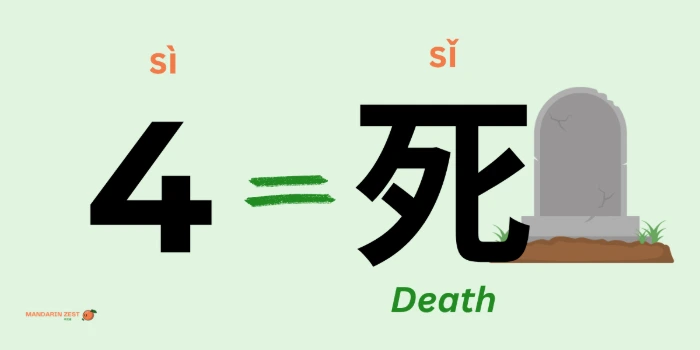
The avoidance of 4 in China comes down to one thing — pronunciation.
In Mandarin, the number 4 is pronounced sì, which sounds nearly identical to 死 (sǐ), the word for "death." In Cantonese and Shanghainese dialects, the two words sound even more alike. This phonetic overlap creates an immediate, subconscious association between the digit and mortality — turning an ordinary number into a symbol of misfortune.
Linguists call this phenomenon homophony-based superstition, and it's remarkably common across East Asia. Japan, Korea, and Vietnam all share a similar avoidance of 4 for the same reason, a legacy of shared linguistic and cultural ties to classical Chinese.
A History of Reversal: How 4 Went From Lucky to Unlucky
This wasn't always the case. In ancient China, 4 carried positive connotations — it represented stability, balance, and completeness. Evidence of this remains embedded in classical culture:
- The Four Great Classical Novels (Dream of the Red Chamber, Journey to the West, Romance of the Three Kingdoms, Water Margin)
- The Four Gentlemen of Chinese painting: plum, orchid, bamboo, and chrysanthemum
- The four seasons as a symbol of wholeness and natural order
- The idiom 四平八稳 (sì píng bā wěn) — meaning "steady and stable" — which carries an entirely positive meaning
So what changed?
The modern taboo emerged gradually through the 20th century, driven by three overlapping forces. First, Mandarin became China's standardized national language and spread widely — before that, regional dialects pronounced 4 very differently, so the death connection wasn't universal. Second, rapid urbanization brought people from different regions together, spreading and reinforcing shared cultural anxieties. Third, as Japan and Korea's similar 4-taboos became more widely known, cross-cultural reinforcement strengthened the association.
A folk belief became a social norm.
Where the Number 4 Taboo Shows Up Today
The avoidance of 4 is woven into everyday Chinese life — particularly in contexts involving health, safety, and important milestones.
Buildings and Real Estate
Walk into almost any apartment block, hotel, or hospital in China and you'll notice the floor numbering jumps from 3 to 5. Sometimes the 4th floor is relabeled "3A." This isn't just for the 4th floor — floors ending in 4, such as 14, 24, and 34, are frequently skipped as well.
Hospitals are especially strict. Ward numbers, particularly in ICUs and maternity units, routinely omit 4 entirely. When health and life are at stake, the symbolic stakes feel higher.
Real estate data backs this up: apartments on floors or in units containing 4 often sell at a measurable discount compared to equivalent units without it — sometimes 3–5% lower in markets like Hong Kong and mainland China.
Phone Numbers and License Plates
Mobile carriers in China regularly offer phone numbers without any 4s at a premium price. Numbers ending in auspicious digits like 8 or 6 command the highest prices. The same logic applies to vehicle license plates — plates containing 4 are less sought after and often sell for less at auction.
Weddings and Important Events
Couples planning weddings, housewarmings, or business openings typically avoid dates falling on the 4th, 14th, or 24th of any month. Invitation cards, banquet table numbers, and gift amounts are also carefully checked. In their place, dates and numbers containing 6 (smooth progress), 8 (prosperity), and 9 (longevity) are actively sought.
Who Still Follows the Taboo?
The short answer: it depends on generation, geography, and education.
Older generations and people in more traditional or rural communities tend to take the taboo seriously — not necessarily out of literal belief, but out of respect for convention and a desire not to tempt fate. Younger, urban, and highly educated Chinese people are generally more relaxed about it, and many will openly say it's superstition.
However, even skeptics often follow the taboo in situations involving family or elders, weddings, or business dealings — because being seen to ignore it carries its own social cost.
Why Does the Taboo Persist?
Even rational people follow social superstitions. The psychology here is well understood: when a behavior is low cost, widely shared, and linked to high-stakes outcomes (health, death, marriage), people default to caution. Avoiding the number 4 takes almost no effort and offends no one. Ignoring it, on the other hand, risks seeming disrespectful or careless.
Following the taboo is also a form of cultural solidarity — a way of signaling awareness and respect for shared values, even without personal belief. In a business negotiation or a gift-giving situation, choosing a 4-free number is simply good manners.
FAQ
The number 4 (sì) sounds almost identical to the Mandarin word for death (死, sǐ). This phonetic similarity has led to widespread cultural avoidance.
6, 8, and 9 are the most auspicious. The number 6 (liù) suggests smooth progress; 8 (bā) sounds like "prosperity" (发, fā); and 9 (jiǔ) sounds like "longevity" (久, jiǔ).
No. Japan, Korea, and Vietnam share similar avoidance of 4 due to the same phonetic association with death in their respective languages — a shared legacy of historical ties to classical Chinese.
Many do not, at least not strictly. Urban, educated younger generations often treat it as cultural tradition rather than genuine belief — but may still follow it out of respect for family or in formal contexts.
Yes. Research on housing markets in Hong Kong and mainland China has found statistically significant price differences between units with and without the number 4 in their address or floor number.

Xinyan Gong
Xinyan, originally from Xiamen, focuses on SEO and content creation, with experience in optimizing online content and developing engaging digital materials. She is committed to improving online visibility and delivering high-quality, targeted content.