
If you’re learning Mandarin Chinese, you’ve probably noticed something curious: many everyday words end in “zi” (子) — like 鞋子 (xiézi, shoes), 桌子 (zhuōzi, desk), or 杯子 (bēizi, cup).
But here’s the confusing part: 子 originally means “child.” So why does it appear in so many unrelated words?
Does it still mean “child”?
Is it always pronounced the same way?
And why does Mandarin use it so often?
Let’s break down the real meaning of the Chinese suffix “zi” (子) and why it plays such an important role in modern Mandarin.
What Does “Zi” (子) Mean in Chinese?
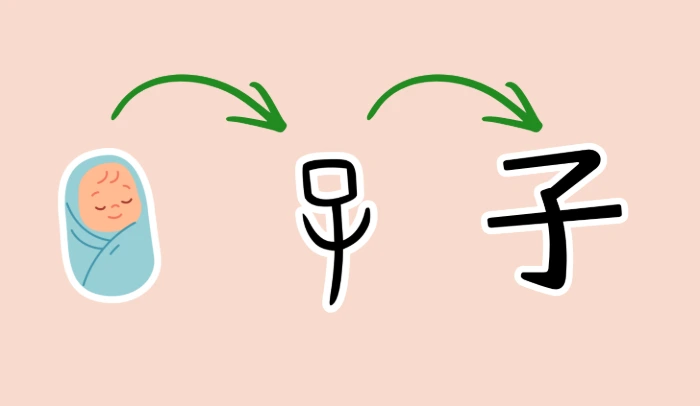
Evolution of the character 子
The character 子 (zǐ) originally meant:
- child
- son
- offspring
You can still see this meaning in words like:
- 王子 (wángzǐ) — prince
- 孔子 (Kǒngzǐ) — Confucius
- 母子 (mǔzǐ) — mother and child
However, in many modern everyday nouns, 子 no longer means “child” at all.
Instead, it functions as a suffix — a grammatical ending added to a word that usually has no independent meaning.
In words like:
- 桌子 (zhuōzi) — desk
- 椅子 (yǐzi) — chair
- 杯子 (bēizi) — cup
The “zi” doesn’t refer to a child. It simply helps form a natural-sounding noun.
Why Do Chinese Words End in “Zi”?
There are three major reasons why Mandarin frequently uses the suffix “-zi”.
1. Mandarin Prefers Two-Syllable Words
Modern Mandarin strongly favors two-syllable nouns over single-syllable words.
A single character like:
- 鞋 (xié) — shoe
is perfectly correct. But in everyday speech, native speakers usually say:
- 鞋子 (xiézi) — shoes
Adding “-zi” makes the word feel complete and natural.
Think of it like this: a one-syllable word can feel slightly abrupt, while two syllables create rhythm and balance in spoken Mandarin.
Common Examples
- 饺子 (jiǎozi) — dumpling
- 桌子 (zhuōzi) — desk
- 椅子 (yǐzi) — chair
- 杯子 (bēizi) — cup
- 被子 (bèizi) — quilt
In all these cases, 子 does not carry meaning — it simply helps form a standard two-character noun.
2. “Zi” Helps Avoid Confusion
Mandarin has many homophones — words that sound identical but have different meanings.
For example:
- 李 (lǐ) — plum
- 里 (lǐ) — inside
They sound exactly the same.
If we only said “lǐ,” context would be needed to understand the meaning.
But when we add the suffix:
- 李子 (lǐzi) — plum
Now it’s clearly different from:
- 里头 (lǐtou) — inside
Adding “-zi” reduces ambiguity and makes communication clearer.
This is one reason two-syllable words became dominant in modern Mandarin.
3. “Zi” Can Turn Verbs Into Nouns
Another important function of the suffix “zi” is changing a word’s grammatical role.
Some characters are originally verbs. When “-zi” is added, they become nouns.
For example:
- 梳 (shū) — to comb
- 梳子 (shūzi) — comb (the object)
Another example:
- 刷 (shuā) — to brush
- 刷子 (shuāzi) — brush
In these cases, 子 helps transform an action into a tangible object.
Is “Zi” Always Pronounced the Same?
No — pronunciation depends on usage.
When 子 means “child” or is part of a proper name, it is pronounced in the third tone:
- 子 (zǐ)
But when used as a suffix in everyday nouns like 桌子 or 杯子, it is usually pronounced in the neutral tone (轻声):
- zhuōzi
- bēizi
- yǐzi
This neutral tone makes speech flow more smoothly and is another reason the suffix feels light and grammatical rather than meaningful.
Is “Zi” Always Meaningless?
Not always.
There are three main uses of 子 in Mandarin:
- Independent noun meaning child/son
- Honorific or title marker (孔子, 老子)
- Grammatical suffix in modern nouns (桌子, 杯子)
When used as a suffix in common objects, it generally has no concrete meaning. Instead, it has become grammatical — linguists call this process grammaticalization, where a word gradually loses its original meaning and takes on a structural role.
Do All Chinese Nouns Use “Zi”?
No.
Many nouns do not use the suffix:
- 书 (shū) — book
- 人 (rén) — person
- 水 (shuǐ) — water
There is no strict rule for when 子 appears. It developed historically and became common with certain everyday objects, especially in Northern Mandarin.
Because of this, learners usually need to memorize which nouns naturally include “-zi.”
Our HSK 1 Materials
Are you planning to take the HSK 1 exam? Check out our dedicated materials, designed by teachers for learners.
Why Understanding the “Zi” Suffix Matters for Learners
If you’re studying Mandarin, understanding the suffix “zi” helps you:
- Sound more natural
- Avoid pronunciation mistakes (neutral tone!)
- Understand word formation patterns
- Recognize when 子 carries meaning and when it doesn’t
Instead of thinking “child” every time you see 子, think of it as a small structural helper that makes Mandarin words whole and rhythmic.
Final Thoughts: The Real Meaning of “Zi” in Chinese
So why do so many Chinese words end in “zi”?
Because modern Mandarin prefers two-syllable words, aims to reduce ambiguity, and uses suffixes to form natural nouns.
In most everyday words like 桌子, 杯子, or 饺子, the suffix 子 no longer means “child.” It’s simply part of how the language evolved.
Next time you see 子 at the end of a word, don’t translate it literally — recognize it as one of Mandarin’s quiet grammatical helpers making speech smooth, clear, and balanced.
FAQ
Originally, 子 means “child” or “son.” However, in many modern nouns, it functions as a suffix without independent meaning.
When used as a suffix, 子 is typically pronounced in the neutral tone to create smoother, more natural speech rhythm.
No. Only certain nouns historically developed with this suffix.
It is most common in Standard Mandarin and Northern varieties. Usage may differ across Chinese dialects.

Xinyan Gong
Xinyan, originally from Xiamen, focuses on SEO and content creation, with experience in optimizing online content and developing engaging digital materials. She is committed to improving online visibility and delivering high-quality, targeted content.