
If you've spent any time in the Chinese capital, you've probably noticed that the Mandarin you hear on the street doesn't always match the Mandarin from your textbook. Sentences seem to blur together, certain syllables vanish entirely, and there's a persistent "r" sound tacked onto the end of all kinds of words.
This is Beijinghua (北京话, Běijīnghuà), the local dialect — and while it shares a common ancestor with the Standard Chinese (普通话, pǔtōnghuà) taught in classrooms worldwide, it has its own grammar quirks and its own private vocabulary.
This guide pulls together what's known about where the dialect came from, how its signature "erhua" sound actually works, what makes its vocabulary distinct, and why fewer and fewer Beijingers speak it fluently today.
Where Standard Mandarin and the Beijing Dialect Diverge

It's worth clearing up a common point of confusion first: Standard Mandarin (普通话) is not the same thing as the Beijing dialect, even though the two are close cousins.
When the People's Republic of China needed to settle on a national language in the 20th century, it based Putonghua's pronunciation on Beijing speech, since Beijing was the political and cultural capital. But "based on" is not "identical to." The Beijing dialect kept a layer of local vocabulary, grammar patterns, and pronunciation habits that never made it into the standardized national language.
Geographically, the term "Beijing dialect" is used a little loosely. Strictly, it refers to the speech of urban Beijing, but linguists sometimes group it with closely related speech from parts of Hebei and Liaoning, since the differences are minor. Even within the city, there's variation: the accent tends to be stronger and more colloquial in the older, working-class southern districts than in more recently developed or administratively formal parts of town, and there's a recognized split between "Old Beijing dialect," the version still spoken by older residents of the hutongs, and a "New Beijing dialect" that has drifted much closer to standard Mandarin.
A Language Shaped by Eight Centuries of History
The roots of the Beijing dialect stretch back to the Yuan dynasty (1271–1368), when Beijing — then called Dadu (大都, Dàdū, meaning "big capital)— became the Mongol-ruled capital of China. The speech of that era, sometimes called the Dadu dialect, absorbed vocabulary and pronunciation habits from the Mongolian-speaking rulers and administrators who settled there.
Over the following centuries, the Ming and Qing dynasties brought further layers: elements of the Nanjing dialect arrived when the Ming court relocated its capital, and Manchu vocabulary worked its way in during the Qing dynasty, when Beijing was again the seat of a non-Han ruling class.
Our HSK 1 Materials
Are you planning to take the HSK 1 exam? Check out our dedicated materials, designed by teachers for learners.
By the early 1800s, the Beijing dialect had overtaken the Nanjing dialect as the preferred speech of the imperial court and ruling elite, cementing its prestige status well before it had any official role as a "national" language. That formal role came later.
Efforts to standardize Chinese pronunciation intensified during the Republic of China period, culminating in a 1918 pronunciation standard rooted in Beijing speech, and after 1949 the new government built Putonghua on the same foundation, reinforced in the 1950s by the introduction of the pinyin romanization system.
The dialect's cultural footprint runs deep, too. Dream of the Red Chamber, one of the most celebrated novels in Chinese literature, was written in the vernacular Beijing speech of its time rather than in formal Classical Chinese, and the 20th-century novelist Lao She built his reputation on capturing the rhythms and slang of Beijing street life.
Because Beijing has also long been the base of China's film and television industry, the dialect is disproportionately represented in Chinese pop culture — and it's especially associated with xiangsheng (相声), the crosstalk comedy routines that function as something close to Chinese stand-up. That association has given the accent a reputation among other Chinese speakers for being witty, brash, and a little theatrical.
The Sound of Beijing: Erhua and Beyond
What erhua actually is
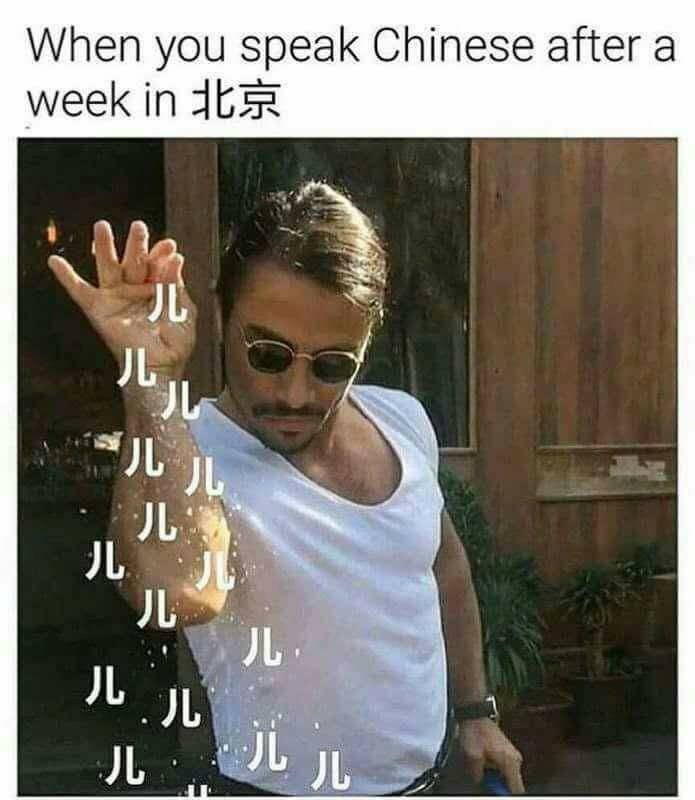
The single most recognizable feature of the Beijing accent is érhuà (儿化), sometimes called erization or rhotacization. Structurally, it isn't a separate syllable — even though 儿 (ér) is a full syllable on its own in a word like 儿子 (érzi, "son"), when it's used as this suffix it fuses into the syllable before it, coloring the vowel with an "r" sound rather than adding an audible extra beat. So 花 (huā, "flower") plus erhua doesn't become "huā-ér"; it becomes 花儿 (huār), pronounced as one syllable with an r-colored vowel.
The mechanics get more specific from there. When erhua attaches to a syllable ending in -n or -ng, the nasal sound drops out of pronunciation even though it's still written — you say the r-sound instead. Vowels shift slightly too: a syllable like shi combined with erhua ends up sounding closer to "shar."
Linguists studying the standard version of erhua have documented fairly precise rules for these shifts (nasal codas deleting, certain vowels centralizing, glides forming), but in everyday Beijing speech the process is applied far more liberally and unpredictably than the tidy version taught in phonetics textbooks.
Join the Mandarin Zest Club
Join the Mandarin Zest Club and become part of a welcoming international community of Chinese learners from all over the world. Practice together, stay motivated, and connect with people who share your goals for learning Mandarin.

Why Beijingers add it — three functions, not one
Non-native learners often assume erhua is simply decorative, but Beijing speakers and linguists generally describe it as doing at least three different jobs, and it helps to keep them separate:
1. Diminutive or affectionate meaning. This is the function most textbooks emphasize: adding 儿 to a noun can shrink it, soften it, or add warmth. 米粒 (mǐlì, "rice grain") becomes 米粒儿; 花 (huā, "flower") becomes 花儿, often implying something small or lovely rather than just "flower" in the generic sense; 老伴 (lǎobàn, "life partner") becomes 老伴儿, with a note of fondness.
2. Distinguishing meaning or part of speech. Sometimes erhua isn't optional flavor at all — it changes what a word means or how it functions grammatically. 头 (tóu, "head") becomes 头儿 (tóur), "boss." 眼 (yǎn, "eye") becomes 眼儿 (yǎnr), "small hole." 信 (xìn, "letter") becomes 信儿 (xìnr), "news" or "word" (as in a piece of information). 尖 (jiān) as an adjective meaning "sharp" becomes 尖儿 (jiānr) as a noun meaning "tip."
Perhaps the starkest example: 白面 (báimiàn) is ordinary "flour," but 白面儿 (báimiànr) is street slang for heroin. These aren't cases where you could take erhua or leave it — using or dropping the suffix changes the word.
3. Casualness and conversational flow. The third function is more about texture than meaning. Beijing speech is often described, even by Beijingers themselves, as having a relaxed, slightly "lazy" quality, and erhua contributes to that — it's easier to glide from one syllable into another with the r-coloring than without it.
A phrase like 今天儿 (adding 儿 after "today") doesn't change the meaning of "today" at all; it just makes the phrase feel more casual and native. This casual register is part of why erhua is generally reserved for informal speech — piling it into a formal or written context can sound as out of place as slipping slang into a business email.
The best Chinese materials!
Chinese doesn’t have to be complicated
with the right tools and structure, it actually makes sense.

The frustrating part: there's no reliable rule for when to use it
If you're hoping for a clean grammatical formula — "add 儿 to all nouns of type X" — you won't find one, and this is worth saying plainly so learners don't waste time hunting for a rule that doesn't exist. A restaurant can be casually called 饭馆儿 (fànguǎnr), but a museum is never 博物馆儿 — it stays 博物馆 (bówùguǎn).
Chinese teachers who specialize in the dialect generally tell students that the placement is largely intuitive, learned by exposure rather than by rule, and that even native Beijingers can't always explain why one word takes it and another doesn't. The practical advice from teachers and long-time learners alike is consistent: don't try to erhua-ify random vocabulary from your textbook; instead, absorb it word-by-word by listening to real speech.
Erhua is also unevenly distributed geographically within Chinese. It's central to Beijing speech and common in Mandarin dialects across northern China, and it even shows up in some southwestern Mandarin varieties like those of Chengdu and Chongqing. Many speakers of non-Mandarin languages in southern China, by contrast, find the sound difficult to produce and tend to avoid erhua-heavy vocabulary even when speaking standard Mandarin, and it's essentially absent from Taiwanese Mandarin. So the "erhua-heavy" ear you're developing in Beijing genuinely will not transfer everywhere else in the Chinese-speaking world.
It's not just erhua: speed, rhythm, and swallowed syllables
Erhua gets most of the attention, but it's only one piece of what makes Beijing speech sound distinct. Beijingers are known for talking fast and running syllables together, sometimes dropping sounds almost entirely. The classic example is 不知道 (bù zhīdào, "I don't know"), which in rapid Beijing speech can come out sounding close to "bur dao," with the middle syllable swallowed and the resulting compressed sound taking on an r-colored quality of its own.
Similarly, 西红柿 (xīhóngshì, "tomato") gets run together into something that sounds like "xiōng shì" — which is how the famous dish 西红柿炒鸡蛋 (tomato and scrambled eggs) ends up jokingly rendered as "胸是炒鸡蛋" ("chest is scrambled eggs") in local slang, since 胸是 sounds identical to the compressed pronunciation of "tomato."
There are also more subtle stress patterns: in two-syllable words, Beijing speech often puts noticeably more weight on the first syllable than the second, and certain words that function as both nouns and verbs — like 言语 ("speech" / "to say something") — get stressed differently depending on which role they're playing in the sentence.
On top of that, the vowel space is shifted somewhat — some describe the accent as being produced with the tongue pulled slightly further back in the mouth than in standard Mandarin, giving it a rounder, "back-of-the-throat" quality that's hard to imitate without a lot of listening practice.
Words You Won't Find in a Standard Textbook

Beyond the sound of the dialect, Beijing has built up its own private vocabulary over the centuries — words and phrases that either don't exist in Putonghua at all, or that mean something different locally. Some are still in everyday use; others are fading fast, kept alive mainly by older residents. Here's a broader sampling, combining well-documented local vocabulary with the phrases most often cited as distinctly Beijing:
- 倍儿 (bèi'ér) — "very," used in place of just 很 (hěn) or 非常 (fēicháng). 倍儿爽 (bèi'ér shuǎng) means "really great/satisfying"; 倍儿新 (bèi'ér xīn) means "brand new."
- 撸串儿 (lūchuànr) — "to eat," specifically to eat grilled meat skewers (chuànr), a beloved Beijing street food that originally came from Xinjiang. 撸 (lū) literally means to strip something off, evoking the act of pulling meat off the skewer.
- 今儿个 (jīnr gè) — "today," alongside 明儿个 (míngr gè, "tomorrow") and 后儿个 (hòur gè, "the day after / later").
- 老家儿 (lǎojiār) — in standard Mandarin, 老家 means "hometown," but in Beijing dialect it shifts to mean "parents."
- 发小儿 (fàxiǎor) — a childhood friend, someone you've known since you were small; carries a warm, nostalgic connotation of long, unbroken friendship.
- 老炮儿 (lǎopàor) — an old-school, streetwise Beijing man, often one who's spent his life in the city and holds onto a certain code of loyalty and toughness; this term was popularized nationally by the 2015 film Mr. Six (老炮儿), directed by Guan Hu.
- 鸡贼 (jīzéi) — literally "chicken thief," used to describe someone stingy, cheap, or sneakily self-interested; often thrown at friends half-jokingly rather than as a serious insult.
- 眼力见儿 (yǎnlì jiànr) — social awareness; the ability to read a room and know how to act appropriately, particularly around seniority and hierarchy. Someone praised as 有眼力见儿 (yǒu yǎnlì jiànr) knows, for instance, to stand and greet the boss the moment he arrives at a dinner.
- 寻摸 (xúnmo) — to search or look around for something.
- 遛弯儿 (liùwānr) — to go for a leisurely walk or stroll.
- 嘛 (ma) — a casual sentence-final or mid-sentence particle, as in 你干嘛去?("Where are you off to?")
- 翻扯 (fānchě) — literally "to turn over," but locally used to mean getting worked up, anxious, or angry.
- 完菜 (wáncài) — "finished" or "done for," literally "the dish is finished," with 菜 tacked on as a filler suffix without independent meaning.
- 羊上树 (yáng shàng shù) — literally "sheep climbing a tree," used to describe someone making an unreasonable or overly difficult demand of others.
- 胡同串子 (hútòng chuànzi) — a bit of local slang for a neighborhood gossip, someone who wanders the hutongs (Beijing's traditional narrow alleyways) carrying news from door to door.
There's also a well-known local saying that captures the flavor of these east-west neighborhood distinctions: "渴不死东城,饿不死西城" — "you won't die of thirst in Dongcheng (the East District), and you won't die of hunger in Xicheng (the West District)." The joke plays on old greeting customs: in the east, the traditional greeting translates to "have you had something to drink yet?", while in the west it's "have you eaten yet?"
For scale, this is genuinely a large and systematic body of vocabulary rather than a handful of slang terms — a specialized dictionary devoted just to erhua words in the Beijing dialect runs to roughly 7,000 entries, and a broader Beijing dialect dictionary catalogs several thousand single-character words alongside well over ten thousand multi-character phrases. Most learners will only ever pick up a small fraction of this in casual conversation.
Where the Hutongs Come In

Much of the "old" Beijing dialect is tied culturally and physically to the hutongs (胡同) — the narrow alleyways lined with traditional courtyard homes (四合院, sìhéyuàn) that once made up most of central Beijing. The word hutong itself is generally traced to a Mongolian term related to "water well," reflecting the Yuan-dynasty origins of these neighborhoods, when communities were built up around shared wells.
For centuries, hutong life meant dense, face-to-face communities where neighbors were constantly in and out of each other's homes and lives — exactly the kind of environment where local slang, in-jokes, and idiosyncratic pronunciation could take hold and spread.
That environment has been steadily disappearing. Waves of demolition — accelerating through the 1980s and 90s and continuing into the 2000s as Beijing modernized and built out its ring roads and skyscrapers — have destroyed the majority of the city's historic hutongs, and with them, much of the daily social fabric that kept old Beijing speech alive and evolving. Residents who once lived shoulder-to-shoulder in these alleys have been resettled into high-rise apartment blocks, where the kind of casual, constant neighborhood chatter that nurtured the dialect is far less common.
Is the Dialect Dying Out?
By most accounts, yes — or at least fading fast in its fullest form. The number of fluent speakers of the "old" Beijing dialect is difficult to pin down precisely, but the trend is clearly downward, and many young Beijingers today can barely understand the heaviest, most slang-dense version of the dialect, let alone speak it. What's emerging instead is something of a hybrid: a version of local speech that keeps some erhua and a handful of signature phrases, but that leans much closer to standard Mandarin than the dialect spoken by residents a generation or two ago.
Several forces are driving this. Beijing's enormous population growth has been fueled largely by migration from other parts of China, diluting the concentration of long-term local families who would have passed the dialect down at home. The hutong demolitions removed the physical neighborhoods where the dialect was densest. And national language policy has consistently prioritized promoting standard Mandarin in schools and media, leaving little institutional support for teaching or preserving the local dialect, even though some linguists have floated the idea of introducing it in local classrooms as a preservation measure.
There is a countervailing cultural pull, though: the Beijing accent still carries real cachet in Chinese pop culture, largely because of its association with crosstalk comedy and with a certain "authentic," street-smart Beijing persona in film and television. That means the accent is fairly widely recognized and even affectionately mimicked across China, even as the number of people who speak the full dialect natively keeps shrinking.
join our discord server!
Join the Mandarin Zest community on Discord. Discover Chinese pop culture and internet trends, chat with fellow learners, and interact with teachers and fluent moderators.

Practical Advice for Learners
If you're studying in Beijing and want to sound more natural rather than textbook-stiff, a few points are worth keeping in mind:
- Separate "erhua" from "hundreds of local words." You can pick up the rhythm and some erhua habits without trying to master the deeper local vocabulary — they're related but not the same project, and trying to do both at once is a lot to bite off.
- Learn erhua words individually, not as a rule you apply on the fly. Since there's no dependable pattern for which nouns take it, treat each erhua'd word you encounter as its own vocabulary item to memorize, the same way you'd memorize an irregular verb.
- Reserve erhua for casual contexts. It signals informality, so it isn't something you'd use in a formal meeting, a presentation, or written Chinese outside of dialogue and slang writing.
- Listen more than you produce, at least at first. Because the accent involves subtle shifts in speed, stress, and vowel quality — not just the addition of "r" sounds — it's easy to overdo an imitation and end up sounding like a caricature rather than a fluent local speaker. Many long-term learners and even some Beijing natives will tell you that a foreigner affecting a strong Beijing accent can come across as trying too hard; a lighter touch, built from genuine listening exposure over time, tends to land better.
- Don't expect it to transfer. An ear tuned to Beijing's rapid, erhua-heavy speech may not serve you well elsewhere in China — plenty of Chinese speakers, particularly in the south, don't use erhua at all and can find a heavy Beijing accent an odd or amusing thing to hear from a foreign learner.
None of this should discourage you from picking up the flavor of the dialect while you're there. Just treat full fluency in the accent as a long-term listening project rather than something you can systematize from a list of rules, because — by every account from linguists and native speakers alike — that systematic rule simply doesn't exist.
FAQ
Standard Mandarin, or Putonghua (普通话, pǔtōnghuà) — the same national language taught in classrooms everywhere. What you'll additionally hear layered on top, especially from older or lifelong residents, is Beijinghua (北京话, běijīnghuà), the local dialect, with its own accent, slang, and grammar habits.
Somewhere in between. It isn't a separate language — a Putonghua speaker can generally follow it — but it's more than "just an accent." It has its own local vocabulary (thousands of words and phrases that don't exist in Putonghua), its own grammatical quirks, and pronunciation habits like erhua that go well beyond what most people mean by "accent." Linguists typically classify it as a dialect of Mandarin.
Érhuà, or "erization," is the practice of adding an "r" sound to the end of a syllable — written with the character 儿 (ér) — most associated with Beijing and other northern Chinese speech. It fuses into the syllable before it rather than forming its own beat, so 花 (huā, "flower") becomes 花儿 (huār), not "huā-ér." It can make a word smaller or more affectionate, change its meaning entirely, or simply make speech sound more casual.
There's no reliable rule — that's the honest answer, confirmed by native Beijing Chinese teachers themselves. A restaurant is casually 饭馆儿 (fànguǎnr), but a museum is never 博物馆儿. The practical approach is to learn erhua'd words individually as you encounter them in real speech, rather than trying to apply a formula to your existing vocabulary.
Not necessarily. Erhua and rapid, run-together speech are strongly associated with Beijing and the north; many speakers in southern China rarely use erhua and may even find a heavy Beijing accent unusual coming from a foreign learner. Think of it as a regional flavor to recognize and enjoy locally, not a universal skill that transfers across China.

Dorota Maczuga
Originally from Poland, Dorota developed a passion for Chinese in high school and spent several years in mainland China and Taiwan. She earned a Chinese-taught Master’s in Political Science from National Taiwan University.