Most guides on Zhuyin either overwhelm you with theory or underestimate how quickly a motivated learner can get through the system. The honest truth: Zhuyin has 37 symbols. If you spend one focused afternoon on it — three to four hours of real practice — you can learn all of them well enough to start using them.
This guide gives you the exact method to do that.
What Is Zhuyin (Bopomofo) and Why Learn It?
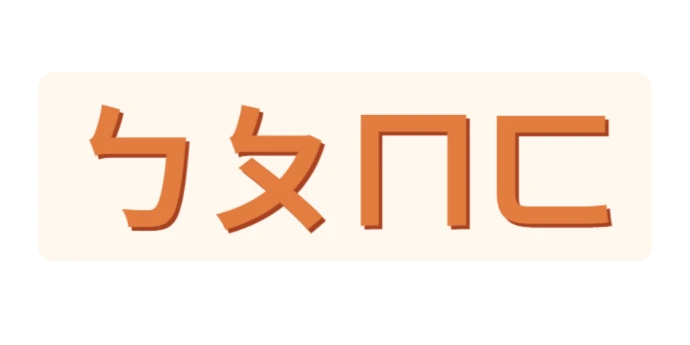
Zhuyin Fuhao (注音符號, zhùyīn fúhào), commonly called Bopomofo after its first four symbols (ㄅ ㄆ ㄇ ㄈ), is the phonetic system used in Taiwan to represent Mandarin pronunciation. It was developed in 1913 and remains the standard phonetic system in Taiwan — used in children's books, dictionaries, and as the primary text input method on Taiwanese phones and computers.
If you're learning Simplified vs Traditional Chinese and focusing on Taiwan, Zhuyin isn't optional — it's how the language is taught and how native speakers input text. But even for mainland-focused learners, Zhuyin has real advantages:
It forces correct pronunciation. Pinyin uses Roman letters that already have sounds in your head. When you see "x" in pinyin, your brain wants to say the English "x." Zhuyin symbols are visually unfamiliar, so your brain has no existing associations — you're forced to learn the Mandarin sound from scratch without interference.
It's how Taiwanese dictionaries work. If you want to use a Taiwanese Chinese dictionary, a children's book with phonetic annotation, or the input system on a Taiwanese phone, you need Zhuyin.
It's faster than you think. 37 symbols. That's it. By comparison, English has 26 letters but far more inconsistent sound-spelling relationships. Zhuyin is completely consistent — one symbol, one sound, no exceptions.

The 37 Symbols: What You're Actually Learning
Zhuyin has three categories of symbols:
21 consonants (initials):
ㄅ ㄆ ㄇ ㄈ ㄉ ㄊ ㄋ ㄌ ㄍ ㄎ ㄏ ㄐ ㄑ ㄒ ㄓ ㄔ ㄕ ㄖ ㄗ ㄘ ㄙ
16 vowels and vowel combinations (finals):
ㄚ ㄛ ㄜ ㄝ ㄞ ㄟ ㄠ ㄡ ㄢ ㄣ ㄤ ㄥ ㄦ ㄧ ㄨ ㄩ
4 tones marked with diacritics:
ˊ (2nd), ˇ (3rd), ˋ (4th), ˙ (neutral) — the 1st tone has no mark
Most syllables in Mandarin are formed by combining one consonant + one vowel/final. The combination ㄅ + ㄚ = ㄅㄚ (bā, eight). That's the system.
The One-Afternoon Method
This approach assumes you have about 3-4 hours and genuine focus. It works best if you do it in one sitting rather than spreading it across days — the symbols need to become automatic before interference sets in.
Step 1: Understand the system first (20 minutes)
Before memorising any symbols, spend 20 minutes understanding the overall architecture.
Read through the full symbol table with their pinyin equivalents once. Don't try to memorise anything yet — just build a mental map. Notice which symbols look similar to each other, which groups share sound families (the ㄅ ㄆ ㄇ ㄈ group are all bilabial sounds, like English b/p/m/f).
The key insight: Zhuyin symbols were designed to look like simplified Chinese characters, and some of them are. ㄇ looks like the character 冂. ㄏ resembles a simplified form. This visual connection helps some learners anchor new symbols.
Step 2: Learn the consonants in groups (60 minutes)
Don't try to learn all 21 consonants at once. Group them by articulation — sounds made in the same part of the mouth are naturally related and easier to learn together.
Group 1 — Lips (ㄅ ㄆ ㄇ ㄈ): b, p, m, f. The easiest group — these are identical to English sounds. Start here. Five minutes maximum.
Group 2 — Tongue tip (ㄉ ㄊ ㄋ ㄌ): d, t, n, l. Also essentially identical to English. Another five minutes.
Group 3 — Velar (ㄍ ㄎ ㄏ): g, k, h. Familiar sounds. Quick.
Group 4 — Palatal (ㄐ ㄑ ㄒ): These are the first sounds with no English equivalent — j, q, x in pinyin. The tongue goes further forward than in English. These need more time — about 15 minutes drilling the sounds alongside the symbols.
Group 5 — Retroflex (ㄓ ㄔ ㄕ ㄖ): zh, ch, sh, r — sounds made with the tongue curled back. These are the ones that most differentiate Mandarin from other languages and from Taiwanese Mandarin (which often doesn't use retroflexes). Give these 15 minutes.
Group 6 — Dental sibilants (ㄗ ㄘ ㄙ): z, c, s. 10 minutes.
Use the free Mandarin Zest Zhuyin practice tool after each group — it lets you test recognition immediately rather than waiting until the end. Testing after each group, rather than all at once, is significantly more effective for retention.
Step 3: Learn the vowels and finals (40 minutes)
The 16 finals are where most learners slow down, but the system is logical.
Simple vowels (ㄚ ㄛ ㄜ ㄞ ㄟ ㄠ ㄡ ㄢ ㄣ ㄤ ㄥ ㄦ): These are the core vowel sounds. Many have pinyin equivalents you already know (a, o, e, ai, ei, ao, ou, an, en, ang, eng, er). Learn these first.
Medials (ㄧ ㄨ ㄩ): i, u, ü — the three vowels that function as both standalone finals and as starting sounds that modify what follows. These are important because they appear constantly in combinations.
For each final, don't just memorise the symbol — say the sound out loud repeatedly while looking at it. The sound-symbol connection needs to be automatic, not mediated by pinyin.
Step 4: Practise combinations (45 minutes)
Zhuyin is most useful when you can read complete syllables instantly — consonant + final + tone mark. This step drills exactly that.
Take 20 common syllables and practise reading them in Zhuyin:
- ㄇㄚ (mā — mother)
- ㄋㄧˇ (nǐ — you)
- ㄏㄠˇ (hǎo — good)
- ㄒㄧㄝˋ (xiè — thank)
- ㄓㄨㄥ (zhōng — middle/China)
- ㄍㄨㄛˊ (guó — country)
- ㄩˊ (yú — fish)
- ㄒㄩㄝˊ (xué — study)
The Mandarin Zest Zhuyin tool includes combination practice — use it here to test your ability to read complete syllables rather than individual symbols.
Step 5: Tones (20 minutes)
Zhuyin tones are marked differently from pinyin:
| Tone | Pinyin mark | Zhuyin mark | Example |
|---|---|---|---|
| 1st (flat) | ā | ㄇㄚ | |
| 2nd (rising) | á | ˊ | ㄇㄚˊ |
| 3rd (dipping) | ǎ | ˇ | ㄇㄚˇ |
| 4th (falling) | à | ˋ | ㄇㄚˋ |
| Neutral | a | ˙ | (light syllable) |
One difference from pinyin: in Zhuyin, the 1st tone is unmarked — you add a mark for the other tones, and the absence of a mark indicates 1st tone. This takes about 10 minutes to get used to.
For a complete explanation of how Mandarin tones work, the tones guide covers everything in full before you connect it to Zhuyin notation.
Step 6: Test yourself on everything (30 minutes)
At the end of the afternoon, go through the complete symbol table and write down the sound for each symbol without looking at any reference. Note which ones you hesitate on — those are the ones to drill again.
Then: change your phone's input method to Zhuyin and try typing five words you already know in Mandarin. The practical pressure of actually using it consolidates learning much faster than passive review.
What Makes Zhuyin Stick (And What Doesn't)
What works:
- Drilling sounds out loud, not silently
- Testing yourself immediately after each group rather than at the end
- Using a real input method on your phone — the practical urgency forces retention
- Short, frequent sessions on the same day rather than one long cramming session
What doesn't work:
- Trying to learn Zhuyin and pinyin equivalents simultaneously — learn the Zhuyin sound directly, not through pinyin translation
- Passive reading without testing
- Stopping after recognition without practising production (typing or writing)
After the Afternoon: Where to Go Next
Learning the 37 symbols is the beginning, not the end. Once you can identify every symbol, the next step is using Zhuyin in real reading contexts — children's books annotated with Zhuyin, Taiwanese dictionaries, input on a Taiwanese device.
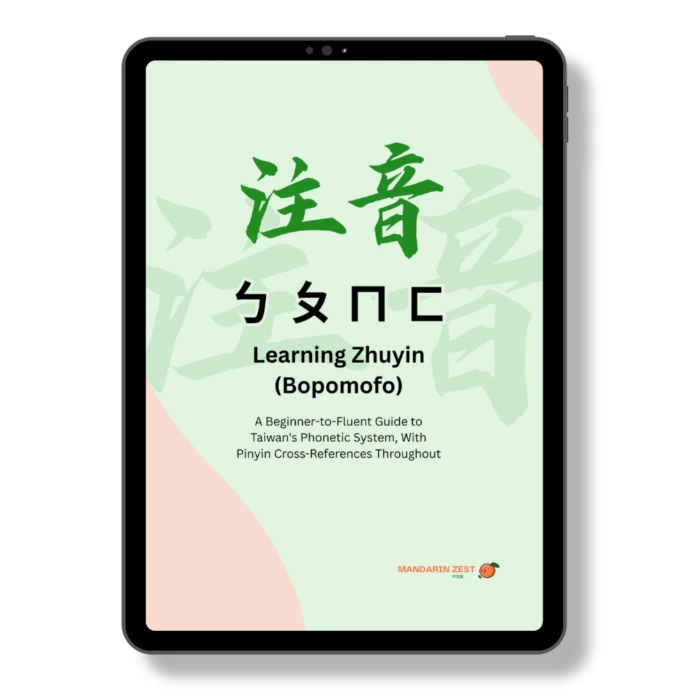
For a structured path from symbol recognition to real Zhuyin literacy, the Mandarin Zest Zhuyin Bopomofo Beginner Bundle covers the full system — symbol guide, writing workbook, and printable reference poster — everything you need to go from zero to functional Zhuyin in one structured package.
Learn Zhuyin
Our beginner guide covers everything you need to know about Zhuyin; from its history to how to efficiently type it on a keyboard.
It comes with a workbook and printable poster!
Zhuyin vs Pinyin: The Honest Comparison
This question comes up every time Zhuyin is mentioned, so worth addressing directly.
Pinyin advantages: Universal — used in mainland China, recognised internationally, required for the HSK exam, used in most learning materials aimed at Western learners.
Zhuyin advantages: No Roman letter interference — your brain learns pure Mandarin sounds. Essential for Taiwan. Used in Taiwanese children's books and dictionaries. Often faster once mastered, because Taiwanese typists are generally faster with Zhuyin than pinyin.
The honest answer: If your focus is mainland China or the HSK, learn pinyin first. If your focus is Taiwan, Traditional Chinese, or you want to use the phonetic system native speakers use — learn Zhuyin. What is pinyin and do you really need it covers this comparison in more detail.
Some serious learners eventually learn both. They serve different contexts and the learning transfer between them is easier than starting from scratch.
The Complete Zhuyin Symbol Reference
Initials (consonants):
| Symbol | Pinyin equivalent | Sound |
|---|---|---|
| ㄅ | b | as in "bay" |
| ㄆ | p | as in "pay" |
| ㄇ | m | as in "may" |
| ㄈ | f | as in "far" |
| ㄉ | d | as in "day" |
| ㄊ | t | as in "take" |
| ㄋ | n | as in "nay" |
| ㄌ | l | as in "lay" |
| ㄍ | g | as in "go" |
| ㄎ | k | as in "keep" |
| ㄏ | h | as in "hay" |
| ㄐ | j | no English equivalent |
| ㄑ | q | no English equivalent |
| ㄒ | x | no English equivalent |
| ㄓ | zh | retroflex |
| ㄔ | ch | retroflex |
| ㄕ | sh | retroflex |
| ㄖ | r | retroflex |
| ㄗ | z | as in "reads" |
| ㄘ | c | as in "cats" |
| ㄙ | s | as in "say" |
Finals (vowels):
| Symbol | Pinyin equivalent |
|---|---|
| ㄚ | a |
| ㄛ | o |
| ㄜ | e |
| ㄝ | ê |
| ㄞ | ai |
| ㄟ | ei |
| ㄠ | ao |
| ㄡ | ou |
| ㄢ | an |
| ㄣ | en |
| ㄤ | ang |
| ㄥ | eng |
| ㄦ | er |
| ㄧ | i |
| ㄨ | u |
| ㄩ | ü |
FAQ
The 37 symbols can be learned to recognition level in one focused afternoon. Using them fluently for reading and input takes longer — several weeks of daily exposure to Zhuyin-annotated text.
Not strictly — Simplified Chinese learners use pinyin, and the HSK tests pinyin. But if you ever want to engage with Taiwanese materials, use a Taiwanese phone, or read children's books from Taiwan, Zhuyin becomes necessary.
Primarily Taiwan. Some overseas Chinese communities maintain Zhuyin use, particularly those with Taiwanese roots. Mainland China and Singapore use pinyin exclusively.
Yes — Zhuyin input is the standard method on Taiwanese phones and computers. It's available as a keyboard option on iPhone (Settings → General → Keyboard → Add New Keyboard → Chinese Traditional → Zhuyin) and Android.
The Mandarin Zest Zhuyin practice tool is free and covers symbol recognition, audio, and combination practice in one place.