
Pronouncing Chinese tones has never been the hard part for me. Once someone shows you that 妈 (mā, mother) is flat and high while 马 (mǎ, horse) dips low before rising, you can produce those sounds reasonably well after some practice. The muscles learn.
What's genuinely hard — and what nobody warned me about — is remembering which tone belongs to which character when you're not looking at the tone mark. You learn 好 (hǎo, good) and move on. A week later, mid-conversation, you can picture the character perfectly. You know what it means. But is it third tone? Second? The tone mark has somehow disappeared from your memory while the character stayed.
This is the actual tone problem. Not production — retrieval.
I'm a visual learner. When I listen to someone speak, I involuntarily generate mental subtitles — the words appear in my mind's eye as I hear them. When I speak, I see the characters as I produce them. I can't turn this off. It's just how my brain processes language. And once I understood this about myself, it pointed directly to the solution: if I was going to see the characters in my mind anyway, I might as well see them in color.
The Color System
The idea is simple. Assign a consistent color to each of the four tones, then always study and visualize characters in those colors. Over time, your brain stops consulting the tone mark and starts consulting the color — which, for visual learners, is retrieved much faster.
There's no objectively correct color assignment. The research on this is consistent: learners who choose their own colors based on personal associations perform better than learners given a standardized system. The subjective fit matters more than any specific color.
That said, here's mine — not as a prescription, but as a starting point to react to:
1st tone (ˉ, flat and high) → light blue The first tone is sustained and steady, like a held note or a soft exhale. Light blue feels right — calm, constant, sky-like.
2nd tone (ˊ, rising) → dark blue Rising, going upward, reaching for something higher. Dark blue going up toward the sky — a deeper, more effortful version of the first tone's serenity.
3rd tone (ˇ, dipping then rising) → green The third tone dips down before coming back up — like the ground shifting under you. Green feels earthy and unstable in just the right way.
4th tone (ˋ, falling sharply) → red Sharp, decisive, falling hard. Red. There's nothing gentle about the fourth tone and nothing gentle about the color.
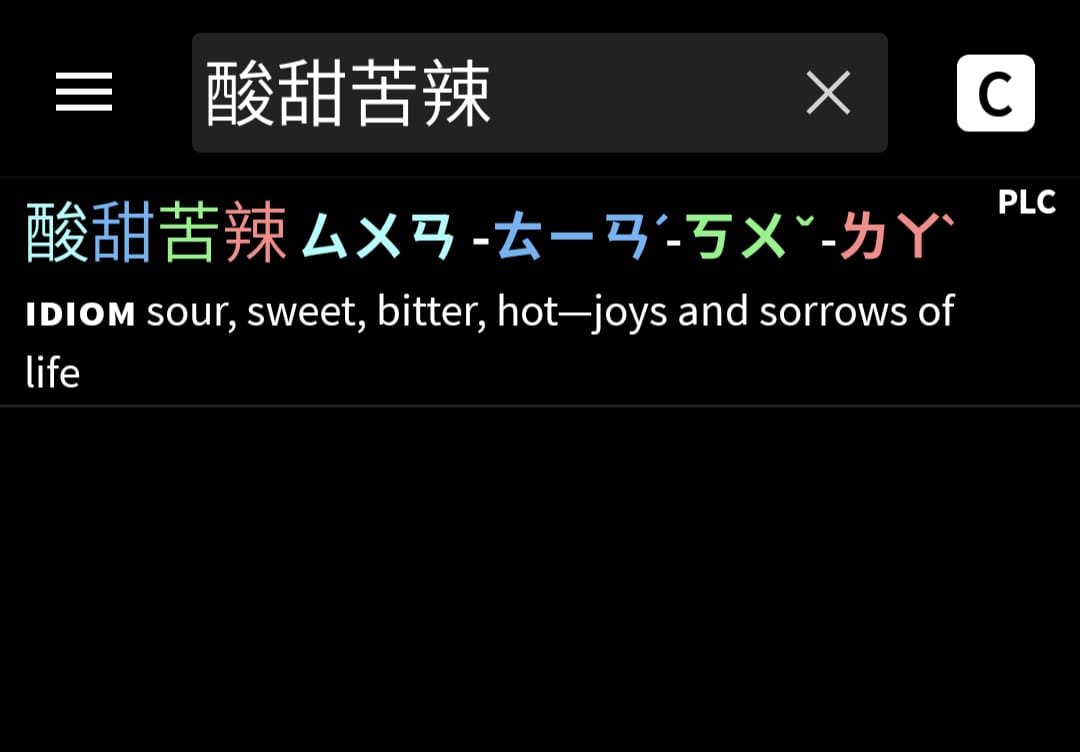
When I picture 好 (hǎo), I see it in green. When I picture 是 (shì), I see it in red. When I picture 中 (zhōng), I see it in light blue. The color is the tone, and the tone is the color. The retrieval problem largely disappears.
How to Build Your Own System
Before you adopt anyone else's colors — including mine — spend five minutes on this exercise.
Write down the four tones. Read their descriptions. Then close your eyes and ask: what color does each one feel like? Trust your first instinct. The gut association is faster and more durable than a logical choice.
Some people make red the first tone because it's primary and obvious. Some people make yellow the second tone because it rises like the sun. There's no wrong answer. What matters is that the color feels like the tone to you — so that when you retrieve the color, the tone comes with it.
Once you have your system, you need to commit to it. The benefit only compounds if you're consistent. Using red for the 4th tone this week and purple next week breaks the association before it can form.
The Tools That Make This Easy
The good news: you don't have to manually color-code every flashcard. Most serious Chinese learning tools already have color-tone systems built in.
Pleco — the best Chinese dictionary app available — displays characters in color by tone in its lookup results and example sentences. You can set your own color scheme in the settings to match whatever system you choose. I use Pleco daily, and seeing every character I look up in the correct tone color means the association is reinforced every single time I use the dictionary. The Anki guide for Chinese learners also covers how to configure Anki flashcard decks with tone colors — a worthwhile setup that takes about ten minutes.
Anki with color-coded cards: If you're using Anki for vocabulary (and if you're learning Chinese seriously, you probably should be), you can add tone color to card templates. Each character appears in its tone color every time you review it. The repetition does the work.
The principle across all these tools is the same: passive, repeated exposure to the color-tone association. You're not consciously studying the tones every time — you're just seeing red whenever you see 是, green whenever you see 好, and the association builds itself.
The 4th Tone Trick: A Bonus Tip
Here's a small piece of statistical information that's genuinely useful for tone guessing.
About 35% of commonly used Chinese characters carry the 4th tone — making it the most frequent tone in everyday vocabulary. If you're listening to natural speech and lose track of a tone, or if you're speaking and blank on which tone a character takes, the 4th tone is your best statistical guess. You have roughly a one-in-three chance of being right, which is meaningfully better than random.
This doesn't replace proper tone learning. But in the moment of uncertainty — during a conversation, mid-sentence — having a default fallback that's correct a third of the time is better than freezing.
Does the Research Support This?
Color-coding tones is well-supported for visual learners in particular, with mixed results for other learning styles.
The key finding that stands out: learners who choose their own colors based on personal associations outperform learners assigned a standardized color scheme. This makes intuitive sense — the color works because of the personal resonance, not because of any intrinsic connection between colors and sounds. Forcing someone else's associations on your visual memory produces weaker results.
The broader research on color in language learning shows consistent benefits for visual learners specifically. If you're someone who reads text and sees it in your mind, who maps spatial relationships to remember things, who naturally thinks in images — color-coding is a tool designed for how your brain already works.
If you're an auditory learner, the evidence is less clear. You might do better with pitch curves, sung tones, or rhythm-based approaches. The complete guide to Mandarin tones covers multiple approaches because different things work for different people.
How This Fits Into the Broader Tone Challenge
It's worth being clear about what color-coding solves and what it doesn't.
What it solves: Tone retrieval. You've learned a character, you know its tone in theory, but under speaking pressure the tone evaporates. Color gives you an additional retrieval path — instead of reaching for the tone mark, you reach for the color, which tends to be faster and more stable under pressure.
What it doesn't solve: Tonal pronunciation itself. If you're producing tones incorrectly, seeing a color won't fix the physical habit. Pronunciation needs audio feedback — listening to native speakers, recording yourself, ideally getting corrections from a real person. The Mandarin Zest Club group sessions are specifically useful here — hearing tones in context and getting real-time feedback is something no flashcard system, color-coded or otherwise, can replicate.
What it definitely doesn't solve: Tone sandhi — the phenomenon where tones change in connected speech. 你好 (nǐ hǎo) becomes ní hǎo in natural speech because two third-tones in a row trigger a change. Color-coding helps you remember individual character tones; connected speech patterns are a separate skill that comes from extensive listening and speaking practice.
Join the Mandarin Zest Club
Join the Mandarin Zest Club and become part of a welcoming international community of Chinese learners from all over the world. Practice together, stay motivated, and connect with people who share your goals for learning Mandarin.

Where to Start
If you want to try this today, here's the minimal version:
Pick your four colors right now. Write them down somewhere permanent. Open Pleco and set the tone color display to match your system. Then go through your next 20 vocabulary items and consciously visualize each character in its tone color as you study it.
That's the whole method. The investment is ten minutes of setup and a deliberate practice habit. The payoff — for visual learners specifically — can be substantial over weeks and months of consistent exposure.
The New HSK vocabulary lists at Mandarin Zest are a good starting point for the vocabulary itself, and the how to learn Chinese characters guide covers character learning more broadly — tones are one dimension of the character knowledge you're building, not a separate system.
The Bigger Picture
Chinese tones can feel like an obstacle at the start of learning and a background hum later on. Most learners who stick with Chinese long enough describe the same transition: at some point, tones stop requiring conscious thought and start happening automatically.
Getting there faster is largely a question of finding the retrieval system that matches how your brain works. For visual learners, color is that system. It's not magic — it's just working with your memory rather than against it.
Your colors might be completely different from mine. That's the point.

Antoine Collard
Originally from Belgium, Antoine lived more than 5 years in Taipei, Taiwan. He graduated from a Chinese-taught master’s program in Political Science at National Taiwan University.